



If Rajasthan were a royal family, Bikaner would be that proud, slightly rebellious cousin — the one who never tried too hard but always stood out.
It doesn’t boast like Jaipur. It’s not as poetic as Jaisalmer. But Bikaner has its own magic — raw, regal, and real.
This desert city has survived sandstorms and empires. It’s built of red sandstone and sharper instincts. The forts here didn’t just look good — they held ground. The food here isn’t just spicy — it’s iconic. And the people? Straightforward, spirited, and full of warmth.
So, if you’re tired of predictable tourist spots and want a slice of Rajasthan that still feels personal and rooted — Bikaner’s waiting.
Quick Glance: What Makes Bikaner Worth Your Time?
| Factor | Details |
|---|---|
| Ideal Duration | 2–3 days |
| Best Known For | Junagarh Fort, camel safaris, Karni Mata Temple, bhujia, Camel Festival |
| Perfect For | Cultural travelers, food lovers, offbeat explorers, families |
| Nearby Cities | Jodhpur (250 km), Jaipur (335 km), Delhi (450 km) |
| Best Season | October to February (cool, festive, ideal for exploring) |
Why Visit Bikaner?
Do People Fall in Love with Bikaner?
You won’t find it trending on Instagram. But you’ll find something better — stories that stay with you.
Because it’s one of the few cities where camels still matter — not just as symbols, but as workers and partners in daily life.
Because the forts don’t just sit pretty — they whisper history from their scars.
Because biting into a Bikaneri bhujia feels like meeting the spirit of the city.
Because the alleys of the old city are living museums of trade, art, and pride.
Because even the rats in Bikaner are sacred.
Top Places To See in Bikaner — What You Can’t Leave Without Seeing
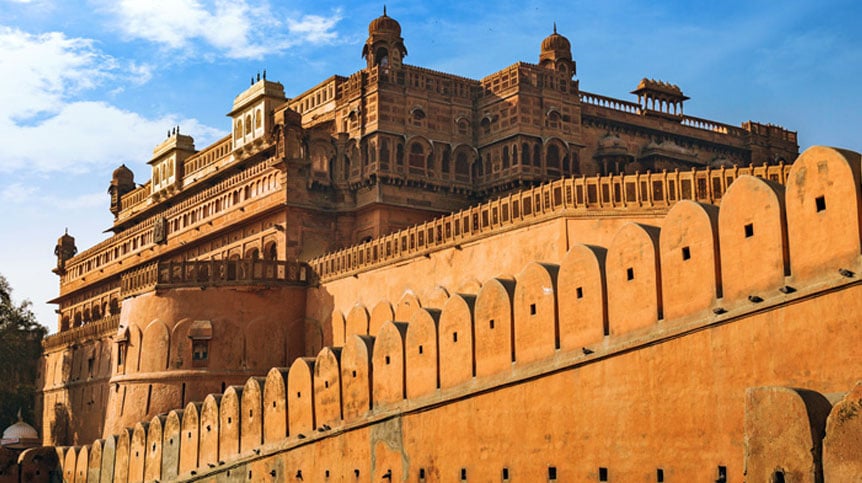
Junagarh Fort
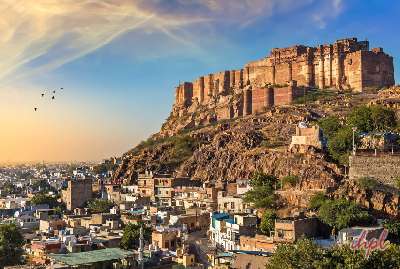
Most Rajasthani forts sit on hills. Junagarh doesn’t. It didn’t need the height — it had heart.
Built in 1594 by Raja Rai Singh, a general in Akbar’s court, Junagarh Fort is one of the rare forts in Rajasthan that was never conquered despite repeated attempts, including by the Mughals and the British.
What’s inside:
Over 30 richly adorned palaces, courtyards, balconies, temples, and halls — built over centuries by successive rulers.
Anup Mahal: The most lavish of them all. Walls are covered in gold leaf, glass mosaics, and intricate red-and-gold woodwork. Once the royal audience hall, it still whispers power.
Badal Mahal: Its blue walls are painted with clouds and lightning motifs to mimic a rainy atmosphere — a clever attempt to beat the desert heat and bring monsoon energy inside.
Chandra Mahal, Ganga Mahal & Phool Mahal: Each unique, each telling a different chapter of royal taste — from white marble to floral frescoes.
The Fort Museum: Armor, miniature paintings, royal decrees, Persian manuscripts, even ancient thrones — a quiet but fascinating window into Bikaner’s royal mind.
Why go: You won’t just admire the architecture, you’ll feel what it meant to be a desert warrior-king, commanding from inside cool halls, battling the elements, and hosting envoys from distant empires. Even after 400+ years, the pride here is intact.
Timings: 10 AM – 4:30 PM
Entry Fee: ₹75 (Indian), ₹300 (Foreigners), Guide extra (~₹200, worth it)
Karni Mata Temple (Deshnok) – The Sacred Rat Temple
Located 30 km from Bikaner, this temple is dedicated to Karni Mata — a female Hindu sage believed to be an incarnation of Goddess Durga. But that’s not why thousands of curious travelers make the trip.
They come for the rats — more than 25,000 of them, freely roaming, fed daily, worshipped as reincarnated souls of storytellers, saints, and children.
Why you should visit:
It’s not a gimmick. The devotion here is deeply real. Locals treat the rats as sacred beings.
White rats are especially rare. Spotting one is considered a sign of good fortune.
You might feel uneasy at first, but the vibe is calm, clean, and strangely serene.
Pilgrims sit and pray alongside the rats, and there’s no panic or chaos — only belief.
Lalgarh Palace
Imagine a royal residence where East met West — and did so with style. Lalgarh Palace, built between 1902–1926 by Maharaja Ganga Singh, is Bikaner’s architectural showstopper.
Unlike the rugged Junagarh Fort, Lalgarh is elegance in red sandstone — complete with European columns, Mughal domes, and British fireplaces.
Don’t miss:
The Darbar Hall — a jaw-dropping ballroom lined with Belgian glass, velvet tapestries, and old photographs.
The Sadul Singh Museum, tucked inside the palace, contains hunting trophies, regal portraits, handwritten letters from the British Raj, and curios from travels abroad.
The gardens and courtyards — peacocks strut around as if they own the place. Honestly, they kind of do.
Today, Part of the palace functions as a luxury heritage hotel. Even if you’re not staying, you can tour the museum and enjoy a coffee at the open-air café.
Timings: 10 AM to 5 PM (Closed Sundays for the museum)
Entry Fee: ₹50–₹100 for museum access
Bhandasar Jain Temple
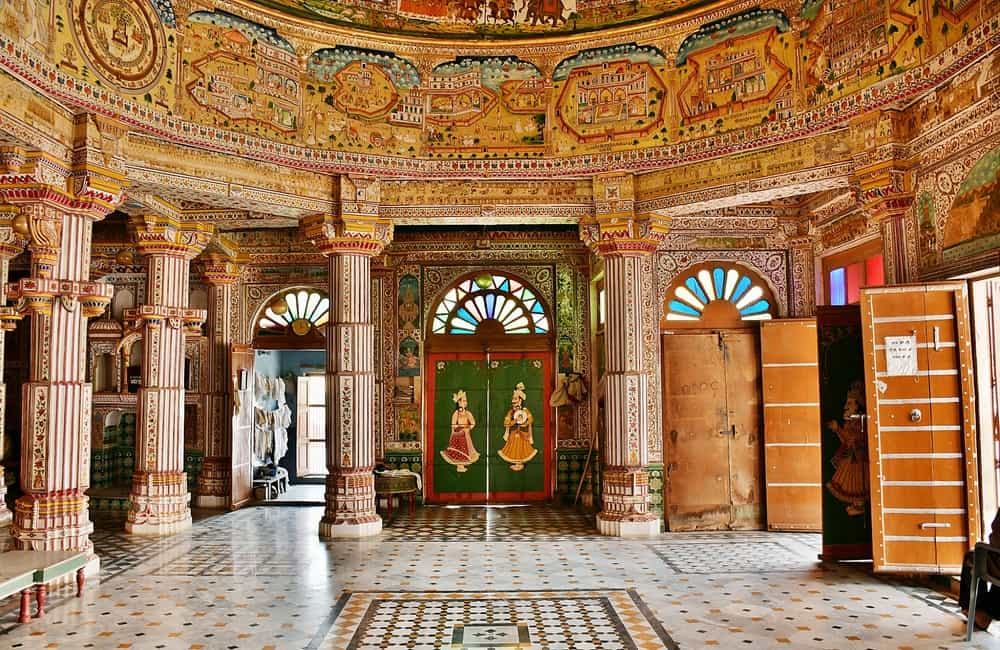
This 15th-century temple is one of the most delicately detailed Jain shrines in Rajasthan. Built by a wealthy merchant, it’s famously said to have been constructed using ghee instead of water in its mortar — a sign of devotion (and wealth) if there ever was one.
Why go:
The paintings and murals inside depict Jain Tirthankaras and scenes from Jain mythology with astonishing precision.
The mirror and gold work on the ceilings make the upper floor shine even under low light.
Climb up the narrow staircase to reach the roof, and you’ll be rewarded with a panoramic view of the old city’s red-hued skyline.
Rampuria Havelis – The Red Sandstone Jewels
A walk down Bikaner’s Rampuria Lane feels like slipping into a Wes Anderson movie set. Built by the Rampuria merchant family in the 19th century, these grand havelis are still considered among the finest in Rajasthan.
Why visit:
The carvings are unreal — every jharokha (balcony), every arch, and every wooden door frame seems to have a life of its own.
The lane is a photographer’s dream. Morning light glows softly against the rose-colored sandstone.
Many havelis are still privately owned, so while you can’t go inside most, the exterior views alone are more than worth your time.
Local Experiences You’ll Regret Missing
| Activity | Why It Matters |
|---|---|
| Eat fresh Bikaneri bhujia | The original — crisp, spicy, addictive |
| Sunset camel ride on the outskirts | Feels timeless. Especially near Devi Kund Sagar dunes |
| Attend a puppet show | Traditional Rajasthani storytelling at its most dramatic |
| Take a walk in Old City | Narrow lanes, old shops, hidden temples — pure charm |
| Buy Usta art souvenirs | Only found in Bikaner — golden floral art on leather and walls |
When to Visit Bikaner — Timing Is Everything
| Season | What You’ll Get |
|---|---|
| Oct – Feb | Best season: Camel Festival, great weather, tourist-friendly |
| Mar – May | Hot & dry: fewer crowds, lower prices |
| Jun – Sep | Humid & green: nice skies, monsoon vibe, local-only crowd |
Where to Stay — From Budget Havens to Royal Havelis
You don’t have to splurge to sleep like royalty in Bikaner.
Budget Options: Guesthouses near Station Road, some starting at ₹800
Mid-Range: Haveli-style hotels like Hotel Jaswant Bhawan — full of character
Luxury: Laxmi Niwas Palace or Lalgarh Palace for the full royal treatment
Getting There — Easier Than You Think
By Train: Bikaner is well-connected by express trains to Delhi, Jaipur, Jodhpur, and even Kolkata.
By Road: Good highways from major cities. Take NH-11 or NH-62 — scenic and surprisingly smooth.
By Air: Bikaner Airport (Nal) has limited flights. Jodhpur (250 km) is the next best option with better frequency.
Festivals of Bikaner
Bikaner Camel Festival (Mid-January)
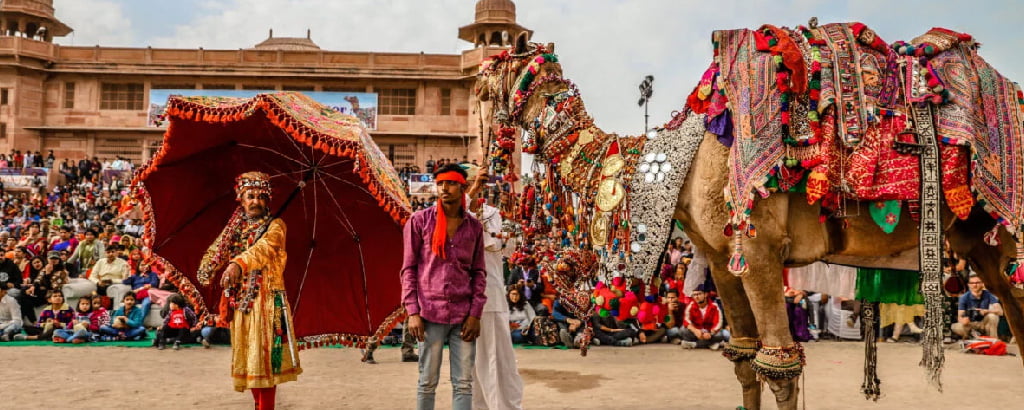
This one’s loud, dusty, colorful — and completely unforgettable. Held every January, the Camel Festival is when Bikaner steps out in style, and the camels do too.
It’s not just about races. These camels walk the ramps. They wear beads, bells, even tassels on their tails. There’s music playing, women singing, kids yelling, and sand flying.
You’ll see:
Camels pulling off dance steps you didn’t think were possible
Men in turbans playing flutes while balancing pots on their heads
Tug-of-war between camels (and between humans, too)
Stalls selling bhujia, bangles, leather bags, and piping hot bajra rotis
Fire dancers and fireworks light up the desert after sundown
Why go: Because it’s not staged for tourists, it’s what the locals would do anyway — you’re just lucky enough to be watching.
Karni Mata Fair (Twice a Year – March/April & September/October)
This one’s spiritual — but not quiet. Held at the famous Karni Mata Temple in Deshnok (yes, the one with the rats), this fair pulls in huge crowds twice a year.
You’ll hear drums and bells early in the morning. The temple gates stay open from before sunrise. Women light incense. Children chase pigeons. Devotees carry trays of sweets, water, and marigolds.
Around the temple, it’s a full-blown fair: Toy stalls, sugarcane juice, bangle sellers, plastic swords, copper utensils. Old men playing cards in the shade while a folk singer strums a ravanhatta. Faith and food side by side — nobody’s separating the sacred from the social.
Why go: Because you’ll understand how faith lives in Rajasthan. It’s loud, human, and shared.
Gangaur & Teej
These are quiet festivals, mostly inside homes, but deeply meaningful. Gangaur happens in spring. Teej comes with the monsoon.
Women dress up. Green bangles. Leheriya dupattas. Mehndi on their hands. They sing songs their grandmothers taught them — songs that talk about Parvati waiting for Shiva to return.
In some lanes, you’ll see processions — girls carrying clay idols of Gauri and Isar (that’s Parvati and Shiva), with lamps in their hands and songs in their steps. The whole thing feels like a prayer, a celebration, and a reunion all rolled into one.
Why go: Because if someone invites you into their home during Teej or Gangaur, you’ll see a side of Rajasthan no brochure will ever show.
Practical Tips from Those Who’ve Been
Walk around early mornings. You’ll see a calmer, richer side of Bikaner.
Bhujia from Bhikharam Chandmal is world-famous. Take some home.
Respect temple customs — even if they seem unusual, they’re sacred here.
Always carry water. Desert air is dry, even in winter.
Haggle a bit at the markets — it’s part of the fun.
Want to Plan Bikaner the Right Way?
Let’s put together your perfect Bikaner itinerary — tailored to what you really enjoy. Festivals? Food? Forts? We’ve got you covered.
Talk to our experts at IndianHoliday.