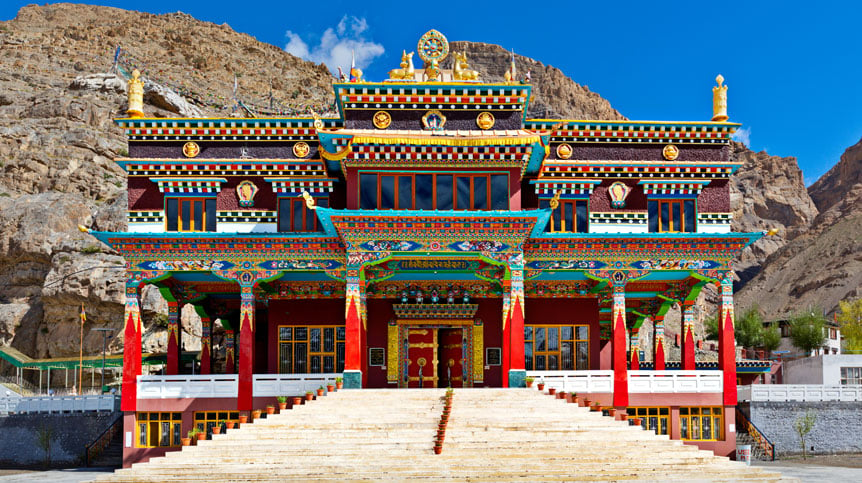

The monasteries of Spiti Valley offer a rewarding experience for travellers who value Buddhist traditions as part of a wider Himalayan cultural journey, and not just high-altitude sightseeing. The experience varies significantly depending on monastery timings, prayer ceremonies, festival periods, weather conditions, and travellers’ comfort with remote mountain routes and basic village infrastructure.
Visiting these monasteries is usually more enriching when approached at a slower pace with respect for local customs and prayer spaces. Travellers should be mindful of footwear rules, photography restrictions inside assembly halls, high-altitude conditions, and limited facilities in remote areas. Early mornings and quieter hours outside major festivals generally offer a calmer and more immersive monastery experience in Spiti Valley.
Quick Planning Snapshot
Which Spiti Monastery Should You Prioritise?
| Monastery | Best For | Route Base | Time Needed | Effort / Comfort Level | Best Added With | Avoid If |
|---|---|---|---|---|---|---|
| Key Monastery | First-time visitors, photography, active monastery life | Kaza | 1–2 hours | Easy to moderate; stairs and altitude | Kibber, Chicham, Langza | You have just arrived in Kaza and feel altitude fatigue |
| Tabo Monastery | Heritage, murals, Buddhist art, quiet cultural depth | Tabo / lower Spiti | 1–2 hours | Easy walking; slow interior visit | Dhankar, Gue, Nako | You want only viewpoint-style sightseeing |
| Dhankar Monastery | Cliffside views, photography, Kaza–Tabo route break | Between Kaza and Tabo | Around 1 hour | Moderate; uphill/uneven sections | Tabo, Dhankar Lake, Lhalung | Senior travellers dislike uneven paths or steep access |
| Lhalung Monastery | Quiet heritage and village atmosphere | Lhalung / Dhankar side | 30–60 minutes | Moderate, route-dependent | Dhankar, Lhalung village | You have limited time and need only major sites |
| Kungri Monastery | Pin Valley culture, Cham festival context, quieter monastery experience | Pin Valley | 30–60 minutes | Easy to moderate; road-dependent | Mudh, Pin Valley | You are not entering Pin Valley |
| Komic / Tangyud Monastery | High-altitude village circuit, remote setting, stark landscapes | Kaza village circuit | 30–60 minutes each | High-altitude comfort needed | Langza, Hikkim, Kibber | Roads are uncertain or travellers are altitude-sensitive |
| Hikkim / Kibber Monastery | Small village gompas and everyday Buddhist life | Kaza village circuit | 15–30 minutes each | Short visit, high altitude | Hikkim Post Office, Chicham Bridge | You expect major architecture or deep heritage interiors |
| Gue Monastery | Offbeat history, mummy shrine, border-route extension | Tabo–Nako / lower Spiti side | 30–45 minutes | Short stop, route-dependent | Tabo, Nako | You do not have time for a border-side detour |
Why Monasteries Are an Important Part of the Spiti Experience
Monasteries are an essential part of Spiti Valley’s cultural identity, not just standalone religious landmarks. Visiting them gives travellers a deeper understanding of the region’s Himalayan Buddhist heritage and quiet mountain culture.
- Many monasteries continue to function as active centres for prayer, learning, and local community gatherings.
- Each monastery offers a distinct experience, ranging from heritage-rich sites such as Tabo Monastery to visually striking hilltop gompas like Dhankar.
- Monastery visits combine architecture, mountain scenery, spiritual atmosphere, and village culture into a single journey.
- Sites such as Key Monastery and Kungri Monastery are valued for both their setting and their active monastic traditions.
- Exploring monasteries helps travellers experience a slower, more reflective side of Spiti Valley beyond photography stops and road-trip viewpoints.
Major Monasteries to Visit in Spiti Valley
1. Heritage & Historical Monasteries
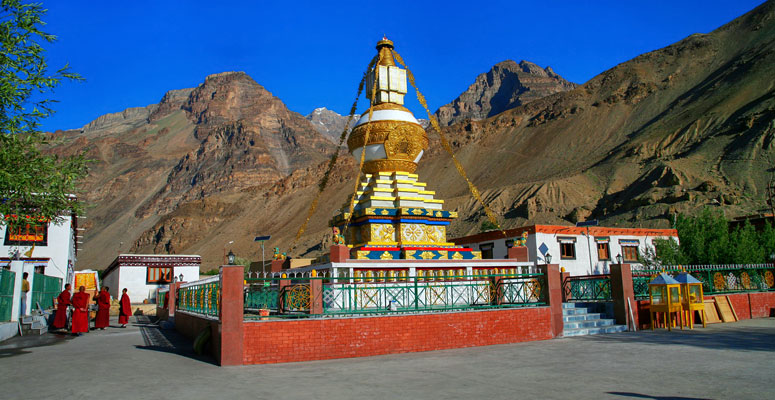
• Tabo Monastery
Tabo Monastery is among the most historically important Buddhist monasteries in Spiti Valley and is especially valuable for travellers interested in murals, old temple architecture, and quiet heritage interiors. Often referred to as the “Ajanta of the Himalayas,” the monastery is renowned for its preserved murals, ancient scriptures, clay statues, traditional prayer halls, and meditation caves that showcase centuries of Buddhist history and artistic tradition.
Daytime visits are generally preferred in Tabo for viewing the murals and architectural details. The visitors should be mindful of photography restrictions and monastery etiquette within the prayer areas.
Time Required: Around 1–2 hours.
Best Combined With: Dhankar Monastery.
Best For: History lovers, culture enthusiasts, and heritage-focused travellers.
• Lhalung Monastery
Lhalung Monastery is a rewarding stop for travellers interested in Spiti Valley’s lesser-known cultural and historical sites. Situated amidst the traditional village of Lhalung, the monastery is believed to be among the oldest in the region and is known for its heritage architecture, ancient religious artefacts, and peaceful setting away from the main tourist circuit.
Time Required: Around 30–60 minutes.
Best Combined With: Dhankar Monastery and Lhalung Village.
Best For: Heritage enthusiasts, cultural travellers, and visitors looking for quieter, offbeat monastery experiences.
• Dhankar Monastery
Dhankar Monastery is best suited to travellers looking to combine cultural sightseeing with some of the most impressive valley views in Spiti. Positioned on a high ridge above the confluence of the Spiti and Pin rivers, it is one of the most scenic monastery stops on the circuit. Visitors should be prepared for a short uphill walk and uneven terrain, particularly as the high altitude can make physical activity more demanding than expected.
Time Required: Around 1 hour.
Best Combined With: Tabo Monastery and Dhankar Lake.
Best For: View seekers, photographers, and travellers interested in combining scenery with cultural sightseeing.
2. Landmark Monasteries
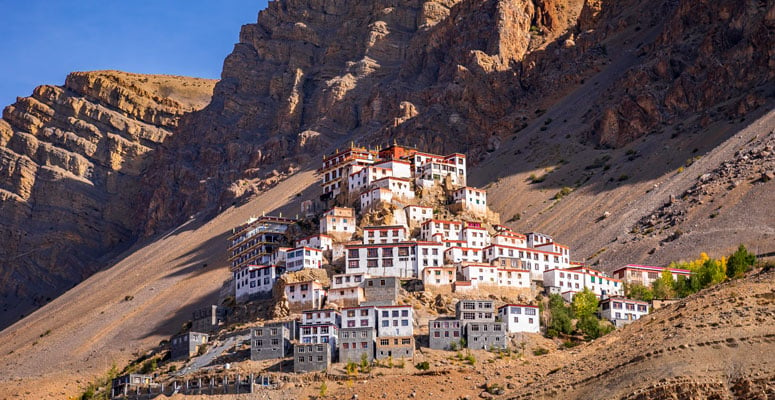
• Key Monastery
Key Monastery is the monastery most travellers prioritise when visiting Spiti Valley. Located just outside Kaza, it is the largest monastery in the region and is easily included in itineraries covering Kibber, Chicham, Langza, and other nearby villages.
The monastery is known for its distinctive hilltop location, fortress-like architecture, and sweeping views across the Spiti Valley, making it one of the most rewarding cultural stops for first-time visitors.
Beyond the scenery, it also offers an opportunity to observe an active monastic community and gain insight into the Buddhist traditions that shape life in Spiti. Morning visits are generally the most pleasant for sightseeing and photography, with fewer visitors and softer light across the valley.
Time Required: Around 1–2 hours.
Best Combined With: Kibber Village, Chicham Bridge, and Langza.
Best For: First-time visitors, photographers, and travellers interested in Buddhist culture and monastery life.
• Tangyud Monastery
Tangyud Monastery is best visited as part of the high-altitude circuit from Kaza covering Komic, Kibber, and Langza villages, and is known for its fortress-like mud architecture set against stark Himalayan landscapes. Its traditional design and elevated setting give it a distinctive character, while the surrounding village environment adds to its cultural appeal. The monastery is usually included in a single-day exploration of nearby villages from Kaza, and daytime visits are preferred for better visibility, more comfortable conditions, and smoother road access.
Time Required: Around 30–60 minutes.
Best Combined With: Komic, Kibber, Langza, and Key Monastery circuit.
Best For: High-altitude explorers, architecture enthusiasts, and travellers exploring Spiti’s village circuit.
3. Village & Cultural Monasteries
Village gompas around Komic, Hikkim, Kibber, and nearby high-altitude settlements should be treated as short cultural stops within a wider village circuit. They are not all major standalone monastery visits. Their value comes from the combination of village life, altitude, landscape, and everyday Buddhist practice.
• Komic Monastery
Komic Monastery is located in one of the world’s highest motorable villages and is best visited as part of the Kaza–Langza–Hikkim high-altitude circuit. Surrounded by stark Himalayan landscapes, it offers a quiet and intimate monastery experience set within traditional Spitian village life, making it more about atmosphere and location than large-scale monastic activity. The visit is usually combined with nearby villages from Kaza, but travellers should plan for cold weather, thin air, and changing road conditions due to the high-altitude setting.
Time Required: Around 30–60 minutes.
Best Combined With: Langza, Hikkim, and Key Monastery circuit from Kaza.
Best For: High-altitude explorers, culture-focused travellers, and those seeking remote village experiences.
• Hikkim Monastery
Hikkim Monastery is a small village gompa located in one of the world’s highest inhabited settlements, best experienced as part of the Komic–Hikkim–Langza circuit from Kaza. Unlike larger monasteries in Spiti, it is not a major architectural or historical site, but offers a glimpse into everyday Buddhist practice in a remote high-altitude village where religion is closely woven into local life.
Time Required: Around 15–30 minutes.
Best Combined With: Komic Monastery, Langza Fossil Village, and Hikkim Post Office.
Best For: High-altitude circuit travellers, village explorers, and those interested in everyday local Buddhist life rather than major monastery landmarks.
• Kibber Monastery
Kibber Monastery is a small village gompa forming part of the Kibber–Chicham–Key circuit, best seen as an extension of Kibber village life rather than a standalone attraction. Located in one of Spiti’s highest inhabited villages, it reflects how monastic practice is integrated into daily community life in remote high-altitude settlements, where spirituality and village culture coexist closely.
Time Required: Around 20–30 minutes.
Best Combined With: Key Monastery, Kibber Village, and Chicham Bridge.
Best For: Travellers exploring the Kibber high-altitude circuit and village culture routes.
4. Offbeat & Special Experiences
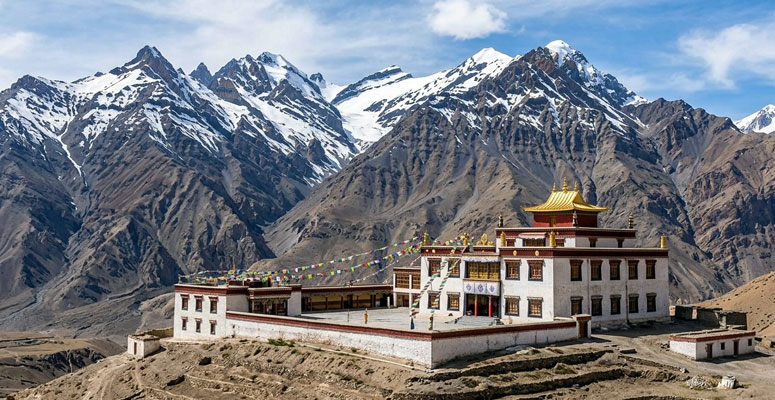
• Kungri Monastery
Kungri Monastery is one of the key cultural stops in Pin Valley and is associated with the Nyingma school of Tibetan Buddhism. Set within a quiet village environment. It is often included as part of a Pin Valley extension from the main Spiti route, especially when visiting Mudh Village and nearby natural landscapes. The monastery is known for its Cham dance festivals, local rituals, and strong ties with the surrounding communities, offering a more traditional cultural experience compared to the busier monasteries near Kaza. Overall, it provides a calmer and more offbeat monastery visit, best suited for travellers exploring beyond the main Spiti circuit.
Time Required: Around 30–60 minutes.
Best Combined With: Pin Valley National Park and Mudh Village.
Best For: Cultural travellers, offbeat explorers, and visitors extending their Spiti itinerary into Pin Valley.
• Gue Monastery
Gue Monastery is an offbeat cultural stop near the Indo-Tibet border side of Spiti, usually added as part of a Tabo–Nako–Gue extension. It is known for a naturally preserved monk mummy, which makes it very different from Spiti’s architecture-led monasteries. Because the site is route-dependent and has a minimal visit format, it should be treated as a short detour rather than a core monastery circuit stop.
Time Required: Around 30–45 minutes.
Best Combined With: Tabo Monastery and Nako (as part of a border-route extension).
Best For: Offbeat travellers, history enthusiasts, and those seeking rare and unusual cultural experiences in Spiti.
Monasteries Best Suited for Different Travel Styles
| Travel Style | Best Monasteries | Why They Fit |
|---|---|---|
| First-time Spiti travellers | Key, Tabo, Dhankar | These give the clearest introduction to Spiti’s active monastery life, heritage interiors, and dramatic hilltop settings. |
| Heritage and Buddhist art travellers | Tabo, Dhankar, Lhalung | Best for older architecture, murals, traditional interiors, and quieter historical context. |
| Photography-focused travellers | Key, Dhankar, Komic, Tangyud | Strong visual settings with hilltop views, cliffside landscapes, high-altitude villages, and wide Spiti Valley backdrops. |
| Spiritual / reflective travellers | Key, Tabo, Kungri | Better for slower visits, prayer atmosphere, monastery life, and less rushed cultural immersion. |
| Offbeat repeat travellers | Kungri, Gue, Lhalung, Hikkim, Kibber | Best when the traveller has already covered the main Spiti circuit or wants a quieter village-linked experience. |
| Senior-friendly / comfort-led travellers | Tabo, Key with slow pacing, Kungri if already in Pin Valley | These can work with careful pacing, but avoid overloading the day with high-altitude village stops and steep access points. |
Recommended Monastery Circuits in Spiti Valley
Beyond visiting individual gompas, understanding how these monasteries connect with Spiti’s wider travel circuits helps travellers plan a more balanced and realistic journey through the valley.
The monasteries of Spiti Valley are best experienced as part of a broader road journey through the region rather than as standalone stops. Most gompas naturally fit into existing village and sightseeing circuits across the valley.
1. Easy Kaza Monastery Circuit
Route: Kaza – Key Monastery – Kibber – Chicham – Kaza
Best for: First-time visitors, short stays, families, and travellers who want a manageable cultural route from Kaza.
Time needed: Half day to relaxed full day.
Why it works: Key Monastery is the main cultural anchor, while Kibber and Chicham add village and landscape context without pushing the day too far.
2. High-Altitude Village Circuit
Route: Kaza – Langza – Hikkim – Komic – Tangyud – Kaza
Best for: Photography, high-altitude villages, remote landscapes, and travellers with 2–3 nights in Kaza.
Time needed: Full day.
Why it works: This route combines small village gompas with fossil landscapes, village life, and stark high-altitude scenery.
3. Heritage Route
Route: Kaza – Dhankar – Tabo
Best for: Heritage travellers, Buddhist art interest, road-trip travellers moving between Kaza and lower Spiti.
Time needed: Half day to full day depending on pace.
Why it works: Dhankar adds dramatic ridge scenery, while Tabo offers deeper heritage value and quieter interiors.
4. Pin Valley Cultural Extension
Route: Kaza – Kungri Monastery – Mudh – Pin Valley – Kaza / Overnight
Best for: Offbeat travellers, quieter cultural routes, nature-linked Spiti extensions.
Time needed: Full day or overnight extension.
Why it works: Kungri Monastery is best understood within Pin Valley, not as an isolated stop.
5. Lower Spiti / Border-Side Extension
Route: Tabo – Gue – Nako
Best for: Repeat travellers, history interest, unusual cultural stops, onward Kinnaur movement.
Time needed: Full-day route segment or onward transfer.
Why it works: Gue adds a distinctive cultural stop while Nako and Tabo help complete the lower Spiti route.
Monastery Planning Mistakes to Avoid
Avoid combining:
- Key, Kibber, Chicham, Langza, Hikkim, Komic, and Tangyud as a rushed half-day plan.
- Tabo, Dhankar, Pin Valley, and the Kaza high-altitude village circuit in one day.
- Gue as a detour during a packed Kaza local sightseeing day.
- Dhankar Lake trek with too many monastery stops unless travellers are fit and acclimatised.
- Festival visits with tight transfer schedules.
- High-altitude village gompas immediately after arriving in Kaza from Manali or long road travel.
A better rule is to choose one route theme per day: Kaza–Key side, Kaza high-altitude village side, Tabo–Dhankar heritage side, Pin Valley side, or Gue–Nako lower Spiti side.
Practical Takeaways
- Combine larger monasteries with smaller village gompas for a more balanced experience.
- Avoid rushing through multiple monasteries in a single day because altitude and road travel can become tiring.
- Morning visits generally offer calmer surroundings and better opportunities to experience monastery life respectfully.
- Keep travel plans flexible during festival periods because prayer ceremonies and local gatherings may affect schedules and crowd levels.
- Travellers sensitive to altitude should allow additional rest time between long drives and uphill monastery visits.
- Ask before photographing interiors, monks, murals, manuscripts, statues, or prayer ceremonies. Photography rules can vary by monastery and by room.
- Do not touch murals, manuscripts, prayer objects, thangkas, statues, or butter-lamp areas.
- Keep silence during chanting, rituals, or teaching sessions. If a prayer ceremony is underway, observe respectfully from the permitted area.
- Carry warm layers, sunglasses, water, and sun protection. Spiti’s high-altitude sun, wind, and cold can feel intense even during clear weather.
- Plan rest breaks for senior travellers. Key, Dhankar, Komic, Tangyud, Hikkim, and Kibber can feel tiring because of altitude, stairs, uneven ground, or exposed walking.
- Do not assume washrooms, cafes, or seating areas will be available at smaller village gompas. Plan food and toilet breaks around Kaza, Tabo, or known route stops.
- Use a local guide when visiting Tabo, Dhankar, Key, or lesser-known heritage sites if the traveller wants context on murals, architecture, local history, and monastery customs.
- Carry small cash for donations where appropriate, but avoid treating donations as entry fees unless the site clearly states so.
Best Time for Different Monasteries in Spiti Valley
| Monastery / Route | Usually Better Window | Planning Caution |
|---|---|---|
| Key Monastery | May–October | Generally practical from Kaza, but road status and snow conditions should still be checked in early/late season. |
| Tabo Monastery | April–October | Lower Spiti may be accessible earlier/later than high-altitude circuits, but route status still matters. |
| Dhankar Monastery | May–October | Cliff-road stability, weather, and walking comfort matter; avoid rushing in poor weather. |
| Kungri Monastery / Pin Valley | May–October | Best added when Pin Valley roads are comfortable and the itinerary has time for a side extension. |
| Komic / Tangyud / Hikkim / Kibber | June–September | High-altitude access and comfort are more reliable in peak season; avoid fixed claims outside verified road conditions. |
| Gue / Nako extension | May–October | Best treated as a route extension; verify border-side access and road status before finalising. |
Festivals and Prayer Experiences in Spiti Monasteries
- Several monasteries host seasonal festivals featuring traditional Cham masked dances, prayer rituals, and community gatherings.
- Festival periods often bring a more energetic atmosphere compared to the quieter rhythm of regular monastery visits.
- Prayer ceremonies, chanting sessions, and monastery gatherings are usually more immersive during early mornings and special religious occasions.
- Key Monastery and Kungri Monastery are among the better-known sites for experiencing monastery festivals in Spiti Valley.
- Travellers visiting during festival periods should expect larger crowds, changing schedules, and limited accommodation availability in smaller villages.
Plan a Culture-Led Spiti Valley Journey
Planning monastery visits in Spiti Valley? The right route depends on your travel month, number of nights, route direction, and whether you want a heritage-led, photography-led, spiritual, or slow cultural itinerary.
IndianHoliday’s Himachal specialists can help place Key, Tabo, Dhankar, Kungri, Komic, Tangyud, Gue, and village gompas into a realistic Spiti route without overloading your travel days.