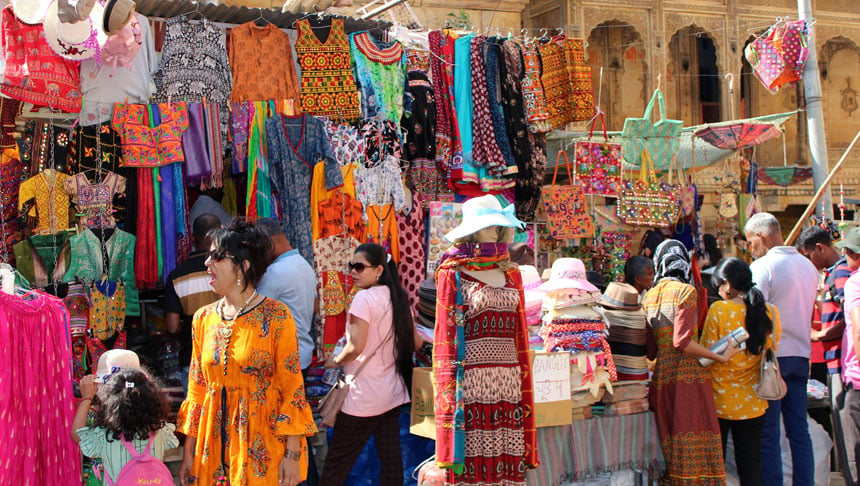

Shopping in Rajasthan is most rewarding when you know which craft belongs where.
Jaipur is the strongest all-round choice for jewellery, block-printed textiles and blue pottery. Jodhpur is useful for bandhej, mojaris, silver and dhurries. Udaipur is better for paintings, silver and decorative craft, while Jaisalmer’s old-city markets work well for textiles, carpets and smaller handicrafts.
You do not need to shop in every city.
Choose one or two places that match what you actually want to buy. For higher-value pieces, give yourself enough time to compare workmanship and provenance rather than buying between sightseeing stops.
Rajasthan Tourism currently highlights jewellery, textiles, carpets and dhurries, miniature paintings, blue pottery, leatherwork, stone carving and other crafts as some of the state’s main shopping traditions.
What to Buy in Rajasthan and Where
| What You Want to Buy | Best Place to Look |
|---|---|
| Kundan, Meenakari and gemstone jewellery | Jaipur |
| Blue pottery | Jaipur |
| Sanganeri block prints | Jaipur / Sanganer |
| Bagru block prints | Bagru |
| Bandhej / tie-dye textiles | Jaipur, Jodhpur, Bikaner |
| Leheria textiles | Jaipur and Udaipur |
| Pichwai and miniature paintings | Udaipur / Nathdwara |
| Dhurries and woven rugs | Salawas near Jodhpur; also Bikaner and Jaisalmer |
| Kota Doria | Kota / Kaithun |
| Mojaris / juttis | Jaipur and Jodhpur |
| Camel-hide craft | Bikaner, with customs considerations |
| Desert-region embroidery and textiles | Barmer and Jaisalmer |
Blue Pottery of Jaipur, Sanganeri Hand Block Printing, Bagru Hand Block Print and Kota Doria are all registered Geographical Indications. That makes their regional identity especially useful when deciding where to shop for these crafts.
What Is Actually Worth Buying in Rajasthan?
Jewellery
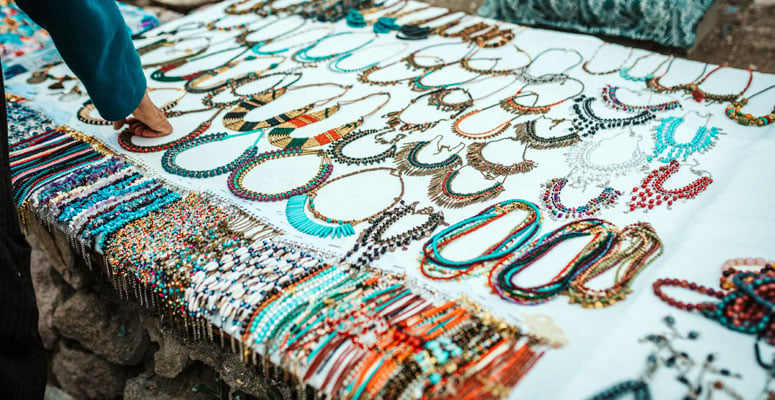
Jaipur is the strongest choice for travellers who are serious about jewellery.
The city is particularly associated with Kundan and Meenakari work, as well as cutting and trading precious and semi-precious stones. Rajasthan Tourism identifies Jaipur as one of the state’s main jewellery centres.
Best for: Travellers looking for a considered purchase rather than a small souvenir.
What to expect: Prices vary enormously according to metal, stones, workmanship and provenance.
For gold, ask for an invoice and check the BIS hallmark and HUID. BIS allows you to verify the HUID associated with hallmarked gold jewellery.
Block-Printed Textiles
For block printing, Sanganer and Bagru matter more than simply buying any printed fabric in a Jaipur bazaar.
Sanganeri printing is known for delicate floral butis and butas, often on lighter backgrounds. The Government of India’s handicrafts portal continues to identify Sanganer as a major production centre.
Best for: Travellers interested in textiles, home furnishings and understanding how a local craft differs by region.
Blue Pottery
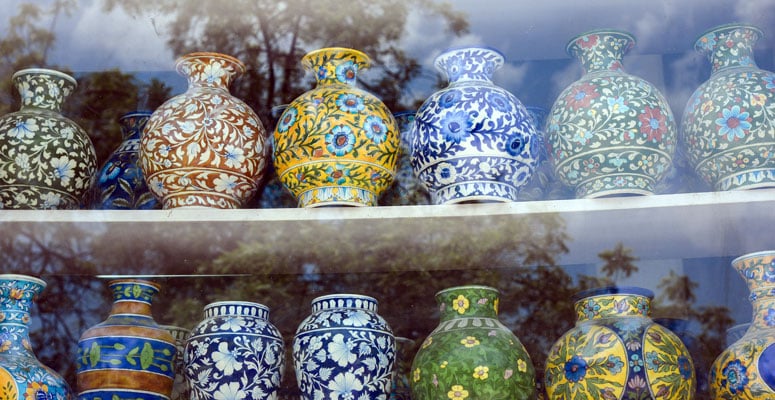
Blue pottery is one of Jaipur’s most recognisable craft traditions.
Unlike ordinary earthenware, Jaipur blue pottery uses a quartz-based body. Cobalt and copper oxides create many of its familiar blue, turquoise and green tones.
Best for: Smaller decorative pieces, tableware and gifts that are practical to carry.
What to check: Look closely for chips, glaze cracks and uneven finishing before pieces are packed.
For larger items, ask the seller how they will be wrapped for air travel or shipping.
Paintings
Rajasthan has several distinct painting traditions rather than one generic “Rajasthani painting” style.
Udaipur is a good base for miniature paintings and Pichwai-style work, while other regional schools include Bundi, Kota, Marwar, Bikaner, Jaipur and Kishangarh. Rajasthan Tourism recognises these as distinct traditions.
Best for: Travellers who want a decorative piece with stronger local context.
Planning note: Ask whether the work is hand-painted, printed or hand-finished. That distinction affects both value and pricing.
Dhurries and Rugs
For travellers specifically interested in weaving, Salawas near Jodhpur is more meaningful than buying a generic rug in a tourist market.
Rajasthan Tourism identifies Bikaner, Jaisalmer and Salawas as areas associated with dhurries made from cotton yarn and, in some cases, camel hair.
Best for: Travellers interested in interiors or craft-led visits.
Large rugs take more planning. Confirm size, weight, packing, insurance and shipping cost before committing.
Kota Doria
Kota Doria deserves its own mention rather than being buried inside a general Kota shopping paragraph.
The textile has registered GI protection, with the Kota Doria Development Hadauti Foundation based in Kaithun, Kota district.
Best for: Travellers specifically interested in handloom textiles.
If Kota is already on your route, this is the main shopping reason to set aside time there. There is little value in adding Kota to a Rajasthan itinerary purely for general souvenir shopping.
Best Places for Shopping in Rajasthan
Shopping in Jaipur
Jaipur is the strongest shopping city for a first Rajasthan trip because several important crafts are available within one destination.
For jewellery, Johari Bazaar is the traditional market in Jaipur. For textiles, mojaris and everyday handicrafts, Bapu Bazaar and Nehru Bazaar are easier browsing areas. Rajasthan Tourism also lists MI Road, the Chaupars and the government-run Rajasthali showroom among Jaipur’s established shopping options.
Rajasthani Art and Craft is an integral part of Rajasthan. You will be awestruck by the intricate nature of the work and the exquisite handiwork of the craftsmen. They learned the tricks of the trade from their forefathers and are still passing them on to their sons, so it stays in the family. Art seemed to be an obsession both with the craftsmen as well as the patrons.
Worth looking for: Kundan and Meenakari jewellery, gemstones, block prints, blue pottery, lac bangles, quilts and mojaris.
Who it suits: Almost any traveller who wants to make one serious shopping stop during a Rajasthan trip.
Time to keep: Around 2–3 hours for bazaar browsing. Keep longer if buying jewellery.
Best time: Late morning to early evening. Individual stores and market sections keep different hours.
Expectation: Traditional bazaars can be busy and traffic-heavy. A private car is useful for the wider day, but much of the old-market area is easier on foot.
Shopping in Jodhpur
Jodhpur works particularly well for textiles and craft shopping in Rajasthan when it is built into an old-city visit.
Sardar Bazaar is the most visited market in Jodhpur. Rajasthan Tourism highlights Rajasthani textiles, local prints, pottery, brass, wooden and marble decorative pieces, and silver jewellery in this market area.
Worth looking for: Bandhej textiles, mojaris, silver pieces, spices, decorative craft and dhurries.
For woven rugs, consider Salawas as a more deliberate craft stop outside central Jodhpur. Rajasthan Tourism identifies the area with dhurrie weaving.
Time to keep: 1.5–2 hours for Sardar Bazaar. Salawas needs a separate excursion.
Best time: Late afternoon works well if you want to combine shopping with the Clock Tower and old-city atmosphere.
Shopping in Udaipur
Udaipur is a better choice for paintings, silver and decorative crafts than for generic souvenir buying.
Hathi Pol and Bada Bazaar are two useful traditional shopping areas. Current Rajasthan Tourism material highlights Pichwai and miniature paintings, silver ornaments, marble curios, furniture and other crafts in these markets in Udaipur.
Worth looking for: Miniature paintings, Pichwai-style art, silver, textiles, mojaris and smaller decorative pieces.
Who it suits: Travellers interested in art, interiors and craft rather than high-volume market shopping.
Time to keep: Around 1.5–2 hours.
Buying tip: For paintings, ask whether you are buying an original hand-painted piece, a workshop reproduction or a print. The price should reflect the difference.
Shopping in Jaisalmer
Jaisalmer’s shopping works best as part of the old-city experience rather than as a separate half-day.
Sadar Bazaar and Bhatia Bazaar are established local market in Jaisalmer. Incredible India identifies Sadar Bazaar with leather goods, textiles, jewellery, paintings and carpets, while Bhatia Bazaar is known for fabrics and souvenirs.
Worth looking for: Embroidered textiles, shawls, rugs, jewellery and small handicrafts.
Time to keep: Around 1–1.5 hours.
Expectation: Many shops are compact, and the lanes can become busy. Shopping works naturally after Jaisalmer Fort or haveli sightseeing.
If you see objects described as genuine antiques, do not assume they can legally be taken out of India. Export of qualifying antiquities is regulated under Indian law.
Shopping in Bikaner
Bikaner is a secondary shopping stop rather than a reason to restructure a Rajasthan trip.
The city is known for mojaris, lacquer bangles, carpets, Kundan work and camel-hide craft, according to Rajasthan Tourism.
Who it suits: Travellers already spending time in Bikaner and looking for desert-region craft.
Time to keep: Around an hour is enough for most visitors.
If buying camel-hide or other animal-derived products, international travellers should check their home country’s customs and import rules before purchasing.
Shopping in Pushkar
Pushkar’s main shopping area is Sadar Bazaar.
Rajasthan Tourism identifies the market with silver jewellery, embroidered clothes, leather products and decorative goods.
Who it suits: Travellers who enjoy informal bazaar browsing and are already staying in Pushkar.
Time to keep: Around 1–2 hours.
Shopping becomes a larger part of the town experience during the Pushkar Fair, when additional handicraft stalls appear, but the market and town are also much more crowded. Rajasthan Tourism currently lists the 2026 Pushkar Fair for 17–24 November.
Shopping in Kota
Kota is a great place to shop for silk sarees and jewellery, especially for Kota Doria sarees.
Rajasthan Tourism specifically associates Kota with Doria sarees.
Who it suits: Textile-focused travellers already passing through Kota or Bundi-Hadoti.
Time to keep: 1–2 hours if shopping specifically for Kota Doria.
Specialist Shopping Stops if They Fit Your Route
Shekhawati
Shekhawati is a region, not a town.
Shopping should remain secondary to its frescoed havelis. Look for textiles, small decorative items and locally made crafts when they appear naturally along a Mandawa, Nawalgarh or Fatehpur visit.
Do not position Shekhawati as one of Rajasthan’s primary shopping destinations.
Barmer
Barmer is more relevant for travellers specifically interested in western Rajasthan’s craft traditions.
Rajasthan Tourism identifies embroidery, handwoven woollen dhurries, carpets, carved wood, traditionally dyed fabrics, paintings and bandhej among the region’s crafts.
Treat it as a specialist craft stop when Barmer is already part of the route.
Practical Tips for Shopping in Rajasthan
Bargain selectively. Negotiation can be normal in traditional bazaars, particularly where prices are not displayed. It is less appropriate in fixed-price emporia, design stores or established ateliers.
Do not rely on one universal market schedule. Most shopping areas work best from late morning into early evening, but individual shops set their own hours and weekly closure days.
Compare before making an expensive purchase. For jewellery, carpets, paintings or furniture, look at more than one piece or seller before deciding.
Ask what you are actually buying. With textiles, ask about fibre, printing/weaving method and whether the work is handmade. With paintings, distinguish originals from prints or workshop reproductions.
Verify precious-metal jewellery. BIS states that hallmarked gold jewellery includes a HUID that consumers can verify through the BIS Care system. Always keep the invoice for a higher-value purchase.
Be cautious with “antiques.” India’s Antiquities and Art Treasures legislation restricts the export of qualifying antiquities. If age or historical provenance is part of the sales pitch, ask for proper documentation before considering the purchase.
Plan shipping before buying large pieces. For carpets, stone objects or furniture, confirm packing, insurance, customs paperwork and the final delivered cost rather than only the shop price.
Expect old-city markets to be busy. Jaipur, Jodhpur and Jaisalmer bazaars often involve narrow streets and mixed pedestrian/vehicle movement. Comfortable footwear and a little extra time make the experience easier.
Where Shopping Fits Best in a Rajasthan Trip
Shopping works best when it follows the city’s natural sightseeing route.
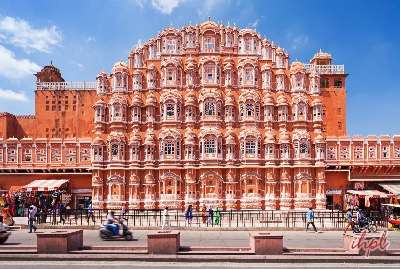
In Jaipur, keep the old-city bazaars around the same part of the day as City Palace or Hawa Mahal, while Sanganer or Bagru needs more deliberate craft-focused time.
In Jodhpur, Sardar Bazaar fits naturally after an old-city walk.
In Udaipur, Hathi Pol or Bada Bazaar can be added around central city sightseeing rather than requiring a separate day.
In Jaisalmer, market browsing works well after the fort and havelis.
Specialist stops such as Salawas, Bagru, or Kota/Kaithun deserve extra time only when the craft itself is part of the travel interest.
This keeps shopping as a meaningful part of the trip without turning it into another checklist.
Continue Planning Your Rajasthan Trip
If Rajasthan’s crafts are an important part of your journey, continue to the Rajasthan Arts and Crafts section for more detail on how individual traditions are made.
Use the Rajasthan Travel Guide and relevant Jaipur, Jodhpur, Udaipur and Jaisalmer destination guides to decide where shopping fits into the wider sightseeing plan.