Golden Triangle with Varanasi Khajuraho
Delhi – Jaipur – Agra – Orchha – Khajuraho – Varanasi – Delhi

Set out on a thoughtfully curated seven-day Golden Triangle tour through North India. The experience opens in Delhi, the capital city, and turns toward Mathura and Vrindavan, towns deeply rooted in Krishna lore. Then you visit Agra, home to architectural masterpieces like the Taj Mahal. The final leg leads to Jaipur, where hilltop forts and ornate palaces echo the pride of Rajputana heritage.
While the itinerary below outlines a suggested plan, get in touch with IndianHoliday experts for easy customisations.
Want to travel on this route?
Plan this 7-day yatraNeed a change in timing, stay or add-on services?
Customise this tourYour tour opens in Delhi, where you are received at the airport and escorted to your hotel by our team. After settling in and completing the check-in process, take the time to relax and recover from your journey. The remainder of the day is free for rest.
Dinner will be served at the hotel, followed by an overnight stay.
After an early breakfast, set out to explore Delhi’s contrasting quarters. Begin at the Red Fort, a vast sandstone citadel that once symbolised imperial authority, followed by a visit to Jama Masjid, an expansive place of worship framed by domes and towering minarets. The experience continues with a lively cycle-rickshaw ride through Chandni Chowk, where age-old bazaars and packed alleyways reveal everyday Old Delhi life.
Post noon, visit Humayun’s Tomb, an elegant garden mausoleum that shaped later Mughal architecture, and then to Qutub Minar, an imposing stone tower rising high above the surrounding ruins. Later, pass by India Gate and the ceremonial boulevard leading toward it. Drive past the Presidential Estate and Parliament House, noted for their stately colonial-era design.
As evening sets in, attend the light and sound presentation at Akshardham.
Back to the hotel for dinner and an overnight stay.
After breakfast, check out from your hotel and begin a road journey toward Vrindavan, covering roughly 181 kilometres in about 3.4 hours. Along the way, pause at the serene Lotus Temple, admired for its striking floral form.
Continuing onward, arrive in Mathura. Visit the Janmabhoomi Temple, believed to mark the divine birthplace of Lord Krishna, followed by the revered Dwarkadheesh Temple, known for its lively devotional setting. Later, stop at Vishram Ghat, set along the Yamuna’s banks, where local belief holds that Krishna paused here after his victory over Kansa.
In the evening, drive onward to Vrindavan, the landscape of Krishna’s childhood mischiefs. Explore the gleaming ISKCON Temple, attend the evening prayers at Banke Bihari Temple, and conclude with a visit to the lovely Prem Mandir.
Have dinner and take your well-deserved rest at the hotel.
After your breakfast and check-out, you’ll be heading to Agra (69.6 km/1.8 hours). On arrival, complete the check-in process and take time to settle in before heading out later in the day.
By afternoon, you’ll start exploring Agra’s storied past with a visit to Agra Fort, a massive riverside stronghold whose weathered red sandstone ramparts once anchored Mughal rule. Continue to the elegant Itimad-ud-Daulah’s Tomb, celebrated for its delicate marble inlay.
As evening approaches, make your way to Mehtab Bagh, a quiet garden across the Yamuna that offers an uninterrupted sunset view of the Taj Mahal.
Dinner and a comfortable overnight stay at the hotel.
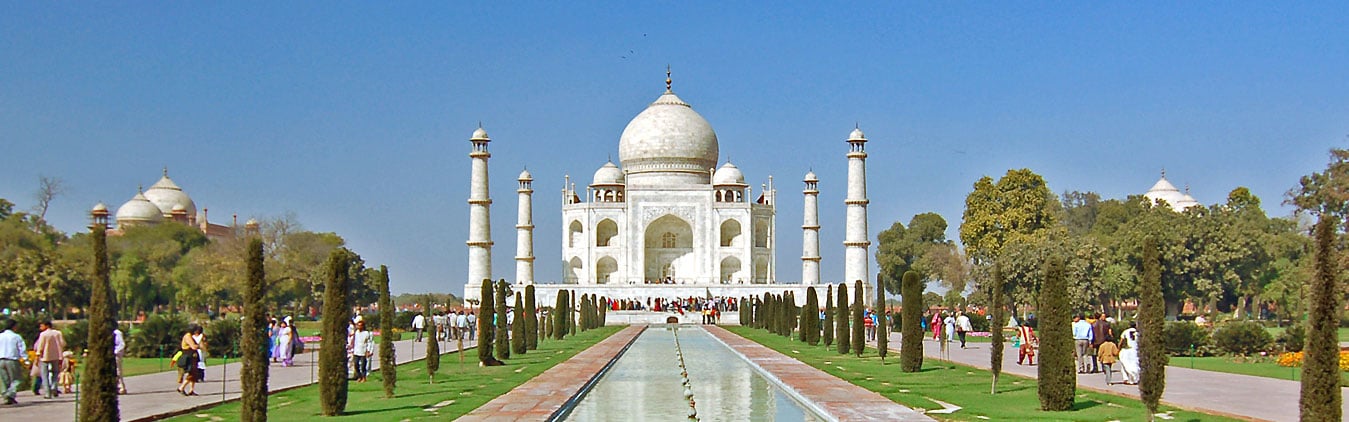
When in Agra, another visit to the Taj Mahal is mandatory, isn’t it? Before sunrise, reach Taj Mahal to see the morning light touch its marble surface. Afterwards, return to the hotel for breakfast and check out. Set off on a road journey to Jaipur, covering nearly 239 kilometres in about 4.4 hours.
Along the way, stop at Fatehpur Sikri, the red sandstone city that once functioned as the Mughal seat of power. Resume the drive through stretches of rural Rajasthan before arriving in Jaipur. Upon arrival, check in at your hotel and lie down for a while.
If the evening allows, you may choose to attend a traditional Rajasthani cultural programme with dinner (will be arranged at an additional cost).
Overnight rest at the hotel.
This day is all about Jaipur! Once you are done with breakfast, our chauffeur will take you to Amer Fort. Ascend to the hilltop fort on an elephant ride, and wander through grand courtyards and shimmering mirror panels.
Then you’ll make a brief halt at Jal Mahal, a serene palace floating on the waters of Man Sagar. Later, visit the City Palace, still linked to Jaipur’s former royal family, followed by Jantar Mantar, an open-air observatory famed for its astronomical instruments. Stop next at Hawa Mahal, and admire its latticed façade.
As evening approaches, spend time browsing Jaipur’s lively bazaars. You can buy handcrafted jewellery, vibrant fabrics, and traditional artefacts.
Return to the hotel for dinner and a good night’s sleep.
This marks the end of your 7-day Golden Triangle journey with Mathura and Vrindavan. After breakfast, gather your belongings and check out of the hotel. You will then be assisted with a timely transfer to Jaipur Airport or the railway station, from where you continue onward with your travel plans.
Note: The cancellation amount is calculated per the total booking amount and not as per the advance deposited. Charges may vary; view the full cancellation policy here.
Want us to check requirements before you proceed?
Check eligibility & availabilityDecades of planning experience across heritage, wildlife, pilgrimage, rail, family, and customised journeys.
A large specialist team for itinerary designing, destination planning, and end-to-end travel coordination.
Recognition that validates travellers’ choice of an experienced and established travel partner.
Official government recognition that reinforces IHPL’s standing as a professionally managed destination management company.
Ans: The ideal time is from October to March, when the weather is pleasant. Avoid summer months (April-June) when temperatures can be extremely high.
Ans: Yes, modest attire is required. Both men and women should cover their shoulders and knees. In certain temples, women may need to cover their heads as well.
Ans: Photography is allowed at most monuments, but there may be restrictions in some regions of religious sites and some museums. Video filming often requires an additional fee.
Still have a question before booking?
Send your enquiry