The United States is best understood as a collection of distinct travel regions rather than a single continuous sightseeing route. Distances between major destinations are large, and each region follows its own travel rhythm, shaped by cities, landscapes, and national parks that are often located far apart.
Most itineraries work better when planned as regional circuits instead of trying to combine the entire country in one trip. For first-time Indian travellers, the smartest approach is to choose one or two regions based on trip length. A 5–7 day trip should usually stay within one region, such as New York, with Washington DC, California, or Florida. A 10–18 day trip can combine two regions, such as the East Coast with the West Coast, or city sightseeing with a national park route.
This guide helps you choose the best places to visit in the USA based on travel month, visa status, arrival city, number of days, family comfort, domestic-flight tolerance, national park interest and whether you want a city, coast, theme park, nature or multi-region holiday.
Quick Planning Snapshot
The USA works best when planned by region rather than as a single route, since travel times between major areas are long and sightseeing styles change significantly across the country.
Which USA Region Should You Choose?
| Region / Route | Best For | Time Needed | Best Paired With | Planning Caution |
|---|---|---|---|---|
| New York + Washington DC | First-time travellers, families, city sightseeing | 5–7 days | Niagara Falls / Boston | Avoid adding West Coast in short trips |
| East Coast Extended | Culture, museums, monuments, historic walks | 7–10 days | Boston, Philadelphia, Niagara Falls | Rail works well, but do not overpack cities |
| California / West Coast | Coastlines, cities, entertainment, scenic drives | 7–10 days | San Francisco, Los Angeles, Las Vegas | PCH / coastal road conditions must be checked |
| Florida / Orlando | Families, theme parks, beaches, cruises | 5–8 days | Miami, Orlando, Kennedy Space Center | Theme parks need full days and advance tickets |
| Las Vegas + Southwest | Couples, entertainment, Grand Canyon / desert routes | 5–8 days | Grand Canyon, Zion, Antelope Canyon | Desert heat and long drives need planning |
| National Parks Loop | Nature, photography, road trips | 7–12 days | Grand Canyon, Yellowstone, Yosemite, Zion | Roads, permits and park access change seasonally |
| Hawaii | Honeymooners, beach lovers, volcano landscapes | 5–8 days | Oahu, Big Island, Maui | Volcano, surf and weather advisories need checking |
| Alaska | Wilderness, glaciers, cruises, wildlife | 7–10 days | Denali, Anchorage, cruise route | Seasonal access and limited services matter |
Best Places to Visit in the USA
1. East Coast Cities and Cultural Landmarks
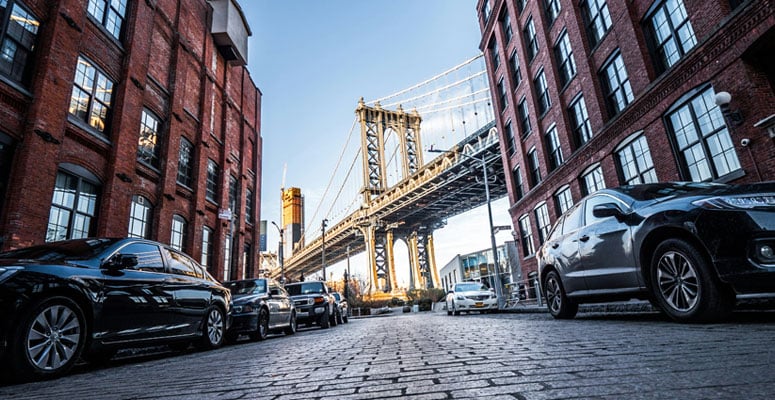
The East Coast of the United States is a compact and well-connected travel corridor where major cities are linked through short flights and rail routes. It works as a structured urban belt rather than a scattered collection of destinations, allowing travellers to combine a few key cities into one planned circuit. Each city in this region serves a distinct role, from dense skyline-driven experiences to political landmarks and historic neighbourhoods.
It combines skyline experiences, museums, political landmarks, immigration history, waterfronts and historic walking districts. For IndianHoliday users, this is usually the safest first-USA route because it offers strong sightseeing value without too many domestic flights.
Why visit: The main urban travel belt of the USA with a mix of cultural landmarks, historic districts, museums, and skyline-focused city experiences.
Time needed: 5–8 days for a two-city circuit, 8–10 days for a fuller East Coast combination.
Best experiences: Midtown skyline viewpoints, Times Square evenings, Brooklyn Bridge walks, Statue of Liberty ferry experience, National Mall monuments, Freedom Trail walks.
| Place | Best For | Time Needed | Pair With | Planning Note |
|---|---|---|---|---|
| New York City | First-time USA, skyline, museums, shopping | 3–4 days | Statue of Liberty, Central Park, Brooklyn Bridge | Stay near the preferred sightseeing zone to reduce transit fatigue |
| Washington DC | Monuments, museums, political landmarks | 2–3 days | National Mall, Smithsonian museums | National Mall walking can be long; plan breaks |
| Boston | History, walking routes, and universities | 1–2 days | Freedom Trail, Cambridge | Best as an East Coast add-on |
| Philadelphia | History and a short cultural stop | 1 day | New York / Washington DC | Works as a rail stop if the route permits |
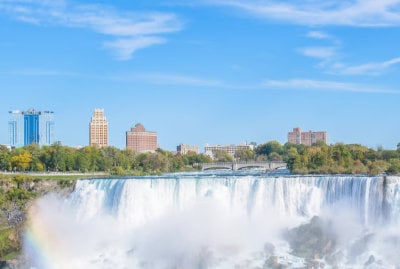
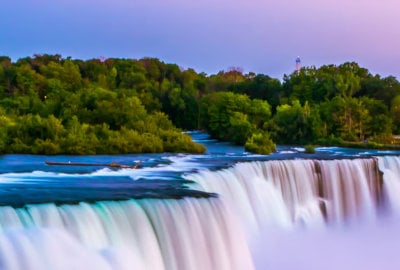
| Niagara Falls | Nature add-on, families, photography | 1–2 days | New York / East Coast packages | Do not treat it as close to New York City; travel time must be planned |
• Bethesda Terrace (Central Park, New York City)
Bethesda Terrace is a central architectural feature inside Central Park, built around a grand staircase overlooking Bethesda Fountain. It acts as a natural gathering and pause point within the park’s mid-section, where design, symmetry, and open space come together. The terrace is best experienced as part of a mid-park walking route where movement naturally slows down.
• Bow Bridge (Central Park, New York City)
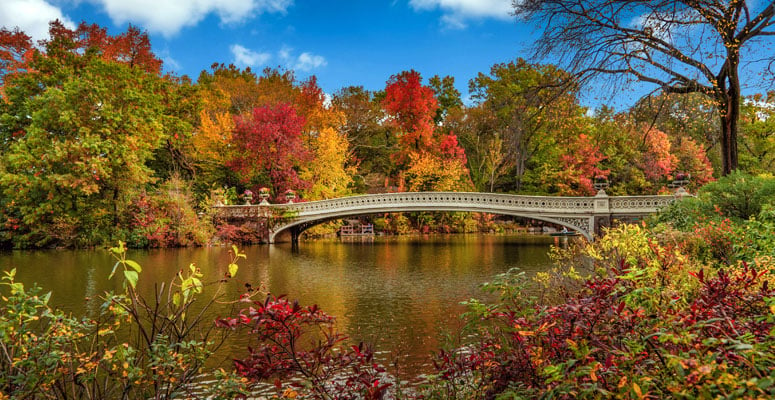
Bow Bridge is a cast-iron pedestrian bridge known for its curved structure and lake-facing views. It connects key walking paths inside Central Park and is widely appreciated for its skyline reflections over the water. The setting works best during quiet walking segments where the contrast between greenery and Manhattan’s skyline becomes more visible.
• Times Square (New York City)
Times Square is the entertainment core of Manhattan, defined by large digital billboards, theatres, and constant movement. It represents the most high-energy urban experience on the East Coast and is best visited briefly, usually in the evening when lighting and activity peak. It functions as a short stop within a wider Midtown circuit rather than a long visit.
• Statue of Liberty & Ellis Island (New York City)
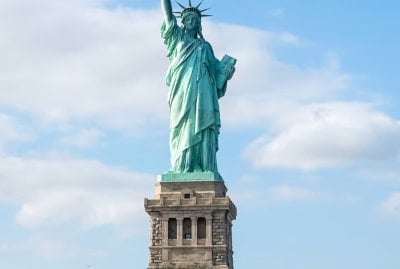
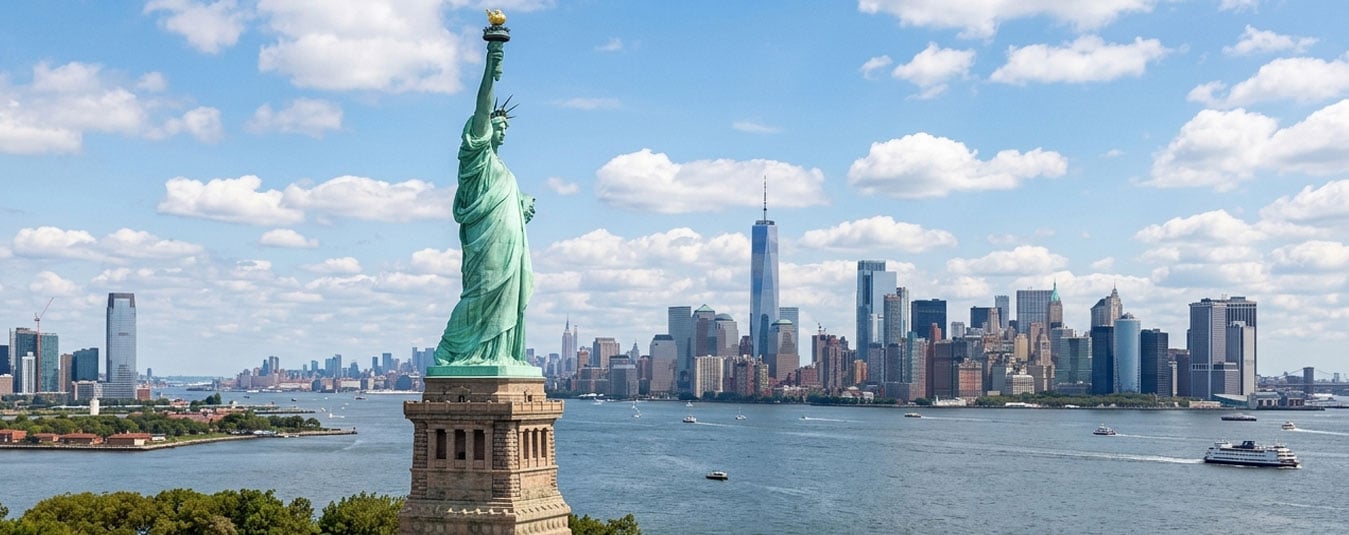
The Statue of Liberty and Ellis Island form a combined heritage experience focused on immigration history and harbour views. Access is via ferry from Battery Park, and the journey itself forms part of the experience with clear skyline views of Manhattan. Ellis Island focuses on migration history through museum exhibits, while Liberty Island centres on the monument and surrounding waterfront views.
• National Mall (Washington DC)
The National Mall is the central sightseeing axis of Washington DC, connecting major monuments and museums in a straight, walkable corridor. It is designed for structured exploration where landmarks are positioned in sequence rather than scattered across the city. The layout makes it one of the most organised urban sightseeing routes in the United States.
2. West Coast Cities and Cultural Landmarks
The West Coast works best as a slower city-and-coast route. San Francisco, Los Angeles, Las Vegas and California’s coastal drives are not as compact as East Coast city clusters, so the route needs more buffer time, domestic flights or carefully planned road transfers.
Why visit: A scenic urban and coastal belt combining entertainment cities, ocean-facing landscapes, and iconic viewpoints shaped by geography and modern culture.
Time needed: 6–9 days for a two-city circuit, 10–12 days for full coverage.
Best experiences: Golden Gate viewpoints, coastal drives, Hollywood district walks, studio experiences, desert nightlife zones, and waterfront promenades.
| Place | Best For | Time Needed | Pair With | Planning Note |
|---|---|---|---|---|
| San Francisco | Golden Gate views, bay experiences, city walks | 2–3 days | Alcatraz / Fisherman’s Wharf / Yosemite | Fog can affect bridge views |
| Los Angeles | Entertainment, beaches, studios, shopping | 3–4 days | Santa Monica, Hollywood, Universal Studios | Traffic makes zoning important |
| Las Vegas | Entertainment, couples, Grand Canyon access | 2–3 days | Grand Canyon / Southwest route | Not a substitute for national park time |
| California Coast / PCH | Scenic drives, couples, photographers | 2–4 days | San Francisco–LA route | Check closures, roadwork and daylight timing before driving |
• Golden Gate Bridge (San Francisco)
The Golden Gate Bridge is one of the strongest skyline and coastal landmarks in San Francisco. It is best experienced from multiple viewpoints rather than a single angle, with changing visibility depending on fog and light conditions. The bridge forms a key part of the city’s coastal identity and skyline composition.
• Fisherman’s Wharf (San Francisco)
Fisherman’s Wharf is a waterfront district known for harbour activity, seafood culture, and bay-facing views. It functions as a casual walking zone where maritime atmosphere and tourist movement blend together along the shoreline.
• Hollywood Walk of Fame (Los Angeles)
The Hollywood Walk of Fame is a street-based landmark spread along Hollywood Boulevard, marked by celebrity star plaques embedded into the pavement. It represents the entertainment identity of Los Angeles and is best experienced as a slow walking stretch rather than a single attraction point.
• Santa Monica Pier (Los Angeles)
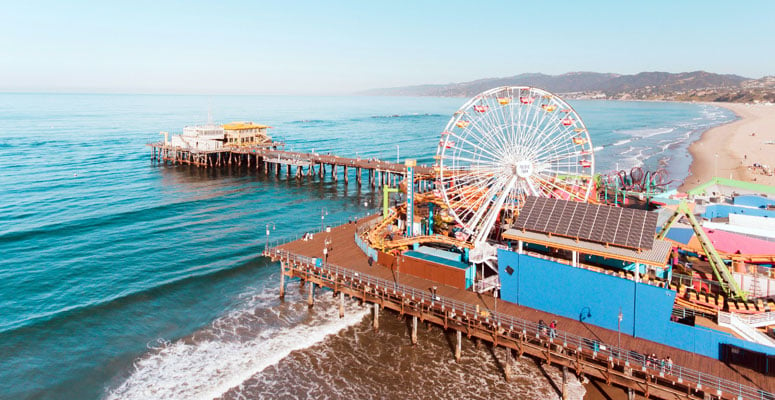
Santa Monica Pier is a coastal amusement and leisure zone where ocean views, entertainment rides, and boardwalk movement come together. It is most active during sunset hours and works as a relaxed endpoint within a broader Los Angeles coastal route.
3. National Parks and Natural Landscapes of the USA
USA national parks require a different travel style from city sightseeing. They depend on driving distances, shuttle systems, road openings, weather, permits, parking and seasonal access. Do not add national parks casually to city-heavy itineraries unless the trip has enough days and route support.
Why visit: The natural exploration belt of the USA features large-scale landscapes, geological formations, and long-distance road-based travel circuits.
Time needed: 6–10 days for a multi-park route.
Best experiences: Canyon viewpoints, forest drives, volcanic landscapes, glacier regions, wildlife zones, scenic highways.
| National Park | Best For | Time Needed | Pair With | Planning Caution |
|---|---|---|---|---|
| Grand Canyon | First-time nature, families, photography | 1–2 days | Las Vegas / Arizona route | South Rim is the standard first-time base; North Rim is seasonal |
| Yosemite | Waterfalls, granite cliffs, hiking, photography | 2–3 days | San Francisco / California route | 2026 entrance reservation not required, but permits/lodging still matter |
| Yellowstone | Geysers, wildlife, geothermal landscapes | 3–4 days | Grand Teton / Wyoming route | Roads and entrances vary by season |
| Zion / Bryce / Utah parks | Desert landscapes, hiking, photography | 3–5 days | Las Vegas / Southwest route | Summer heat and shuttle rules matter |
| Denali | Wilderness, Alaska, wildlife | 2–3 days | Anchorage / Alaska cruise route | Park road/bus access is restricted and seasonal |
• Grand Canyon National Park (Arizona)
The Grand Canyon is best planned by rim and season. For most first-time travellers, the South Rim is the standard base because it has stronger year-round infrastructure. The North Rim is more seasonal and remote; verify access before routing. Grand Canyon announced North Rim 2026 summer access from May 15, 2026, but current service and fire-recovery restrictions should still be checked before travel.
• Yellowstone National Park (Wyoming)
Yellowstone is a geothermal landscape known for geysers, hot springs, and wide wildlife zones. The park operates as a large circular driving circuit where natural features are spaced across long distances and experienced through slow travel routes.
• Yosemite National Park (California)
Yosemite works well as a California nature extension from San Francisco or a longer West Coast route. In 2026, NPS says an entrance reservation is not required, but lodging, camping, wilderness permits and Half Dome permits may still be required depending on activity.
4. Hawaii and Alaska Travel Belts
Hawaii and Alaska function as standalone travel systems due to their geographic separation from the mainland USA. They are not part of traditional road or rail circuits and require dedicated trip planning focused on island or wilderness-based travel.
Why visit: Isolated travel belts offering island landscapes and extreme natural environments distinct from mainland circuits.
Time needed: 5–8 days per destination.
Best experiences: Volcano landscapes, beaches, glaciers, wildlife cruises, and island drives.
• Waikiki Beach (Hawaii)
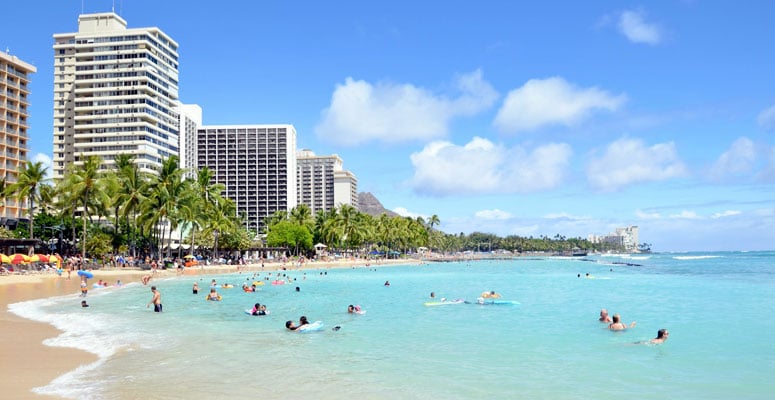
Waikiki Beach is a coastal leisure zone known for calm waters, resort surroundings, and consistent beach activity. It is one of the most accessible beach experiences in the USA and functions as the central hub of Hawaii travel.
• Hawaiʻi Volcanoes National Park (Hawaii)
This park is defined by active volcanic landscapes, lava fields, and crater viewpoints. It offers a rare geological experience where volcanic activity shapes the environment.
• Denali National Park (Alaska)
Denali National Park is best treated as a seasonal Alaska wilderness experience. It is not a simple self-drive park. In 2026, NPS says the Denali Park Road closure at Mile 43 is expected to remain in place through the summer while the Polychrome Area Plan is implemented, and visitors should use the current NPS conditions before planning.
Other High-Value Places to Visit in the USA
• Orlando and Florida
Orlando is one of the strongest USA choices for families because it offers theme parks, entertainment, shopping and resort-style stays. It should be treated as a full family holiday base rather than a one-day stop.
Best for: Families, children, theme-park travellers.
Time needed: 4–6 days.
Pairs well with: Miami, Kennedy Space Center, cruise extensions.
• Miami and South Florida
Miami works well for beach, nightlife, cruise departures and South Florida extensions. It can pair with Orlando or Caribbean cruise routes.
Best for: Couples, cruise travellers, beach holidays.
Time needed: 2–4 days.
Pairs well with: Orlando, Key West, cruise itineraries.
• Las Vegas and Southwest USA
Las Vegas is a strong entertainment and gateway city for Grand Canyon, Zion, Bryce and desert routes.
Best for: Couples, entertainment, desert road trips.
Time needed: 2–3 days for Las Vegas; 5–8 days with parks.
Pairs well with: Grand Canyon, Zion, Antelope Canyon.
• Chicago and the Midwest
Chicago adds architecture, lakefront, museums and city culture for repeat USA travellers or extended routes.
Best for: Architecture, museums, city culture.
Time needed: 2–3 days.
Pairs well with: East Coast or Great Lakes route.
• New Orleans and the South
New Orleans is useful for culture, music, food and historic districts, especially for repeat travellers.
Best for: Music, food, culture, French Quarter walks.
Time needed: 2–3 days.
Pairs well with: Southern USA route.
Sightseeing Add-ons to Pair With USA Sightseeing
| Experience | Best Paired With | Planning Note |
|---|---|---|
| Skyline viewpoints & observation decks | New York City (Top of the Rock, One World Observatory, Empire State Building) | Best done during sunset or night hours for clearer skyline contrast. Avoid stacking multiple decks in one day. |
| Urban walking circuits | Central Park, Brooklyn Bridge, Freedom Trail (Boston), National Mall (Washington DC) | Works best as slow-paced walking blocks. Keep each circuit separate to avoid fatigue across cities. |
| Ferry & waterfront experiences | Statue of Liberty ferry, Brooklyn waterfront, San Francisco Bay cruises | Morning ferries give better visibility and fewer crowds. Weather affects clarity significantly. |
| Theme park experiences | Universal Studios (Los Angeles/Orlando), Disneyland California | Requires full-day allocation. Avoid combining with long travel or sightseeing on the same day. |
| Coastal drives & viewpoints | Pacific Coast Highway (California), Santa Monica Pier, Golden Gate viewpoints | Best experienced during daylight with flexible stopovers rather than fixed scheduling. |
| Museum circuits | Smithsonian Museums (Washington DC), MoMA (New York), American Museum of Natural History | Combine a maximum of 2–3 museums per day to avoid overload. Alternate indoor and outdoor days. |
| Historic walking districts | Freedom Trail (Boston), French Quarter (New Orleans), Lower Manhattan | Best explored early morning for lighter crowds and better walking flow. |
| National park exploration | Grand Canyon, Yellowstone, Yosemite, Zion | Requires dedicated multi-day travel. Do not mix with city-heavy itineraries on the same block. |
How to Plan Your USA Trip by Duration
3-Day USA Highlights Route
Route: New York City → New York City
This short route focuses on core Manhattan experiences, combining skyline viewpoints, Central Park walking circuits, and a single waterfront landmark experience. It is best suited for first-time visitors who want a compact introduction without intercity travel.
Recommended focus: Central Park, Times Square, Brooklyn Bridge walk, Statue of Liberty ferry.
Prioritise: Manhattan core zones only.
Do not add: Washington DC, Boston, West Coast cities, or national parks.
Best for: Short stopovers and first-time urban introductions.
5-Day East Coast Classic Route
Route: New York City → Washington DC → New York City / Exit
This route combines skyline-heavy urban experiences with structured monument-based sightseeing. It balances New York’s district-based exploration with Washington DC’s linear National Mall circuit.
Recommended focus: Central Park, Midtown skyline views, Statue of Liberty, National Mall, Lincoln Memorial.
Prioritise: New York and Washington DC core landmarks only.
Do not add: Boston or the West Coast in the same itinerary.
Best for: Families, couples and first-time East Coast travellers.
7-Day East Coast Extended Circuit
Route: New York City → Washington DC → Boston → New York City / Exit
A structured multi-city loop covering the most important East Coast cities in a balanced sequence. Each city contributes a distinct travel layer: skyline-driven urban experiences in New York, monument-led structure in Washington DC, and historic walking circuits in Boston.
Recommended focus: Brooklyn Bridge, Statue of Liberty, National Mall, Freedom Trail and Boston Common.
Prioritise: One core circuit per city rather than full coverage in each destination.
Do not add: West Coast destinations or national parks within the same itinerary.
Best for: Full East Coast cultural exploration.
5–8 Day Florida Family Route
Route: Orlando → Kennedy Space Center / Miami → Cruise or Beach Extension
Best for: Families with children and theme-park travellers.
Recommended focus: Theme parks, resort stays, shopping, beach or cruise add-on.
7–10 Day Southwest Parks Route
Route: Las Vegas → Grand Canyon → Zion / Bryce → Las Vegas
Best for: Nature lovers, photographers, couples and road trips.
Recommended focus: Desert landscapes, canyon viewpoints and scenic drives.
7–9 Day California Route
Route: San Francisco → Yosemite / Monterey → Los Angeles
Best for: Couples, families, scenic drives and first-time West Coast travellers.
Recommended focus: Golden Gate Bridge, coastal scenery, Los Angeles attractions and an optional Yosemite extension.
10–18 Day Two-Region USA Route
Route: East Coast + West Coast / East Coast + Florida / California + Southwest
Best for: Premium first-time long-haul holidays.
Practical Travel & Comfort Notes
- Check your visa status before making non-refundable bookings. Tourism usually requires a B-2 or combined B1/B2 visa unless the traveller qualifies under another category.
- Plan city clusters instead of attempting full-country movement. The USA is not designed for continuous overland travel between major destinations, so itineraries work better when grouped into compact regional circuits.
- Keep accommodation close to your sightseeing area. In cities such as New York, Washington DC and San Francisco, staying near the main sightseeing zone reduces daily travel time and walking fatigue.
- Avoid overloading museum and skyline days. Pair indoor attractions with outdoor walking experiences for a more comfortable pace.
- Ferry and waterfront experiences depend heavily on weather and visibility. Keeping these flexible usually improves the overall experience.
- Allow extra time for security screening at observation decks, ferry terminals, airports and selected government buildings.
- Plan meal stops around neighbourhood transitions instead of fixed schedules, especially in busy city centres.
- Carry appropriate travel insurance and ensure medicines and prescription documents are packed before departure.
Best Time to Visit the USA
| Season | Better For | Planning Reality |
|---|---|---|
| Spring (March–May) | East Coast cities, Washington DC, California cities and walking circuits | Comfortable weather in many regions, although rain, late snow and local events may affect plans. |
| Summer (June–August) | Alaska, selected national parks, family holidays and long daylight hours | Peak crowds, higher prices, desert heat, wildfire or smoke conditions and park congestion require careful planning. |
| Autumn (September–November) | New England foliage, New York, California and mixed city-plus-scenic routes | Excellent travel season, though hurricane activity can affect parts of Florida and the East Coast. |
| Winter (December–February) | New York festive travel, ski holidays, indoor city sightseeing and warm-weather Florida | Northern cities can experience severe winter weather, while some national park roads may close. |
| Hawaii | Year-round island travel | Surf conditions, rainfall, volcanic activity and air-quality advisories should be checked before travel. |
| Alaska | Mainly summer travel | Seasonal access, cruise schedules, Denali road status and weather conditions strongly influence travel plans. |
Common Mistakes Travellers Make While Planning USA Sightseeing
- Trying to cover New York, Washington DC, California, Yellowstone, Florida and Hawaii in one short trip.
- Assuming driving across the USA is practical for first-time tourists.
- Adding national parks without checking roads, permits, weather and shuttle systems.
- Treating Niagara Falls as a quick New York City stop without planning travel time.
- Booking non-refundable hotels before checking visa timelines.
- Planning theme parks, museums and long transfers on consecutive days.
- Choosing airports only by airfare instead of overall routing logic.
- Underestimating jet lag after long India–USA flights.
- Adding Hawaii or Alaska casually to a mainland itinerary.
- Treating the “best time to visit the USA” as one national answer instead of planning region by region.
How to Reach the USA in 2026
The USA is reached mainly by air, while domestic flights connect major regions across the country. Rail and road travel are most useful within individual regions rather than for cross-country journeys.
By Air
Major international gateways include New York, Los Angeles, San Francisco, Chicago and Washington DC. These airports connect India with the United States through direct or one-stop flights. New York is the primary East Coast gateway, while Los Angeles and San Francisco serve most West Coast itineraries.
By Rail
Amtrak connects many important cities on the East Coast, including New York, Washington DC and Boston. Rail coverage is more limited elsewhere but remains useful for selected regional routes.
By Road
Highways connect nearby cities and scenic regional routes, particularly in California, Florida and the American Southwest. Self-drive holidays are best planned within one region rather than across the entire country.
Plan Your USA Holiday Route
Planning a USA trip from India? The ideal route depends on your travel month, visa status, number of days, arrival city, family profile, comfort with domestic flights, interest in national parks, theme parks, beaches or cities, and whether you want an East Coast, West Coast, Florida, Hawaii, Alaska or premium multi-region holiday.
IndianHoliday’s USA specialists can help you choose the right regional circuit, flight routing, hotel locations, private transfers, national park add-ons, cruise extensions, theme-park days and sightseeing pace without overloading your itinerary.
Share these details before finalising your USA route:
- Travel month
- Number of travel days
- Visa status or visa appointment stage
- Starting city in India
- Preferred arrival city in the USA
- Traveller age profile
- Trip type: family, couple, honeymoon, luxury, group or first-time USA visit
- Interests: cities, shopping, theme parks, national parks, beaches, cruises, museums, scenic drives or wildlife
- Comfort with domestic flights
- Preferred route: East Coast, West Coast, Florida, Southwest parks, Hawaii, Alaska or a multi-region USA itinerary