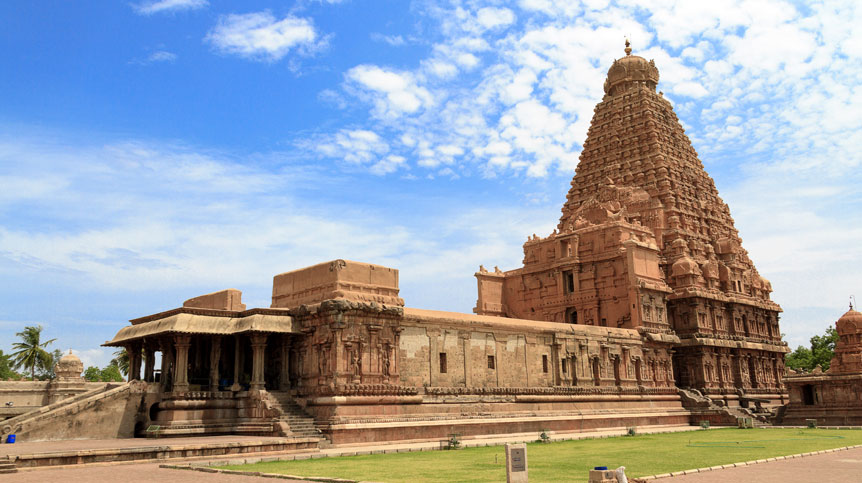

Tamil Nadu’s temples form one of India’s most significant pilgrimage and heritage circuits, with key sites such as Madurai’s Meenakshi Temple, Rameswaram’s Ramanathaswamy Temple, Kanchipuram’s temples, and Chidambaram Nataraja Temple drawing travellers across the state.
Since each temple differs in scale, rituals, and crowd intensity, planning which ones to visit and when is essential to ensure a smooth and well-paced journey.
Understanding timing, local customs, and how each temple fits into a wider route helps travellers experience them in a more structured and meaningful way rather than as isolated stops.
Quick Planning Snapshot
| Planning Need | Recommended Guidance |
|---|---|
| Ideal trip length | 4–6 days for a balanced first-time temple circuit covering Madurai–Rameswaram–Thanjavur–Chidambaram–Kanchipuram, depending on travel pace and temple depth. |
| Short trip priority places | For 2–3 days, focus on only one strong route: the Madurai–Rameswaram belt or the Chennai–Kanchipuram–Chidambaram circuit. Avoid combining distant temple zones in a short itinerary. |
| Best first-time temple circuit | Start with Chennai–Kanchipuram for accessible heritage temples, then Madurai–Thanjavur for major Dravidian temple architecture, and extend to Rameswaram if time allows. |
| Best experiences by theme | Major temple architecture: Madurai Meenakshi, Brihadeeswarar Temple (Thanjavur). Pilgrimage circuits: Rameswaram, Kanchipuram temples. Cultural temple towns: Chidambaram, Kumbakonam belt. |
| Who does it suit best | Pilgrimage travellers, culture and architecture enthusiasts, photographers, and first-time visitors exploring structured South Indian temple circuits. |
| Skip if short on time | Attempting all major temple towns in one trip, combining multiple long-distance circuits (Chennai–Madurai–Rameswaram–Thanjavur) in under 4 days, or frequent backtracking between regions. |
| Key travel rule | Plan Tamil Nadu as distinct temple circuits (Chennai region, central temple belt, southern pilgrimage zone) rather than a continuous point-to-point route. |
Major Temples in Tamil Nadu
1. Heritage Temples in Tamil Nadu
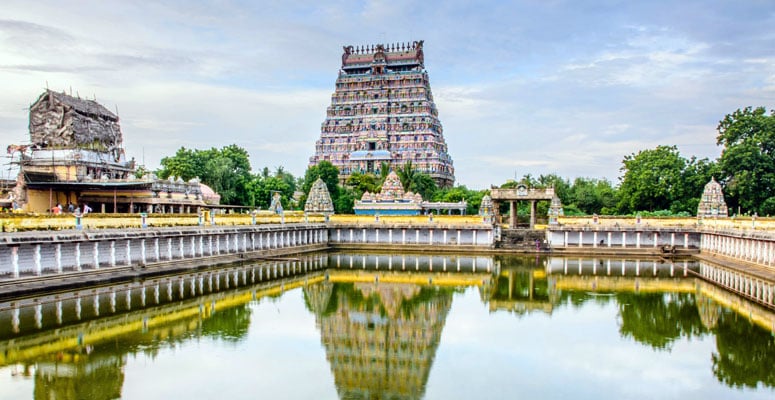
Tamil Nadu’s heritage temples reflect several major South Indian building traditions, especially Pallava and Chola-period temple architecture. These temples are best understood as experience-driven monuments, where scale, design precision, and historical continuity matter more than individual rituals or quick visits. These sites are typically positioned away from short city loops, so they work best when planned as dedicated half-day or full-day heritage circuits rather than transit detours.
- Why visit: To experience the peak of South Indian temple architecture, especially Chola-era design systems and UNESCO-recognised heritage landscapes
- Time needed: 3–5 hours per circuit (half-day minimum)
- Best experiences: Brihadeeswarar Temple (Thanjavur), Shore Temple (Mahabalipuram), temple-palace combinations, and structured heritage walks within temple complexes
• Brihadeeswarar Temple, Thanjavur
A UNESCO World Heritage Site and one of the finest examples of Chola architecture, Brihadeeswarar Temple stands out not just for its scale but for its precise geometric planning and spatial discipline. Rather than a single visual reveal, the temple is experienced in layers as you move through its vast courtyard and align with its central axis.
• Shore Temple, Mahabalipuram
Located along the Bay of Bengal, the Shore Temple is one of the most recognisable UNESCO-listed monuments in Tamil Nadu. Its significance lies in the rare combination of a coastal setting and early medieval stone architecture, which makes it both a scenic landmark and a heritage-driven experience.
Unlike inland temples, the structure is continuously influenced by sea-facing exposure, which adds a changing visual character depending on light, wind, and tide conditions.
• Darasuram Airavatesvara Temple, Kumbakonam
A later Chola-era UNESCO-listed temple, Airavatesvara Temple, is notable for its highly detailed stonework and sculptural density compared to earlier grand-scale temples. The experience here is more intricate and close-up, with attention shifting from architectural scale to fine narrative carvings.
A key insight is that this temple rewards slow movement and close observation, making it feel more like a sculptural gallery within its structure than a large spatial monument.
Grouped Travel Logic
These temples function best when treated as anchoring points inside heritage clusters, not isolated POIs:
- Thanjavur circuit: Brihadeeswarar + palace complex (dense cultural block, not linear sightseeing)
- Mahabalipuram circuit: Shore Temple + rock-cut monuments (short-distance, high-density heritage loop)
Rather than covering more temples, the value here comes from slowing down within fewer sites and reading spatial design, not just structure lists.
2. Pilgrimage-Scale Temple Destinations
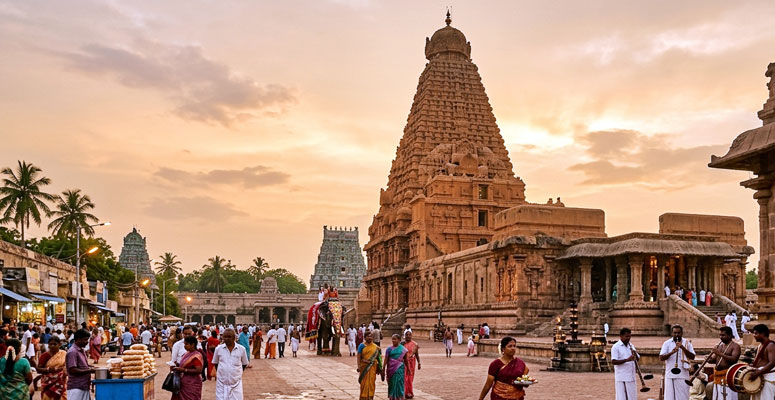
This includes Tamil Nadu’s largest temple destinations, where the experience is defined less by individual sightseeing and more by the scale of living temple ecosystems, ritual intensity, and city-wide spiritual movement. These destinations function as standalone travel legs rather than short stops, with the temple acting as the core around which the entire town or city is structured.
Unlike heritage-focused temple circuits, these require slower pacing and more structured planning, as timing, queues, and ritual cycles significantly shape the overall experience.
- Why visit: To experience Tamil Nadu’s most significant living temples, where devotion, architecture, and daily life are deeply integrated
- Time needed: 1–2 days per destination
- Best experiences: Early morning darshan cycles, gopuram architecture, temple tank rituals, circumambulatory pathways, and festival periods where applicable
• Madurai Meenakshi Amman Temple
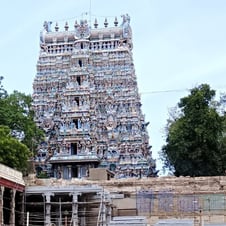
One of India’s most active and architecturally dense temple complexes, Madurai Meenakshi Amman Temple functions as both a spiritual centre and a city core. The experience is defined by its multi-gopuram structure, continuous ritual movement, and tightly integrated temple streets that extend the activity beyond the main complex.
• Srirangam Ranganathaswamy Temple
Spread across a vast island-like temple town, Srirangam is one of the largest functioning temple complexes in India. Unlike compact temples, it operates as a layered ecosystem with multiple enclosures, streets, and ritual pathways, where movement between gates is as much a part of the experience as the main sanctum itself.
Planning Insight: Srirangam is not a “single-entry visit” temple; the experience improves significantly when approached with time allocated for internal circulation among the multiple prakarams, rather than focusing solely on darshan. Many travellers underestimate walking distance and time between layers, which can reshape the overall pacing of the visit.
3. City-Based Temple Circuit
This circuit includes temples in major Tamil Nadu cities, where religious sites are tightly integrated with daily urban life, markets, and cultural streets. Unlike pilgrimage-scale destinations, these are not standalone travel legs but flexible half-day additions within city itineraries.
The value of this circuit lies in contrast; temples here are experienced alongside food streets, colonial zones, museums, and local neighbourhoods rather than as isolated heritage monuments.
- Why visit: To experience living city-based temples where daily worship, local culture, and urban activity overlap
- Time needed: 2–4 hours per city stop
- Best experiences: Morning darshan, gopuram street views, temple tank areas, and surrounding cultural streets
• Kapaleeshwarar Temple
Kapaleeshwarar Temple is one of Chennai’s most prominent Dravidian-style temples, located in the culturally dense Mylapore area. The experience here is defined by its towering gopuram, active ritual cycles, and the surrounding temple-street ecosystem, where traditional shops and cultural movements continue alongside daily worship.
• Parthasarathy Temple (Chennai)
Located in Triplicane, Parthasarathy Temple is one of Chennai’s oldest Vaishnavite temples, known for its layered structure and long-standing ritual traditions. Unlike more visually dominant temple complexes, this one is experienced through its sequence of enclosed spaces and steady devotional rhythm.
• Rockfort Ucchi Pillayar Temple (Trichy)
Perched atop the Rockfort hill in the centre of Trichy, Ucchi Pillayar Temple offers a compact temple experience that combines climbing movement with city-wide views. The ascent itself becomes part of the visit, with intermediate shrines and viewpoints along the way.
• Arunachaleswarar Temple
Located at the base of Arunachala Hill, Arunachaleswarar Temple is one of the largest and most significant Shaivite temple complexes in South India. Unlike hilltop shrines that require a steep ascent, this temple is defined by its flat, expansive complex framed by the sacred hill itself, which dominates the entire town skyline.
4. Sacred Water & River Temple Destinations
This includes Tamil Nadu’s temples, where the experience is defined less by architecture alone and more by the presence of rivers, temple tanks, and coastal water systems that actively shape ritual flow and movement patterns. These destinations function as ritual-structured travel stops, where water-based practices such as bathing ceremonies, tank rituals, and riverside offerings are an essential part of the visit experience.
- Why visit: To experience temples where rivers, temple tanks, and coastal waters directly shape ritual practice and travel structure
- Time needed: Half day to 2 days per destination
- Best experiences: Temple tank rituals, river or sea baths, early morning water ceremonies, and festival-linked bathing events
• Rameswaram Ramanathaswamy Temple
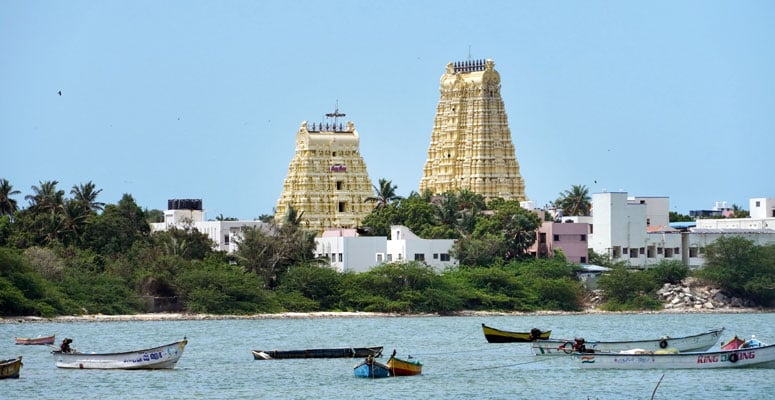
Rameswaram, on an island linked to the mainland by the Pamban Bridge, is both a major pilgrimage destination and a geographically distinct travel experience, where access itself becomes part of the journey. The temple is known for its exceptionally long corridors, sacred water tanks, and a structured sequence of ritual bathing across multiple theerthams, which often extends the visit beyond standard darshan timing.
• Mahamaham Tank Temple Cluster (Kumbakonam)
Kumbakonam is defined by its dense network of temples surrounding the Mahamaham Tank, one of the most significant ritual water bodies in South India. The temples here function as a clustered system rather than isolated monuments, especially during festival cycles when ritual bathing becomes the central event.
Which Tamil Nadu Temple Region Should You Prioritise?
| Traveller / Trip Type | Prioritise | Defer or Skip | Why |
|---|---|---|---|
| 1–2 day Chennai trip | Chennai temples (Kapaleeshwarar, Parthasarathy) | Long circuits | Best short urban temple experience |
| 2–3 day trip | Chennai + Kanchipuram | Madurai, Thanjavur, Rameswaram | Closest heritage temple cluster |
| 4–6 day circuit | Chennai → Kanchipuram → Chidambaram → Thanjavur | Full southern loop | Balanced Dravidian temple coverage |
| 6–7+ day full circuit | Chennai → Kanchipuram → Chidambaram → Thanjavur → Madurai → Rameswaram | None | Complete temple belt experience |
| Heritage traveller | Kanchipuram + Thanjavur + Chidambaram | Urban-only temples | Strong architecture focus |
| Pilgrimage traveller | Madurai + Rameswaram | Leisure hopping | High ritual significance |
| Long-route traveller | Full temple belt | Fragmented visits | Best as a single structured circuit |
Best Time to Visit
| Factor | Best Window | What to Expect | Planning Insight |
|---|---|---|---|
| Climate | Nov–Mar | Pleasant weather, easier travel across temple circuits | Best overall period for combining multiple temple regions |
| Summer | Apr–Jun | High heat, strong afternoons | Stick to early morning and evening temple visits only |
| Monsoon | Jul–Oct | Humid with intermittent rain | Travel possible, but intercity movement can slow down |
| Festival Peaks | Jan–Mar, Aug–Sep (varies) | High crowds, longer queues, active rituals | Requires advance planning; experience is more immersive but slower |
| Morning Timing | 5:30–9:00 AM | Calm, cooler, better darshan flow | Best slot for pilgrimage and major temples |
| Evening Timing | 5:00–8:30 PM | Active rituals, stronger temple atmosphere | Ideal for urban temples and evening aarti experience |
How to Plan Your Tamil Nadu Temple Trip by Duration
1. 3–4 Day Tamil Nadu Temple Route
Chennai → Kanchipuram → Chidambaram → Chennai
This short circuit covers the most accessible mix of urban and heritage temples, combining Chennai’s living temple culture with Kanchipuram’s classical Dravidian architecture and Chidambaram’s ritual-heavy temple experience.
Recommended focus:
- Kapaleeshwarar Temple (Mylapore)
- Parthasarathy Temple (Triplicane)
- Kanchipuram temple cluster (Ekambareswarar, Kamakshi Amman)
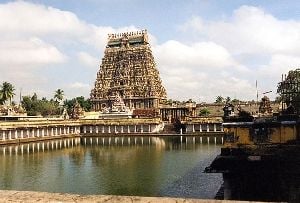
- Chidambaram Nataraja Temple
- Short Chennai coastal walks (optional)
Prioritise: Chennai + Kanchipuram + Chidambaram temple core
Do not add: Madurai, Rameswaram, Thanjavur in this short route
Comfort note: Keep travel within the Chennai–Kanchipuram–Chidambaram triangle to avoid long-road fatigue
Best for: First-time temple travellers, short cultural breaks, weekend + 1 extra day trips
2. 5–6 Day Classic Tamil Nadu Temple Route
Chennai → Kanchipuram → Chidambaram → Thanjavur → Chennai (or Trichy exit)
This route connects Tamil Nadu’s most significant heritage and temple towns, moving from urban temples to the core Chola architecture belt.
Recommended focus:
- Chennai temple circuit (Kapaleeshwarar, Parthasarathy)
- Kanchipuram heritage temples
- Chidambaram Nataraja Temple rituals
- Brihadeeswarar Temple (Thanjavur)
- Darasuram Airavatesvara Temple
- Optional Trichy Rockfort stop
Prioritise: Chennai + Kanchipuram + Chola temple belt
Do not add: Madurai–Rameswaram in the same short circuit
Comfort note: Allow one full day for the Thanjavur–Kumbakonam cluster to avoid rushed temple visits
Best for: Families, culture-focused travellers, architecture enthusiasts