
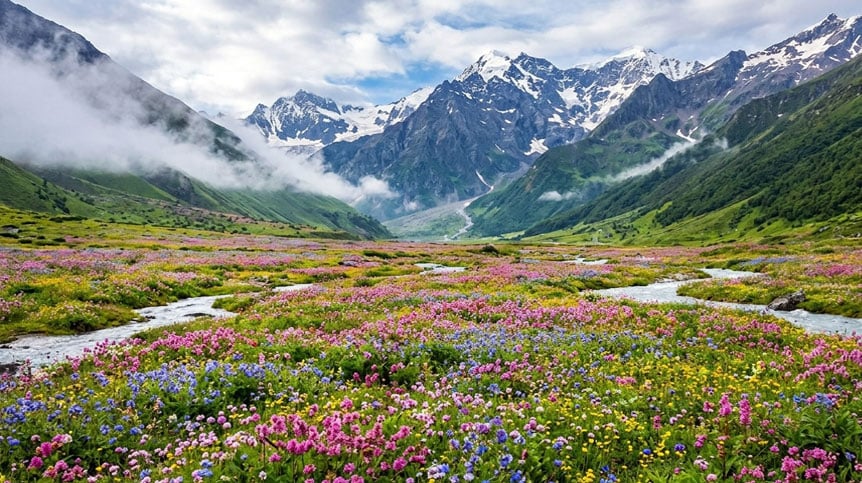

Reaching the Valley of Flowers is not only about choosing among air, train, or road as separate options but also about the journey itself. The route is almost the same whether you fly to Uttarakhand or take the train, then continue by road to Govindghat. Further, complete the approach to Ghangaria on foot. That makes this a road-plus-trek journey, not a destination you simply reach by vehicle.
By Air
The nearest airport is Jolly Grant Airport in Dehradun. Flying is the easiest choice for travellers coming from farther away or for those trying to save time on the first leg into Uttarakhand. But it only simplifies the entry into the state. It does not remove the long road approach to Govindghat, which remains the main transfer point before the trek begins.
By Train
The most relevant train entry point is Rishikesh. The distance from the railhead to Govindghat is around 273 km. This makes train access a sensible option for travellers from North India who are comfortable with a train arrival and do not mind shifting to a mountain-road transfer the next day.
Train plus road is often the most balanced plan when the trip is not being compressed. It usually suits travellers who want an entry point to Uttarakhand without air travel while keeping the route straightforward. The main thing to understand is that rail only gets you to the state gateway. The real access logic still depends on the road to Govindghat and the trek beyond it.
By Road
Road travel is the strongest part of the access plan because every Valley of Flowers journey becomes road-led before it becomes trek-led. The official Uttarakhand tourism states that the motorable road runs up to Govindghat, the starting point for the trek. This means the road stage deserves more thought than the flight or train you use to enter Uttarakhand.
For most travellers, the smartest way is to reach Joshimath or Govindghat, halt, and begin walking the next day. That is usually a better decision than trying to combine a long hill drive and the first major trekking leg in one overpacked day.
Routes & Access
The road journey ends at Govindghat. From there, the approach shifts fully into trekking mode. Ghangaria is reached on foot from Govindghat and functions as the base for both the Valley of Flowers and Hemkund Sahib. From Ghangaria, the valley itself is another 4 km away, which is why most travellers make Ghangaria an overnight stop, followed by a separate visit to the valley the next morning.
Which Option Is Best for Different Travellers
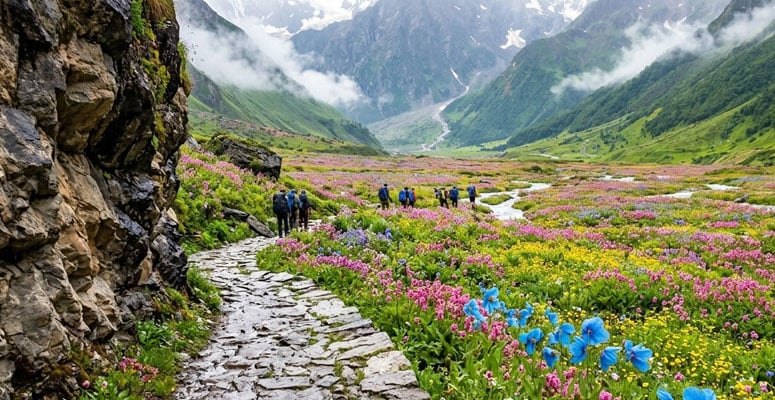
1. Senior travelers
For senior travellers who are still comfortable with sustained mountain walking, the best plan is usually a flight or train entry into Uttarakhand, a road halt before the trailhead, and a measured approach via Ghangaria.
2. Families
Families usually do best when they treat the Valley of Flowers as a short trekking journey rather than a rushed sightseeing stop. A halt before Govindghat, followed by a proper move to Ghangaria, makes the experience feel far more manageable. This route is generally better suited to families with older children or groups comfortable with walking.
3. Travelers with limited time
Flying into Dehradun is usually the cleanest option if time is tight. It shortens the entry stage, but the road and trekking sequence still remains the same. When time is limited, the mistake is usually not the choice of airport but how much the Govindghat–Ghangaria valley shapes the trip.
4. Travellers combining with a wider Uttarakhand route
This route fits best with the Joshimath–Auli–Badrinath side of Uttarakhand rather than as a single stop. As Auli is a gateway to the Valley of Flowers, Govindghat lies along the broader Badrinath route. So if the trip is being built into a mountain circuit, the journey usually works best when planned thoughtfully.
Plan your journey the right way
The best way to think about reaching the Valley of Flowers is to get into Uttarakhand comfortably, treat Govindghat as the road endpoint, Ghangaria as the real base, and plan the valley visit as the final walking stage.


