
Well-known for its ancient temples, beautiful palaces, and alluring monuments, Gwalior is the tourist capital of Madhya Pradesh. Gwalior is best known for being the birthplace of the great musician Tansen. The city is also popular for its rich cultural heritage and glorious history.
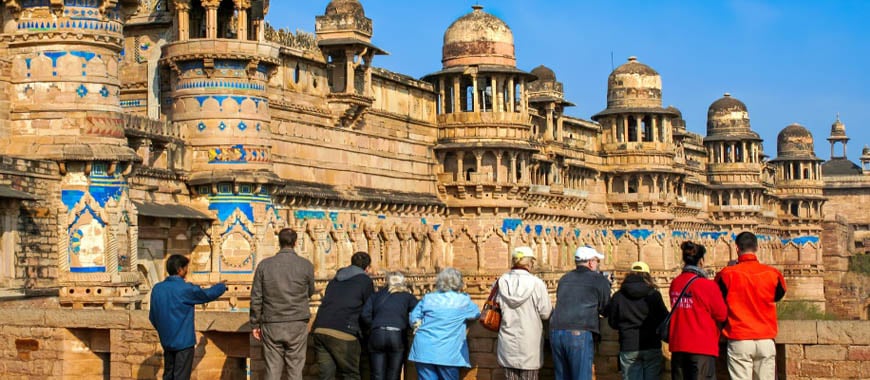
The city has been called the ‘pearl in the necklace of the forts of Hind.’ The city’s star attraction is Gwalior Fort, the administrative center of many North Indian dynasties. The rich historical past of the city is displayed through its beautiful attractions. The royal charm of Gwalior can be seen through its spectacular architecture. The rule of the Rajputs and Britishers over Gwalior is reflected in every corner of the city.
When it comes to tourist attractions, Gwalior has much to offer to all tourists. Some popular attractions of Gwalior include Phool Bagh, Suraj Kund, Hathi Pool, Man Singh Palace, and Jai Vilas Palace. The Tansen music festival, organized yearly in Gwalior, is also a famous attraction. The culture and tradition of Gwalior make it a popular tourist attraction in India.
Here are the Top Tourist Places in Gwalior You Must Visit on Your Trip.
1. Gwalior Fort
Popular by the name ‘the pearl amongst fortresses in India’, by Babur, a Mughal Emperor, Gwalior Fort is one of the best Gwalior tourist places. It is an impenetrable fortress in northern and southern India located atop a rocky mountain in Madhya Pradesh. This magnificent fort dominates Gwalior Tourism, attracting a large number of tourists every year. The best time to visit here is winter, as summers are harsh. Besides, the fort’s architecture is its main attraction, dating back to the 6th century. The fort was built in two parts and in two different time periods. Gwalior Fort is a complex with multiple buildings inside like Man Mandir, the Jahangir, the Gujari, the Shah Jahan, and more.
Timings – 6 am to 5.30 pm, 3-4 hours.
Entry Fee – INR 75 for Indians, INR 250 for foreigners, and Kids below 15 years entry is free.
Light and Sound Show at Gwalior Fort Timings –
- The Hindi Show starts at 7.30 pm.
- The English Show starts at 8.30 pm.
2. Jai Vilas Palace
Also known as Jai Vilas Mahal, this palace is among the top 2 tourist places in Gwalior. It is a symbol of ancient Indian culture and luxury, preserved to this date. Jayaji Rao Scindia, the Maharaja of Gwalior, commissioned to build this majestic edifice to ensure a grand welcome to King Edward VII, the then Prince of Wales in 1874. Today, the descendants of the royal Maratha Scindia family live here. The palace is open to the public in the form of a museum housing the Chitrangada Raje Art Gallery and a library that comprises more than 5,000 books. There are 35 rooms with items of historical importance that you cannot afford to miss.
Timings – 10 am to 4.45 pm (April to September), 10 am to 4.30 pm (October to March), Closed on Wednesdays, 2-3 hours.
Entry Fee – INR 100 for Indians, INR 600 for foreigners, children up to 5 years, and physically challenged entry is free.
3. Gwalior Zoo
Among the top tourist attractions in Gwalior for kids, Gwalior Zoo is not just about wildlife but also a place of rich heritage. Madhaorao Scindia established this zoo in 1922, a part of a larger garden called Phool Bagh. It houses a variety of rare animal species like golden peasants, sambhars, hyenas, bison, spotted deer, black bucks, and a white tiger. Crocodiles, monkeys, birds, and snakes are also found here. The zoo is a protected site and is taken care of by the Municipal Corporation of Gwalior. The Prince of Wales inaugurated the Phool Bagh almost 100 years ago, which continues to be well-maintained.
Timings – 10.30 am to 5 pm, Closed on Fridays, 1-2 hours
Entry Fee – INR 20 for adults, INR 5 for kids
4. Tomb of Tansen
This tomb is dedicated to Tansen, one of India’s greatest musicians. He was an eminent vocalist in the courts of Mughal Emperor Akbar in the medieval period. Tansen was also one of the nine gems of the Mughal court. He was believed to create magic with his music and even cause rain and enchanted animals. Mohammad Ghaus taught him Hindustani classical music, and he developed a Gwalior Gharana style of music. After his death, Tansen was buried near his guru, which is a marvelous architectural marvel. For the full experience, attend the annual Tansen Music Festival in November, which welcomes renowned musicians from all across the nation to perform classical shows.
Timings – 8 am to 6 pm, 1 hour
Entry Fee – Free
5. Sun Temple
Sun Temple is also called the Surya Mandir and is among the famous tourist places in Gwalior. The temple is an architectural wonder dedicated to the holy Sun God. The famous industrialist G.D. Birla established Sun Temple in 1988, taking inspiration from Konark’s Sun Temple in Odisha. Sun Temple is built with intricate architecture in red sandstone and white marble. The idol of the Sun Lord is enshrined inside the temple, and though it was not built too long ago, it is still among the most revered shrines in Gwalior, attracting devotees and tourists in masses.
Timings – 6.30 am to 12 pm, 1 pm to 6 pm, 1 hour
Entry Fee – Free
Check out our packages: Madhya Pradesh tour packages, Orchha tour packages, Jabalpur tour packages, Kanha tour packages, Bandhavgarh tour packages, Pachmarhi tour packages, Maheshwar tour packages, Khajuraho tour packages.