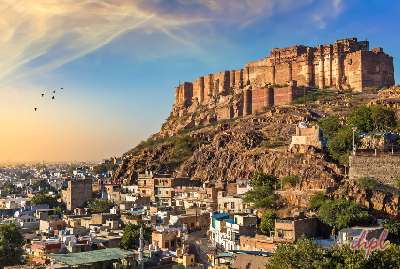
If you are looking to visit a heritage destination in Rajasthan without running through multiple monuments all day, Bikaner is the place for you.
The city offers an eclectic mix of royal monuments, merchant havelis, museums and desert festivals. The Junagarh Fort gives you the most apt introduction to Bikaner’s rich history. Beyond the centre, Deshnok, Gajner and the Camel Research Centre show very different sides of the region.
For a first visit, do not try to see everything in one day. Two days work much better. This gives you enough time for the major heritage sites, one out-of-city visit and some time in the old markets for shopping in Bikaner.
Bikaner Sightseeing at a Glance
| Planning Point | What Works Best |
|---|---|
| Ideal for | Cultural travellers, heritage lovers, families, photographers and architecture enthusiasts |
| Recommended stay | 2 nights |
| Minimum time | 1 full day for the main city attractions |
| Better pace | 2 days including Deshnok or Gajner |
| Best time to visit | October to March |
| Guide | Useful at Junagarh Fort and during an old-city heritage walk |
| Main priority | Junagarh Fort, old-city havelis and one temple or museum |
| Outside-city stops | Karni Mata Temple, Gajner Palace and National Research Centre on Camel |
Places to See in Bikaner
• Forts, Palaces and Royal Heritage
1. Junagarh Fort
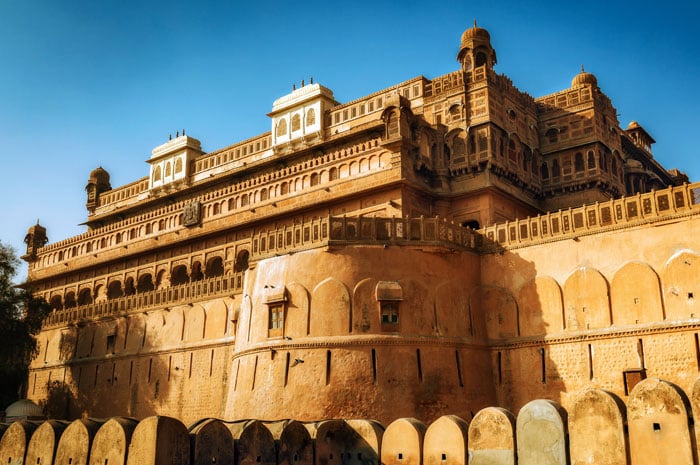
If you have time to explore just one monument in Bikaner, make sure you choose the Junagarh Fort.
Unlike many of the great forts of Rajasthan, Junagarh lies on the plains rather than a hill. It is said that Raja Rai Singh began the construction of the Fort in the late 16th century, but later rulers added many palaces, halls and courtyards over the course of time. Rajasthan Tourism describes its interiors as a rich mix of red sandstone, marble, balconies, courtyards and decorated palace spaces.
Once inside, look for areas to explore such as Anup Mahal, Karan Mahal, Phool Mahal and Chandra Mahal.
Do not rush the interiors. Gold work, painted ceilings, mirrors and carved details are often more interesting than the fort’s size itself.
- Best for: First-time visitors, architecture and royal history
- Time needed: Around 1.5 to 2 hours
- Timings: 10:00 AM – 4:30 PM
- Entry fee: ₹50 Indian adult; ₹300 foreign visitor
- Pair with: Ganga Government Museum or Lalgarh Palace
2. Lalgarh Palace and Sadul Museum
Lalgarh Palace belongs to a later chapter of Bikaner’s royal history.
Maharaja Ganga Singh commissioned the construction of this red sandstone structure in honour of his father, Maharaja Lal Singh. The architecture combines Rajput, Mughal and European influences. Today, parts of the complex serve as heritage accommodation and royal residence, while the Sadul Museum preserves photographs and objects linked with Bikaner’s rulers.
Do not expect to walk freely through the entire palace. Visitor access is mainly connected with the museums in Bikaner and designated areas.
- Best for: Travellers interested in Bikaner’s later royal period
- Time needed: About 45 to 60 minutes
- Typical visitor hours: Around 10:00 AM–5:00 PM
- Entry fee: Published museum rates vary. Allow roughly ₹20 – 30 for Indian visitors and confirm the current foreign visitor rate at the counter.
- Pair with: Junagarh Fort
If you have limited time, prioritise Junagarh. Lalgarh works better as a second royal stop.
Devi Kund Sagar
Devi Kund is quieter than Bikaner’s main palaces.
It is the royal cremation ground of the former Bikaner ruling family. The site contains a series of chhatris, or cenotaphs, built in sandstone and marble. Rajasthan Tourism highlights the cenotaph of Maharaja Surat Singh as a notable example here.
This is a good stop for travellers who enjoy memorial architecture and places away from the main sightseeing crowds.
- Best for: Architecture, photography and quieter heritage
- Time needed: 30 – 45 minutes
- Timings: Around 8:00 AM–6:00 PM
- Entry fee: Free in current visitor listings
- Pair with: Camel Research Centre or an excursion towards Deshnok
Late afternoon works particularly well because the softer light brings out the colour of the sandstone.
• Old Bikaner: Havelis and Painted Heritage
3. Rampuria Havelis
Bikaner’s old city tells a different story from its royal palaces.
The Rampuria Havelis were built by prosperous merchant families. Their red-sandstone façades have carved jharokhas, narrow columns, arches and detailed latticework. Rajasthan Tourism and Incredible India both highlight them among Bikaner’s important heritage structures.
The best experience is not about entering one building.
Walk through the lanes slowly. Look at the façades, doors and balconies. Notice how closely the merchant homes sit within the old neighbourhood.
Most of the havelis remain private or have limited internal access.
- Best for: Architecture, photography and cultural travellers
- Time needed: 30 – 60 minutes for the old-city area
- Timings: Public lanes can be explored during daylight
- Entry fee: No standard fee for viewing the exteriors
- Pair with: Bhandasar Jain Temple and Bada Bazaar
• Temples and Spiritual Heritage
5. Bhandasar Jain Temple
Bhandasar Jain Temple offers some of Bikaner’s finest painted interiors.
The temple is dedicated to Sumatinath, the fifth Jain Tirthankara. Its walls and ceilings feature detailed paintings, gold work and decorative patterns. It is among the finest temples in Bikaner.
For travellers who enjoy the painted interiors of Rajasthan’s palaces and temples, this is worth adding after the old-city havelis.
- Best for:Art, religious architecture and cultural travellers
- Time needed: Around 30 minutes
- Timings: Approximately 5:30 AM – 11:30 AM and 5:30 PM – 8:30 PM
- Entry fee: Free
- Pair with: Rampuria Havelis and Shri Laxminath Temple
Remember that this is an active Jain temple. Dress modestly, remove footwear when required and avoid disturbing prayers.
6. Shri Laxminath Temple
Shri Laxminath Temple is one of Bikaner’s important historic Hindu temples.
This temple is dedicated to Lord Vishnu and his consort Goddess Lakshmi. It is an active place of worship, and the ambience significantly differs from Bikaner’s museum-like monuments.
Add it to your itinerary if religious history interests you or if you are already exploring the older part of the city.
- Best for: Spiritual heritage and families
- Time needed: Around 20–30 minutes
- Timings: Approximately 5:00 AM – 1:00 PM and 5:00 PM – 11:00 PM
- Entry fee: Free
- Pair with: Bhandasar Jain Temple
Early morning or evening prayer time gives the strongest sense of the temple as a living religious place.
7. Karni Mata Temple, Deshnok
Karni Mata Temple is about 30 km from Bikaner in Deshnok.
The temple is famous for thousands of rats living inside the temple premises. Devotees consider them sacred, and Rajasthan Tourism describes them as kabas and celebrates the temple’s unusual religious tradition.
This is not simply an unusual tourist stop. It remains an important place of worship.
Some travellers find the experience fascinating. Others may be uncomfortable with rats moving freely across the temple floor.
Know what to expect before you go.
- Best for: Religious culture and travellers interested in unusual living traditions
- Time needed: Around 45 minutes at the temple, plus travel from Bikaner
- Timings: Current visitor information commonly lists about 4:00 AM–10:00 PM
- Entry fee: Free
- Pair with: A morning or evening excursion from Bikaner
8. Bhandasar Jain Temple
• Museums and Cultural Context
9. Ganga Government Museum
The Ganga Government Museum is useful if you want more context after seeing the forts and temples.
Its collections include sculpture, inscriptions, miniature paintings, terracotta, arms, coins, textiles and regional craft objects. Rajasthan’s official museum portal confirms the current visitor details.
It is especially useful for a two-day visit because it helps connect Bikaner’s architecture with the wider history and art of the region.
- Best for: History, archaeology and art
- Time needed: Around 45–60 minutes
- Timings: 9:45 AM – 5:15 PM
- Entry fee: ₹20 Indian adult; ₹100 foreign adult; concessions apply to students
- Pair with: Junagarh Fort
• Bikaner’s Camel Heritage
10. National Research Centre on Camel
Camels are closely tied to Bikaner’s identity.
The National Research Centre on Camel lies about 8 km from the city. Rajasthan Tourism describes it as a major research and breeding centre where visitors can learn about different camel breeds and try camel-milk products.
This works particularly well for families and travellers who want some variety after forts and temples.
It is not a conventional zoo. The centre is primarily a working research institution.
- Best for: Families, animal interests and desert culture
- Time needed: Around 1 – 1.5 hours
- Visitor hours: Commonly listed around 2:00 PM–6:00 PM; Sunday and public-holiday closures are widely reported
- Entry fee: Published visitor rates are around ₹20 for Indians and ₹50 for foreign visitors, but current rates should be reconfirmed before visiting.
- Pair with: Devi Kund or a relaxed afternoon
Afternoon works best because visitor access is generally scheduled later in the day.
If You Have Extra Time: Gajner Palace and Lake
Gajner lies around 32 km from Bikaner.
The palace stands beside Gajner Lake and was once used as a royal hunting and leisure retreat. It now operates as a heritage hotel. Rajasthan Tourism also highlights the surrounding sanctuary for chinkara, nilgai, blackbuck, wild boar and winter birdlife.
This is not essential for a short first visit to Bikaner.
Add it when you have an extra half day or want a quieter lakeside experience after the city.
- Best for: Couples, heritage stays, birdlife and slower travel
- Time needed: Around 2 hours plus travel
- Visitor hours: Commonly listed around 10:00 AM – 5:00 PM
- Entry fee: Around ₹100 in recent visitor listings; confirm directly before travelling because the palace operates as a hotel.
Quick Guide to Timings and Entry Fees
The fees and timings below reflect the current official or available 2026 visitor information. They are subject to change, especially at privately managed sites.
| Attraction | Timings | Entry Fee |
|---|---|---|
| Junagarh Fort | 10:00 AM–4:30 PM daily | ₹50 Indian; ₹300 foreign visitor |
| Lalgarh Palace / Sadul Museum | Around 10:00 AM–5:00 PM; museum closure day should be confirmed | Approx. ₹20–30 Indian; foreign visitor rates vary by current access |
| Rampuria Havelis | Exterior best seen in daylight | No fee for walking the public lanes; most interiors are private |
| Ganga Government Museum | 9:45 AM–5:15 PM | ₹20 Indian adult; ₹100 foreign adult |
| Bhandasar Jain Temple | Approx. 5:30 AM–11:30 AM and 5:30 PM–8:30 PM | Free |
| Shri Laxminath Temple | Approx. 5:00 AM–1:00 PM and 5:00 PM–11:00 PM | Free |
| Karni Mata Temple, Deshnok | Around 4:00 AM–10:00 PM | Free |
| Devi Kund Sagar | Around 8:00 AM–6:00 PM | Free |
| National Research Centre on Camel | Usually around 2:00 PM–6:00 PM; closed Sundays/public holidays | Published rates are about ₹20 Indian / ₹50 foreign visitor; reconfirm |
| Gajner Palace & Lake | Visitor access commonly listed around 10:00 AM–5:00 PM | Around ₹100; confirm directly as it operates as a heritage hotel |
Best Time to Visit Bikaner Tourist Attractions
October to March is the best time to visit Bikaner.
Days are easier for walking through forts, markets and the old city. Evenings can become cool during winter, so a light layer is useful.
November to February works well if you prefer long outdoor sightseeing days. Try to visit Junagarh Fort close to opening time for the best experience.
Set aside old-city walks for the morning or late afternoon, and plan outdoor excursions before the stronger midday heat whenever possible.
In January, Bikaner’s Camel Festival can add another cultural layer to your trip, although dates are subject to change each year and accommodation can become busier around the festival.
Rajasthan Tourism organises the event as a celebration of the region’s camel traditions.
Shopping in Bikaner
Shopping fits naturally at the end of a sightseeing day, especially around the old city.
Kote Gate
Kote Gate is one of the main traditional market in Bikaner.
You will find textiles, leather goods, handicrafts and local food products. Kote Gate is known for leather goods as well as its handicrafts.
This is a good market if you want to browse rather than go to a single showroom.
Bada Bazaar
Bada Bazaar is another useful stop for textiles and jewellery.
It can be combined with an old-city walk and visits to Bhandasar Jain Temple or the haveli lanes. Incredible India identifies both Bada Bazaar and Kote Gate as important markets for textiles and jewellery.
Khari Bazaar
Khari Bazaar is better known for spices and everyday local shopping.
It feels less like a tourist showroom and more like a working market. Incredible India’s current Bikaner guide highlights it for aromatic spice shops.
What Is Worth Buying in Bikaner?
Rajasthan Tourism recommends products such as:
- Bikaneri-style mojaris
- Textiles and colourful dupattas
- Lac bangles
- Kundan-style jewellery
- Carpets
- Wooden decorative objects
- Camel-hide crafts
- Bikaneri sweets and savouries
If you are a traveller looking for unique finds, Usta art will definitely interest you. A detailed decorative tradition strongly associated with Bikaner. Incredible India notes that examples can still be found in local handicraft shops.
And if you are taking food home, Bikaneri Bhujia is more than a famous local snack. It is a registered Geographical Indication, with its GI registration currently valid until October 2028.
Shopping Tip
Here are a few tips for a smooth shopping experience in Bikaner.
- Do not judge handmade pieces only by price.
- For jewellery, leatherwork or Usta pieces, ask what material has been used and where the piece was made.
- For bhujia and sweets that need to travel, choose sealed packaging and check the shelf life before buying
Food and Culture
The food culture of Bikaner is worth exploring!
When you look beyond bhujia, you will find that the city is also famous for peppy snacks and sweetmeats like kachori, samosa, rasgulla and traditional Rajasthani meals. Incredible India’s current destination guide also recommends dishes such as dal baati churma and regional thalis.
You may find these delicacies at a local snack stop during an old-city walk, and proper Rajasthani meals at local restaurants.
Practical Travel Tips
Continue Planning Your Bikaner Visit
Bikaner works best when you allow its different layers to unfold rather than treating it as a quick stop between Jaipur and Jaisalmer.
Start with the royal history of Junagarh. Give the old city time for its havelis, temples and markets. Then choose one experience outside the centre based on what interests you most – Karni Mata Temple for living religious culture, the Camel Research Centre for Bikaner’s desert heritage, or Gajner for a quieter lakeside setting.
If Bikaner forms part of a longer Rajasthan journey, explore the relevant Rajasthan Tour Packages to see how it can fit naturally with Mandawa, Jaisalmer, Jodhpur or Jaipur without creating unnecessary travel.