
Rajasthan fairs and festivals are renowned for celebrating the state’s vibrant colours, folk music and rich cultural heritage. But would you plan your trip around them?
Some events, such as the Pushkar Fair or Jaisalmer Desert Festival, can justify planning travel dates around them. Others work better as an extra experience when you are already staying in Jaipur, Udaipur, Jodhpur, Bikaner or Bundi.
Festival dates are often accompanied by dull hotels, busy roads, and lots of traffic diversions. But they can also give you access to processions, folk music, rural fairs and religious traditions that you would not see on an ordinary day.
The best approach is to choose one festival that fits a Rajasthan journey you already want to take, then give that place enough time before or after the event for regular sightseeing.
Note: Many Rajasthan festivals follow religious or lunar calendars, and tourism-event schedules can change. Always confirm the final dates with Rajasthan Tourism before booking flights and hotels.
Which Rajasthan Festival Suits Your Trip?
| What You Want to Experience | Festival to Consider | Where | Usual Period |
|---|---|---|---|
| Rural fair and livestock culture | Pushkar Fair | Pushkar | October–November |
| Desert culture and folk performances | Desert Festival | Jaisalmer | January–February |
| Camel traditions | Bikaner Camel Festival | Bikaner | January |
| Royal procession and women’s traditions | Gangaur | Jaipur and Udaipur | March–April |
| Spring culture beside the lakes | Mewar Festival | Udaipur | March–April |
| Monsoon procession | Teej | Jaipur | July–August |
| Smaller regional Teej celebration | Kajli Teej | Bundi | August–September |
| Marwar folk culture | Marwar Festival | Jodhpur region | September–October |
| Heritage town festival | Bundi Festival | Bundi | October–November |
| Music and dance at a fort | Kumbhalgarh Festival | Kumbhalgarh | December |
| Tribal religious gathering | Baneshwar Fair | Dungarpur region | Around February |
| Pilgrimage and lake fair | Kolayat Fair | Near Bikaner | October–November |
Who Gets the Most From Festival Travel in Rajasthan?
Festival-based travel works particularly well for people who enjoy living culture rather than quiet sightseeing alone.
It can suit:
- Travellers interested in photography, music and local traditions
- Couples building cultural experiences into a Rajasthan journey
- Families who prefer organised viewing and reliable transport
- Repeat visitors who have already seen Rajasthan’s main forts and palaces
- International travellers who want a deeper view of local life
- Travellers comfortable with some crowds in exchange for a more time-specific experience
Major Festivals of Rajasthan
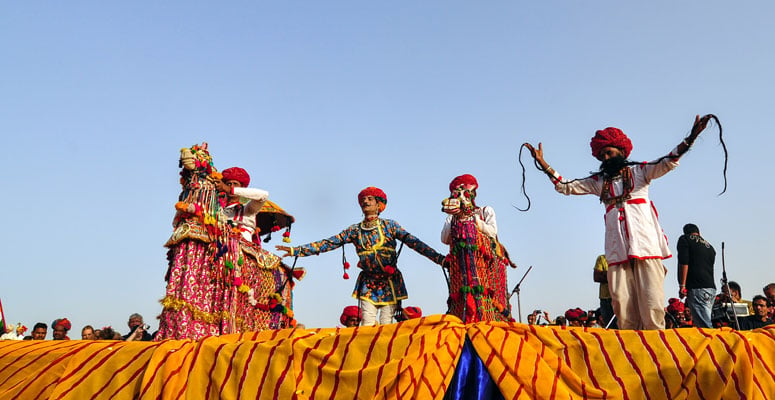
A festival should not simply be added as another sightseeing stop. Large events can change the rhythm of the destination.
Pushkar Fair
Best for: Cultural travellers, photographers and travellers interested in rural Rajasthan
Usual period: October – November
How long to stay: Around 2 nights, longer if the fair is a major trip focus
The Pushkar Fair combines several experiences in one small town.
It remains a camel and livestock fair, but it is also linked with pilgrimage, public competitions and tourism events. Rajasthan Tourism describes it as one of the world’s largest livestock fairs and confirms that trading remains an important part of the event.
Pushkar also has a strong religious identity. Kartik Purnima draws pilgrims to Pushkar Lake and the Brahma Temple, so the feel of the town changes as the religious part of the festival reaches its peak.
How to experience it better
- Livestock activity, public competitions and pilgrimage gatherings can create different experiences across the event period.
- If photography and rural fair activity matter most, align your stay with the livestock and public-event days.
- If religious culture is your main interest, the period around Kartik Purnima has greater significance.
Desert Festival, Jaisalmer
Best for: Desert culture, folk performances and first-time Jaisalmer visitors
Usual period: January – February
How long to stay: 2 – 3 nights in Jaisalmer
The Desert Festival is one of the easier Rajasthan events to combine with a normal sightseeing trip.
The Rajasthan Tourism Department organises the three-day festival around Jaisalmer’s desert setting. Folk music, dance, puppetry, camel events and public competitions form part of the programme.
It works best for travellers who already want to visit Jaisalmer or explore Jaisalmer desert safari tour packages.
Bikaner Camel Festival
Best for: Camel heritage, families and travellers exploring western Rajasthan
Usual period: January
How long to stay: 1 – 2 nights
Bikaner’s Camel Festival focuses on the animal that has long been closely linked with life in this part of Rajasthan.
Rajasthan Tourism currently describes it as an annual January event dedicated to the camel. The next listed edition is scheduled for the second weekend of January 2027.
The event can include camel displays and cultural programmes, but its greatest value is when it is combined with Bikaner’s wider heritage.
Gangaur Festival
Best for: Religious culture, processions and travellers visiting Jaipur or Udaipur in spring
Usual period: March – April
Gangaur is one of Rajasthan’s important traditional festivals.
It centres on the worship of Gauri, or Goddess Parvati, and has particular significance for women. Celebrations take place across Rajasthan, but Jaipur and Udaipur are two of the easiest places for travellers to experience the public side of the festival.
In Jaipur, a traditional procession moves through the old city.
Udaipur gives the celebration a different setting around its lakes and the Mewar cultural tradition.
Mewar Festival, Udaipur
Best for: Spring travel, music, cultural performances and couples
Usual period: March – April
The Mewar Festival is closely associated with Udaipur and the arrival of spring.
It overlaps with the wider Gangaur period and brings processions and cultural activity into the city. Rajasthan Tourism identifies Udaipur as the main setting for the event.
This is an example of a festival that works best as an addition to a Udaipur stay, not as the only reason to travel to Rajasthan.
If the dates match naturally, keep three nights in Udaipur rather than forcing the event into a one-night stop.
Teej Festival, Jaipur
Best for: Monsoon culture, old-city processions and travellers comfortable with crowds
Usual period: July – August
Teej changes the look and feel of Jaipur’s old city.
Rajasthan Tourism describes a royal procession of Teej Mata that moves from the City Palace area through Tripolia Bazaar and Chhoti Chaupar. Camels, folk performers, traditional palanquins and chariots form part of the public procession.
It is also closely linked with women’s traditions, monsoon celebrations and seasonal food such as ghevar.
Kajli Teej, Bundi
Best for: Smaller-town festival atmosphere and travellers already visiting Bundi
Usual period: August – September
Kajli Teej gives travellers a more regional version of the Teej season.
Rajasthan Tourism describes it as a celebration closely associated with Bundi, with traditional clothing, local fairs, handicrafts and public festivities.
It suits travellers who are interested in seeing Bundi’s palace paintings and stepwells as well as a local celebration.
Marwar Festival, Jodhpur
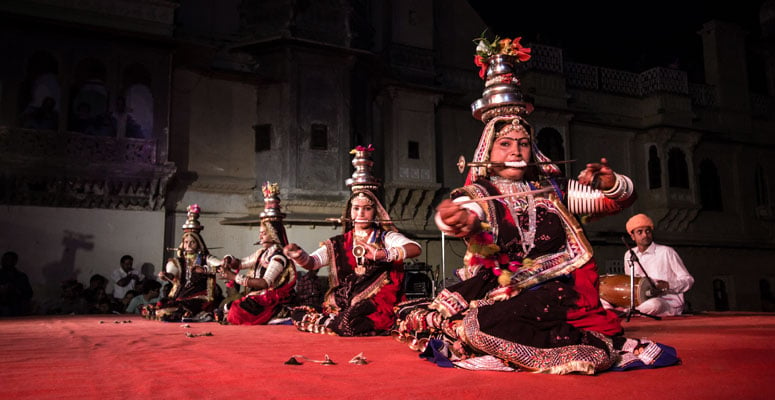
Best for: Folk music, Marwar traditions and travellers already visiting Jodhpur
Usual period: September – October
Marwar Festival focuses on the music and stories of the Marwar region.
It was originally known as the Maand Festival. Rajasthan Tourism links the event with folk music and performances celebrating Rajasthan’s heroes and currently lists festival activity around Jodhpur and Osian.
This works naturally as part of a Jodhpur stay.
Keep Mehrangarh Fort and your main sightseeing separate from the festival programme rather than trying to fit both into the same few hours.
Bundi Festival
Best for: Art, crafts and travellers who prefer smaller heritage towns
Usual period: October – November
Bundi Festival brings processions, craft displays, cultural performances and traditional competitions into one of Rajasthan’s quieter heritage towns.
Rajasthan Tourism currently describes the programme as including a Shobha Yatra, arts and crafts, traditional sports, music and dance.
The festival is best treated as a reason to extend a stay in Bundi, not rush into town for a day event.
Garh Palace, Chitrashala and the stepwells are the stronger reason for staying. The festival then adds another cultural layer.
Kumbhalgarh Festival
Best for: Heritage settings, music and dance
Usual period: 1 – 3 December
This festival has one clear advantage: the setting.
Kumbhalgarh Fort forms the backdrop for several days of cultural performances. Rajasthan Tourism divides the event between daytime folk activities and evening music or dance programmes.
It works especially well when Kumbhalgarh is already part of a Udaipur – Ranakpur route.
Baneshwar Fair, Dungarpur Region
Best for: Travellers with a serious interest in tribal and religious culture
Usual period: Around February
Baneshwar is very different from Pushkar or a tourism-led city festival.
Rajasthan Tourism describes it as an important tribal fair held around the confluence of the Mahi, Som and Jadkham rivers, drawing communities from Rajasthan as well as neighbouring states.
Visitors should arrive with respect for the event rather than treat it as a staged cultural attraction.
The area is also more rural than Jaipur, Jodhpur or Udaipur.
Choose it if the fair itself genuinely interests you and you are comfortable with simpler on-ground conditions.
It fits most naturally into a Udaipur – Dungarpur journey.
Rajasthan International Folk Festival – RIFF
UNESCO-endorsed as the People’s Platform for Creativity and Sustainable Development. A five-day folk and world music festival at Mehrangarh Fort bringing together Rajasthani folk legends with international artists from Hungary, Brazil, Australia, France, and beyond. Dawn concerts on the ramparts, midnight jam sessions in the fort courtyards, cross-genre collaborations, and informal workshops.
Signature experiences: Living Legends series featuring Manganiyar and Langa musicians, international fusion performances, sunrise ragas overlooking Jodhpur’s blue city from the fort ramparts.
Planning notes: 3 – 4 nights in Jodhpur for RIFF, extended to 7 – 8 days with Jaisalmer or Udaipur. Being inside Mehrangarh Fort for a sunrise concert is one of the strongest festival experiences in Rajasthan. October is peak season – book accommodation 2 – 3 months ahead.
Practical Planning for Rajasthan Festival Travel
- Confirm dates before fixing flights
- Book important stays early
- Allow extra movement time
- Give major festivals an extra night
- Expect different crowd levels within the same festival
- Plan around comfort
- Photographers are advised to arrive early when the event involves a fairground or open public space.
- Follow cultural etiquette – Dress modestly around temples, shrines and ghats.