








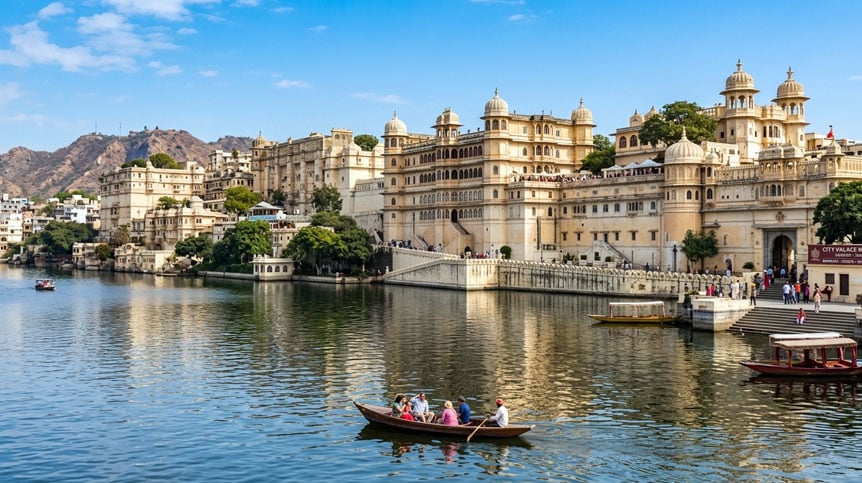

Udaipur’s museums are most rewarding for travellers who want cultural depth beyond lakeside photography and palace exteriors. While the City Palace Museum is the essential starting point for understanding Mewar history, other museums in Udaipur work very differently — Ahar Museum rewards archaeology-focused travellers, Shilpgram is strongest for craft and rural culture experiences, Bagore ki Haveli works best as an evening performance venue, and Crystal Gallery appeals more to travellers interested in royal lifestyle and unusual collections than traditional museum exhibits.
Which Museum in Udaipur Deserves Your Time?
| If You Want… | Best Choice |
|---|---|
| Udaipur’s strongest overall museum | City Palace Museum |
| Archaeology and ancient artifacts | Ahar Museum |
| Living craft and artisan culture | Shilpgram |
| Evening folk performance | Bagore ki Haveli |
| Royal luxury collections | Crystal Gallery |
| Folk art and puppetry | Bhartiya Lok Kala Mandal |
| Automotive history | Vintage Car Museum |
| Limited time in Udaipur | City Palace Museum + Dharohar Show |
| Family-friendly cultural stop | Shilpgram |
City Palace Museum (Pratap Museum)
The most significant museum in Udaipur and one of the finest palace museums in India, housed within the City Palace complex on the banks of Lake Pichola. Built over three centuries by successive Mewar rulers, the museum is segmented into a series of palace sections, each with a distinct character.
Best for: First-time Udaipur visitors, royal-history travellers, architecture lovers, and anyone wanting the strongest overview of Mewar heritage.
Key spaces:
Mor Chowk — The dining courtyard with five peacock statues covered in glass inlay work, built with 500 mosaic tiles in unique patterns.
Mardana Mahal and Zenana Mahal — Separate palace sections for royal men and women, each with distinct decorative programs reflecting the gendered social organisation of the Mewar court.
Badi Mahal (Garden Palace) — 104 pillars carved from local marble with intricately fixed marble tile ceilings.
Rajya Angan (Royal Courtyard) — Gallery dedicated to Maharana Pratap with original armour and weapons used in battle.
Kanch ki Burj — Small dome building with a ceiling entirely covered in glass and mirrors.
Bhim Vilas and Krishan Vilas — Galleries housing exquisite 18th and 19th-century miniature paintings of the Mewar school.
Zenana Palace — Adorned with swings, balconies, frescoes, and alcoves.
The museum also houses ancient sculptures, antiques, inscriptions, rare Rajasthani murals, glass inlay work, and Mewar school court paintings. The sound and light show “The Legacy of Honour” at Manek Chowk runs 7–8 PM — a strong evening add-on.
Timings: 9:30 AM–5:30 PM. Closed Sundays.
Reconfirm current closure days and ticket structure before visiting because schedules and operational policies occasionally change.
Worth dedicated time? Yes — this is the one museum in Udaipur that genuinely deserves half a day if you are interested in Rajasthan’s royal history.
Travellers with limited time should prioritize Mor Chowk, Rajya Angan, the miniature painting galleries, and lake-facing palace sections rather than trying to examine every palace chamber in detail.
Ahar Museum (Ahar Cenotaphs)
Located adjacent to the cenotaphs of the Maharanas of Mewar — over 250 cenotaphs built from white marble and red sandstone representing the royal ancestry — the Ahar Museum is one of the most archaeologically significant stops in Udaipur. The collection spans artefacts dating back 5,000 years, excavated by the Archaeological Department of Rajasthan.
Best for: Archaeology-focused travellers, history enthusiasts, and visitors interested in understanding the deeper historical roots of the Mewar region beyond royal palaces.
Excavations around Ahar and nearby Dhulkot revealed evidence of one of Rajasthan’s earliest settled cultures, including pottery, copper objects, and ancient habitation remains dating back several thousand years.
Timings: 9:30 AM–5:30 PM.
Worth dedicated time? Yes, for travellers interested in archaeology and dynastic history; otherwise, best combined with nearby cenotaph exploration rather than visited as a standalone museum stop.
Comfort note: The cenotaph complex involves moderate walking in exposed sunlight, especially uncomfortable in peak summer afternoons.
Shilpgram Museum
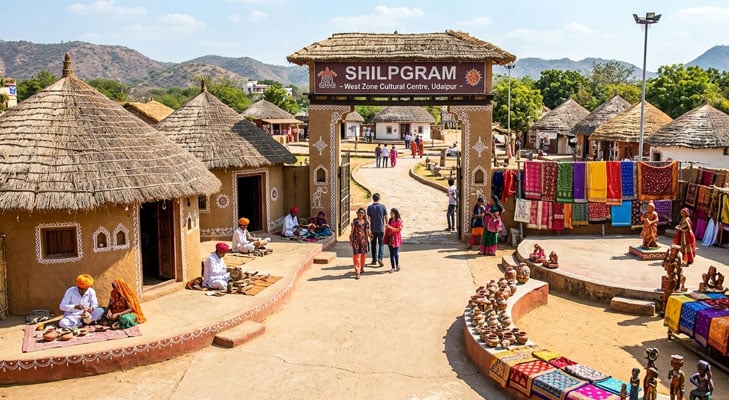
A living ethnographic exhibition spread across 70 acres in Havala Village near Udaipur — one of the most distinctive cultural museum experiences in Rajasthan. Shilpgram is not a conventional museum but a craft village featuring thematic huts designed to match the geography and ethnicity of different communities across western India. Two museums within the village exhibit objects of daily rural and tribal life crafted by local artisans.
Best for: Families, craft lovers, photographers, slower cultural travellers, and visitors wanting a more interactive cultural experience than a conventional museum.
The village specifically aims at preserving awareness about rural life and crafts for younger generations — workshops for children in hands-on arts, theatre, and music are a consistent programme. Pottery, stone carvings, wooden furniture, paintings, and traditional clothing are available to purchase directly from craftspeople. The Shilpgram Crafts Mela in December (21–31) transforms the village into its most vibrant state — 10 days of artisan demonstrations and selling. The complex recreates traditional village architecture from Rajasthan, Gujarat, Maharashtra, and Goa through region-specific huts and workshop spaces.
Worth dedicated time? Yes — especially during the December Shilpgram Crafts Mela, when artisan demonstrations and folk performances make it one of Rajasthan’s strongest living-culture experiences.
Location: Havala Village, near Udaipur.
This is, arguably, one of the most family-friendly museum experiences in Udaipur because of its open layout, workshops, and live artisan interaction.
Bagore ki Haveli Museum
Bagore ki Haveli functions less as a traditional museum and more as an atmospheric heritage-and-performance venue overlooking Lake Pichola at Gangaur Ghat. While the haveli interiors contain royal costumes, puppet displays, and cultural artefacts, the evening Dharohar folk performance is the real reason most travellers should prioritise it.
Best for: Evening cultural experiences, folk performance lovers, photographers, and travellers staying around Lake Pichola.
Timings: 9 AM–5 PM. Dharohar show: Evening — confirm timings locally.
Worth dedicated time? Yes, if attending the Dharohar show; otherwise, the museum interiors alone are less essential than the City Palace Museum.
Vintage and Classic Car Museum
An exquisite collection of vintage and classic vehicles once owned by the Maharajas of Udaipur — Cadillac, Morris, Chevrolet, and other luxury automobiles that served as royal transportation.
Best for: Automotive-history enthusiasts, royal-lifestyle travellers, and visitors specifically interested in vintage luxury vehicles.
Worth dedicated time? Optional unless classic cars or royal transportation history strongly interest you.
Location: Fateh Vilas, near Hotel Fateh Garh, Bujra, Udaipur.
Timings: 9 AM–7:30 PM.
Bhartiya Lok Kala Mandal
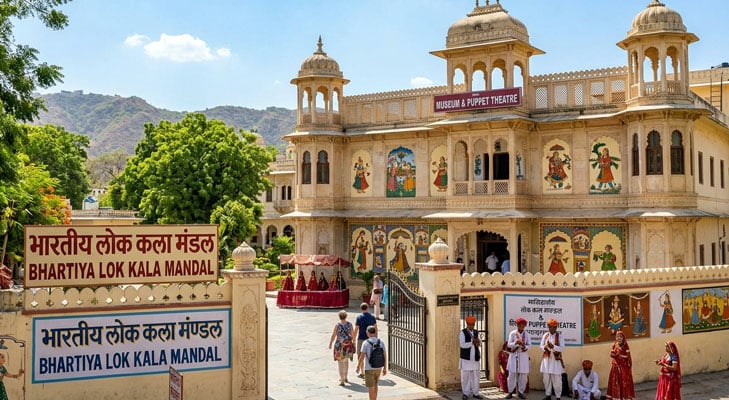
Near Chetak Circle. Exhibits traditional garments, ritual pots, dolls, wall sculptures, paintings, and puppets — a comprehensive display of Rajasthan’s folk artistic heritage. Folk dance performances on Friday, Saturday, and Monday evenings (7:15–8:30 PM) make it a strong cultural evening option.
Best for: Travellers interested in puppetry, folk music, traditional performance, and Rajasthan’s rural artistic traditions.
Established in 1952 by Devi Lal Samar, the institution became one of Rajasthan’s most important centers for preserving folk performance traditions.
Timings: 9 AM–5:30 PM. Performance evenings extended.
Worth dedicated time? Mainly if you attend the evening folk performance, otherwise better treated as a shorter cultural stop.
Moti Magri Museum
Located on a hill near Fateh Sagar Lake, Moti Magri is better understood as a memorial-and-viewpoint stop than a conventional museum. The centrepiece is the large bronze statue of Maharana Pratap mounted on Chetak, alongside displays and battlefield models connected to the Battle of Haldighati.
Best for: Travellers interested in Maharana Pratap history and visitors already exploring Fateh Sagar Lake.
Timings: 8 AM–8 PM.
Worth dedicated time? No — best treated as a short stop within the Fateh Sagar circuit rather than a standalone museum visit.
Crystal Gallery
One of the most unusual museum experiences in Udaipur — a collection of furniture made entirely of crystal glass, including beds, chairs, sofas, and tables, secretly commissioned by Maharaja Sajjan Singh in 1877 from F&C Osler of England. The collection arrived after the Maharaja’s death and was never used during his lifetime, giving it an unusual poignancy alongside its visual spectacle.
The gallery is famous not only for the crystal furniture itself but also for the strange historical detail that most of the collection remained unused after Maharana Sajjan Singh died before it arrived from England.
Timings: 9 AM–7:30 PM.
Best for: Luxury-history travellers, decorative-arts enthusiasts, and visitors interested in royal eccentricity rather than conventional museum collections.
Worth dedicated time? Optional for short Udaipur stays because of the high entry fee, but memorable for travellers interested in unusual royal collections.
Tribal Research Institute Museum
The Tribal Research Institute Museum focuses on the indigenous communities of southern Rajasthan, including Bhil, Garasia, Sahariya, and Meena tribal groups. Exhibits include traditional clothing, jewellery, tools, musical instruments, paintings, masks, and ritual objects.
Best for: Anthropologically interested travellers, cultural researchers, and visitors wanting a deeper understanding of Rajasthan beyond royal heritage.
Worth dedicated time? Yes, for travellers interested in tribal culture; optional for standard first-time Udaipur itineraries.
Solar Observatory (Specialist Interest)
Located on an island in Fateh Sagar Lake, the Udaipur Solar Observatory is one of India’s most unusual scientific institutions and is modelled partly on the solar observatory at Big Bear Lake in California. This is a specialist-interest stop rather than a mainstream museum experience.
How to Plan Udaipur’s Museum Circuit
Essential Heritage Circuit
City Palace Museum → Lake Pichola → Bagore ki Haveli Dharohar show.
Archaeology & Royal History Route
Ahar Museum and cenotaphs → City Palace Museum → Moti Magri.
Craft & Folk Culture Route
Shilpgram → Bhartiya Lok Kala Mandal evening performance.
Specialist Museums Route
Crystal Gallery → Vintage Car Museum → Tribal Research Institute Museum.
Planning Notes
City Palace Museum is the essential museum experience in Udaipur.
Bagore ki Haveli is strongest when combined with the Dharohar folk show.
Crystal Gallery has the highest museum fee and works best for specialist-interest travellers.
Shilpgram becomes significantly more rewarding during the December Crafts Mela.
Folk performances at Bhartiya Lok Kala Mandal operate only on select evenings — verify schedules locally.
October to March offers the most comfortable museum and walking conditions.
Reconfirm current timings and fees before visiting because schedules occasionally change.
Continue Planning Your Udaipur Heritage Trip
Travellers exploring Udaipur’s museums often combine them with palace circuits, lakeside heritage walks, folk performances, and wider Rajasthan cultural routes.


