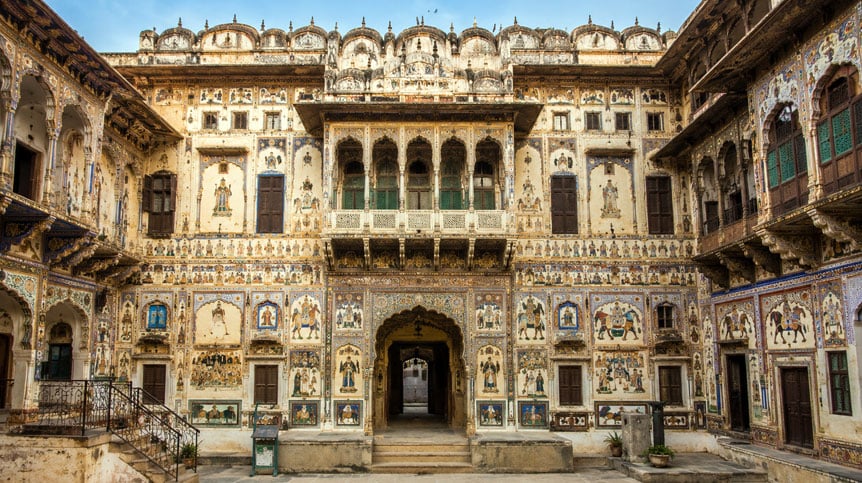

Bansidhar Newatia Haveli works best for travellers who want Mandawa to feel like more than a quick photo stop. It is one of those haveli visits where the value comes from slowing down, looking closely at the painted surfaces, and understanding how Shekhawati’s merchant homes carried stories through frescoes, façades, courtyards, and everyday architectural details.
This is not a site to isolate oneself from the rest of Mandawa. It makes more sense as part of a focused haveli walk, especially for travellers interested in painted havelis, old merchant architecture, Shekhawati frescoes, photography, and slow heritage exploration.
Why does this haveli matter?
Bansidhar Newatia Haveli matters because it represents the painted haveli culture that defines Mandawa’s heritage identity. In Shekhawati, havelis were not just private homes. They were also visual statements of merchant success, family pride, artistic taste, and exposure to the wider world.
For travellers, the important point is this: not every Mandawa haveli offers the same experience.
Some havelis are better for scale.
Some are better for façade photography.
Some are more rewarding for fresco details.
Some help you understand the old-town setting better.
What the visit experience is like
The experience at Bansidhar Newatia Haveli is quiet, observational, and detail-focused. Do not expect the scale of a fort or the polish of a fully restored palace. The charm here is more subtle.
You are likely to spend your time looking at painted walls, façade details, old residential features, and the way the haveli sits within Mandawa’s historic lanes. Depending on access at the time of visit, some parts may be easier to appreciate from outside, while interiors may depend on local arrangements or caretaker availability.
What makes the visit rewarding:
The painted surfaces offer a closer look at the Shekhawati fresco traditions.
The old-town setting helps you understand how these homes formed part of Mandawa’s merchant neighbourhoods.
The details become more meaningful when compared with nearby havelis.
The site works well for travellers who enjoy heritage photography, textures, façades, and architectural storytelling.
How much time to spend here
You do not need to keep a large block of time for the Bansidhar Newatia Haveli, but it deserves more than a passing glance if frescoes interest you.
Quick look: 10–15 minutes if you are only viewing the exterior and taking a few photographs.
Better-paced visit: 25–40 minutes if you want to properly observe the frescoes and architectural details.
With a guide: 40–60 minutes if the guide explains fresco themes, the merchant-family context, and the differences between havelis.
As part of a Mandawa walk: 2–3 hours for a well-paced heritage walk covering selected havelis, old lanes, and bazaar areas.
When a guide improves the visit
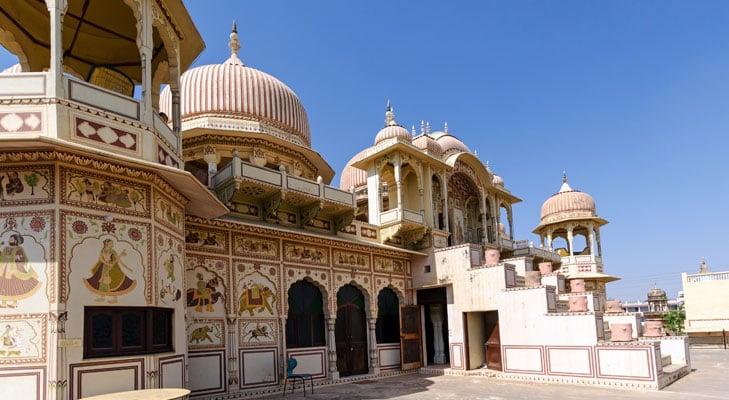
A guide is not compulsory, but it can noticeably improve the experience. Without a guided context, many travellers see only old painted walls. With the right explanation, the same walls begin to reveal themes, social clues, artistic choices, and how Shekhawati families used their homes to reflect status and shifting influences.
A guide helps with:
Decoding fresco themes and visual details.
Explaining Shekhawati’s merchant background.
Showing how Bansidhar Newatia Haveli differs from nearby havelis.
Pointing out restored, faded, or worn sections where relevant.
Managing the walking route through Mandawa’s old lanes.
How to pair it with nearby attractions
Bansidhar Newatia Haveli works best when it is paired with other Mandawa heritage stops in a thoughtful way. The aim should not be to cover every haveli in town. A better plan is to build a balanced walk with fresco detail, old lanes, façade photography, and one or two broader heritage stops.
If you have a short Mandawa visit
Keep the visit selective. Pair Bansidhar Newatia Haveli with one or two nearby painted havelis and a short walk through the old lanes.
If you have half a day
Use Bansidhar Newatia Haveli as part of a proper haveli walk. Depending on your access and the guide’s advice, you can combine it with other Mandawa havelis, such as Murmuria Haveli, Jhunjhunwala Haveli, Gulab Rai Ladia Haveli, or Goenka Havelis.
If you are doing a deeper Shekhawati circuit
Bansidhar Newatia Haveli becomes more meaningful when seen as part of a wider painted-haveli trail across Shekhawati. Mandawa can be combined with places such as Nawalgarh, Fatehpur, Dundlod, or Ramgarh, depending on your route.For that you can explore Mandawa tour packages
Should you visit or skip it?
Visit Bansidhar Newatia Haveli if you enjoy painted havelis, fresco details, old merchant homes, architecture, photography, and slow walks through historic lanes.
It is a good fit for:
Heritage-focused travellers.
Photographers interested in old walls, façades, and textures.
Travellers who enjoy guided walks.
Visitors use Mandawa as their main Shekhawati stop.
Rajasthan itineraries that include slower cultural stops, not only forts and palaces.
Skip it if:
You have very limited time in Mandawa.
You only want quick landmark photography.
You are already visiting several similar havelis without a guide.
You prefer large, fully restored monuments.
Travel Tips
Morning and late afternoon usually work better for walking and exterior photography.
Midday visits are possible, but heat can make the old lanes less comfortable.
Wear comfortable walking shoes, as the route may involve uneven terrain and long periods of standing.
Ask before photographing interiors, people, or private areas.
Avoid using flash around older painted surfaces.
Access, ticketing, and opening conditions may vary locally, so confirm current details with your hotel, guide, or local contact before planning around fixed timings.