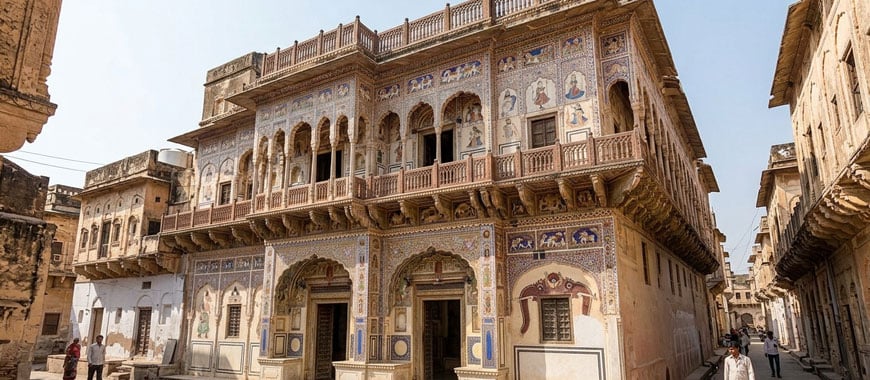

Gulab Rai Ladia Haveli is best experienced as part of a Mandawa or wider Rajasthan heritage journey, where fresco-rich havelis create a slower, more detail-oriented travel experience. Within Mandawa’s old-city circuit, it serves as a visually rich heritage anchor that balances the scale of Mandawa Fort with more intimate architectural exploration.
Unlike larger heritage sites, the haveli shifts attention toward storytelling through frescoes and lived-in design, making it especially valuable for travellers who prefer artistic depth over monument scale.
Gulab Rai Ladia Haveli plays an important role in Mandawa itineraries by introducing a quieter, detail-focused layer that balances the scale of forts and larger heritage structures.
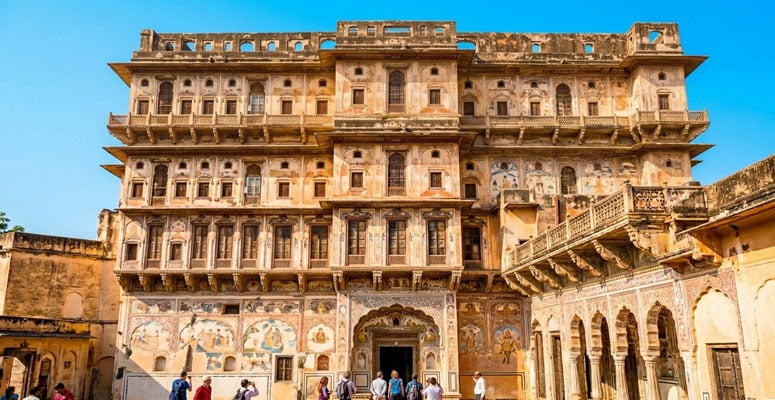
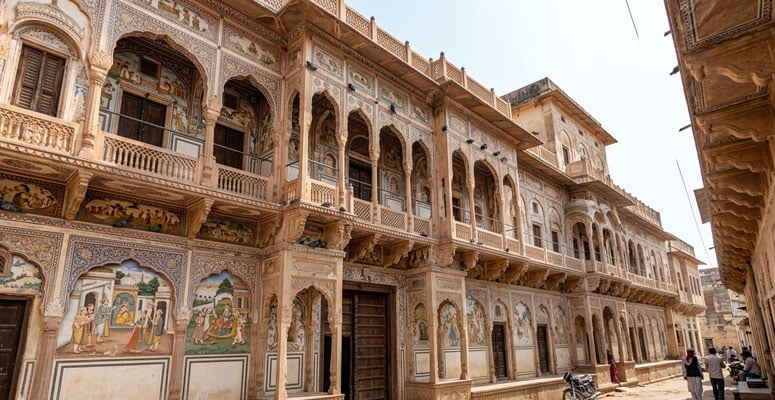
Built during the peak of Shekhawati’s merchant prosperity, the haveli reflects both wealth and artistic ambition through its elaborate murals, carved wooden elements, and layered architectural design. Unlike more uniform or restored structures, Gulab Rai Ladia Haveli retains a strong sense of age and authenticity. Its walls depict layered narratives ranging from symbolic animal imagery to intimate glimpses of domestic life. Compared to busier heritage sites in Rajasthan, this haveli offers a quieter, more contemplative environment, making it particularly valuable for travellers who prefer aesthetic depth over crowded sightseeing.
To plan your route more effectively across Mandawa and nearby fresco towns, explore popular Mandawa tourist attractions to structure a well-paced Shekhawati itinerary.
Why Gulab Rai Ladia Haveli Appeals to Mandawa–Shekhawati Planners
For Mandawa planners, Gulab Rai Ladia Haveli represents one of the most expressive examples of fresco storytelling in the region. Its significance lies not just in its architecture but in the narrative richness embedded across its walls. Built by affluent merchants, the haveli reflects a time when trade wealth translated directly into artistic patronage, resulting in elaborate mansions designed to showcase status, culture, and creativity.
From a planning perspective, the haveli plays a key role in structuring a balanced itinerary. It allows for a transition from large, open heritage sites to enclosed, detail-oriented spaces. This shift in scale enhances the overall experience, preventing monotony and keeping the exploration engaging.
Why it works effectively in curated routes:
Quiet, atmospheric heritage spaces ideal for slow exploration
Slow, scenic walking paths through courtyards and corridors
Distinct fresco style combining symbolic, cultural, and daily-life themes
Easy-to-reach location within Mandawa’s haveli cluster
Scenic and photogenic corners filled with intricate detailing
Geographically, the haveli sits within a dense network of heritage mansions, making it easy to include alongside Mandawa Fort, Goenka Double Haveli, and Murmuria Haveli. This clustering allows planners to design half-day or full-day heritage walks without logistical complexity.
How to Experience Gulab Rai Ladia Haveli
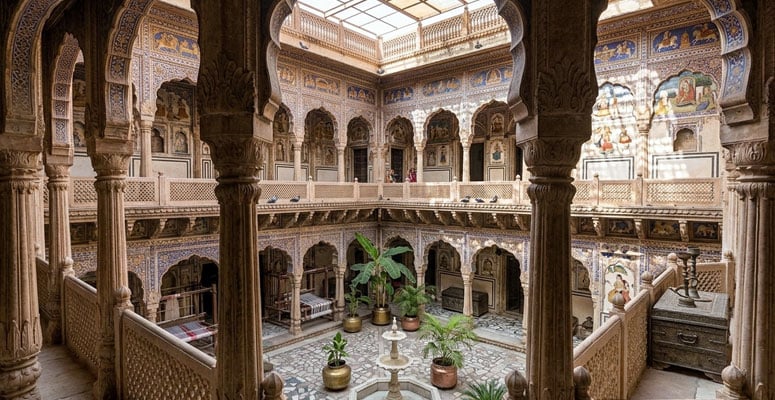
To fully appreciate the haveli’s layered design and storytelling, a structured movement through the space is recommended:
Start at the main entrance, observing the carved wooden gates and aged textures
Move into the central courtyard, which acts as the visual and spatial anchor
Explore surrounding walls featuring murals of animals, birds, and symbolic imagery
Continue through corridors displaying scenes of domestic life and cultural motifs
Pause at latticed windows and jharokhas for architectural detail and light play
Finish by revisiting key mural panels to absorb finer details often missed initially
This approach ensures a relaxed pace and avoids rushing through the haveli’s most intricate elements.
Traveller Insight
Heritage & Architecture Travellers
This haveli represents the core of Shekhawati’s architectural identity, with detailed frescoes, wooden craftsmanship, and traditional spatial planning.
Slow-Paced & Atmospheric Explorers
The calm environment, combined with visually rich interiors, makes it ideal for travellers who prefer unhurried exploration.
Planners Sequencing the Day Thoughtfully
It works perfectly between larger stops like Mandawa Fort and other nearby havelis, helping maintain variety and pacing.
Families & Casual Travellers
The compact layout and engaging visuals make it accessible and enjoyable without requiring deep historical knowledge.
Photographers
The haveli offers excellent opportunities for close-up compositions, texture shots, and natural light photography through windows and courtyards.
Best Time to Visit Gulab Rai Ladia Haveli
The best time to visit is between October to February (Winter), when the most comfortable conditions allow for longer walks and detailed observation of the frescoes.
During March to June (Summer), visits are best planned early in the morning. Interiors remain slightly cooler, making it manageable despite external heat.
The July to September (Monsoon) period is a quieter time with softer lighting conditions that enhance the colours and textures of the frescoes.
Key Highlights Inside Gulab Rai Ladia Haveli
Narrative Frescoes and Murals
The haveli’s most striking feature is its diverse range of murals, depicting animals, domestic scenes, and symbolic imagery. Unique visuals such as mirrored tigers, horses, and birds add depth to the storytelling.
Carved Wooden Gates and Doors
The entrance showcases traditional craftsmanship, with intricate carvings that reflect both functionality and artistic intent.
Latticed Windows and Jharokhas
These elements create patterns of light and shadow, enhancing the visual appeal and offering ideal photography angles.
Central Courtyard Layout
The courtyard serves as the heart of the haveli, connecting different sections and allowing natural light to illuminate the interiors.
Authentic Rajputana Ambience
Unlike heavily restored sites, the haveli retains its original feel, offering a more genuine and immersive heritage experience.
Quick Planning Snapshot
Ideal duration: 45–60 minutes
Best time of day: early morning or late afternoon
Best for: heritage travellers, photographers, slow explorers
Combine with: Mandawa Fort, Goenka Double Haveli, Murmuria Haveli
Avoid if: looking for large-scale monument experiences
It is best treated as a short, high-value stop within a Mandawa walking circuit rather than a standalone visit.
Practical Planning Advice
Best Time to Visit (Experience-Based)
Winter provides the most comfortable experience. Early morning visits are recommended during summer, while the monsoon offers quieter exploration conditions.
Ideal Duration
A standard visit takes around 45 minutes. Travellers interested in photography or detailed observation may extend this to an hour.
Crowd Patterns
Morning hours are usually quiet. Midday may see small tour groups, but the haveli rarely feels crowded.
Essential Visitor Information
Timings : ypically open from around 9:00 AM to 5:00 PM. Timings may vary slightly, so local confirmation is recommended.
Location : Gulab Rai Ladia Haveli, Mandawa, Jhunjhunu District, Rajasthan, India
How to Reach
By Air: Jaipur International Airport is approximately 180 km away.
By Train: Jhunjhunu Railway Station is the nearest railhead.
By Road: Mandawa is well connected by road; local exploration is best done on foot.
Nearby Attractions
These attractions can be combined into a seamless half-day or full-day heritage circuit.
Explore Mandawa & Shekhawati Heritage Journeys
Mandawa is best explored through carefully structured heritage walks that highlight its fresco-rich identity, and Gulab Rai Ladia Haveli plays a key role in this experience.
If you’re planning to include Gulab Rai Ladia Haveli in your trip, these curated itineraries help you experience Mandawa’s fresco-rich heritage within a well-paced Rajasthan journey:
These journeys position Gulab Rai Ladia Haveli as a key stop within a fresco-focused heritage circuit.
Gulab Rai Ladia Haveli is best experienced as a detail-rich heritage stop within a thoughtfully planned Mandawa itinerary rather than as a standalone attraction.