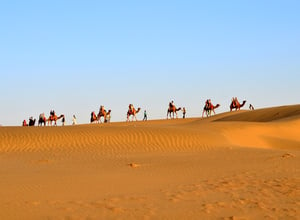
Fondly known as the Great Indian Desert, the expansive Thar Desert lies along the India-Pakistan border. This massive infinite space of sweltering and glistening golden brown sand of the Thar is protected by the lofty Aravallis on the east. The desert also concludes till the Nara Valley in Pakistan and the rich basin of River Indus. Due to its awe-inspiring vastness, the Thar Desert enjoys the 18th position among the largest subtropical deserts in the world.
The Legend of the Thar
There are several stories related to the origin of Thar Desert. A mythological legend states that Lord Rama took an arrow and loaded it in his bow, aiming it at Lanka. This was the place or the home to demon King Ravana where he had kept Goddess Sita, after abducting her.
Fearing the destruction his powerful arrow can bring, people pleaded him not to use the arrow. But, he had already set the arrow and could not abort his action. When Lord too thought about the aftermath, he shot his arrow towards a faraway sea. Due to the effect of the arrow, the sea completely dried, and converted into a desert. This is how Thar Desert originated.
However, there are a number of theories regarding its origin. While some people believed that the desert is around 4000 to 10,000 years old, the other say that it is much older.
Land of the Thar
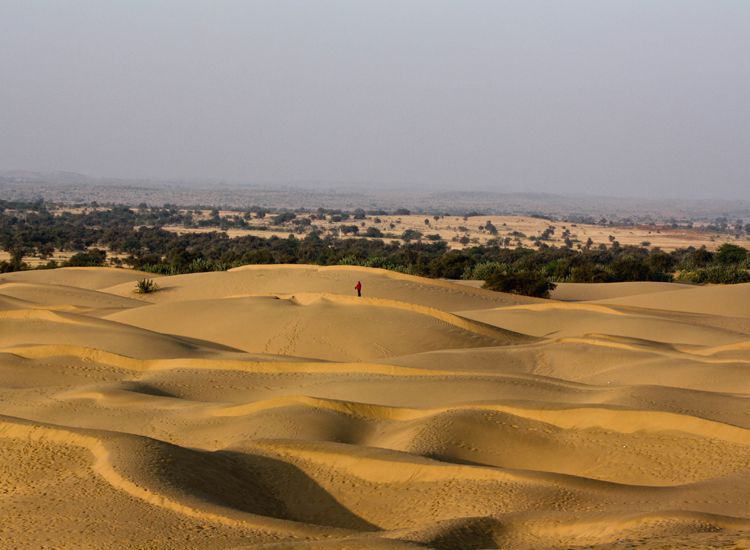
The land of Thar comprises of various kinds of sands that have been brought by the air and rivers over billions of years. It comprises of an undulating surface with both low barren hills and sandy plains. The sand dunes of Thar Desert differ in sizes and shapes. The older dunes are now stabilized in height are 500 feet high. The landscape of Thar also has playas or dhands (saline lake beds), all throughout.
The soil here belongs to a number groups like red deserter soils, yellow soils of the foothills, brownish gray soils, desert soils, lithosols and regosols, and the saline soils of the depressions. Calcareous, coarse-textured, and well-drained are the main features of the soils here.
Annual rainfall stays somewhere between 4 inches or less in the west to 20 inches in the east. 90 percent of the rainfall is during the southwest monsoon, from July to September. May and June are the hottest months while January is the coldest. While front is a frequent phenomenon in winters, the summer month’s experiences dust storms with a speed of 140 to 150 km per hour.
Drought resistance trees can be seen in the eastern side and other the vegetation in Thar is stunted scrub. The plains have khejri trees and the hills have gum arabic acacia.
Life of people in the Thar Desert

Agriculture and animal husbandry is an important part of the life of the people of Thar Desert. Government assistance in projects of irrigation and power has helped the people largely in doing agriculture. Hindus, Muslims and Sikh reside in the Thar. The families living here are away from urbanization. They stay in huts made from natural and local materials. The locals are known for their colorful culture, filled with food, music and dance. The main festivals of Thar are Gangaur, Holi, Bhopaji Puja Ramdevji Yatra, and Blaji Dham Yatra etc.
One of the most important communities living in the Thar are the Bishnois who are known to be the followers of Lord Jambheswar, an incarnation of Lord Vishnu. They are known to be the staunch protectors of flora and fauna of their desert. People here mainly speak Rajasthani. In Southwest part of Thar, it is Sindhi, in northwest it is Lahnda and in the eastern part, it is Rajasthani, mainly Marwari language. The literature of this land has given various popular poets.
A major part of the population of Thar are located in the rural areas and thus there is a variety in the density of population. The population is divided into social and economic groups with Hinduism and Islam, both being practiced here. It can clearly be seen that Thar’s composition is assorted. Most important group here is the Rajputs who reside in central Thar. Nomads of Rajasthan indulge in crafts, animal husbandry and also trade.
Flora and Fauna in Thar Desert
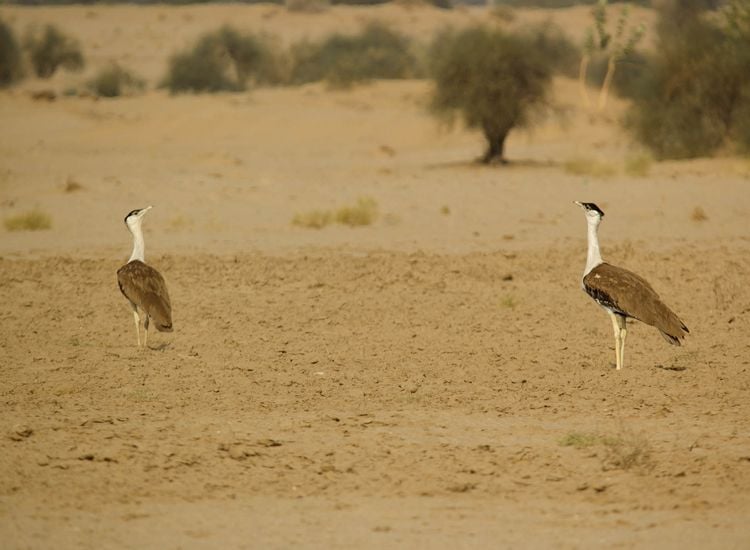
Home to the endangered great bustard, the desert also has thinly populated grassland with quail, chinkara, black bucks, and francolins. Ducks, geese and sand grouse are some of the migratory birds that can be seen here. There are around 23 species of lizards and 25 species of snakes here.
Species of Trees and Herbs
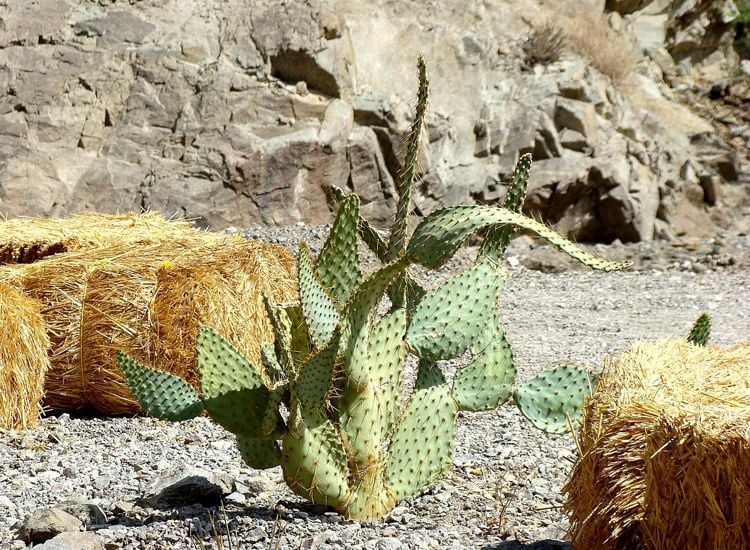
Grewia populifolia, Acacia jacquemontii, Calotropis procera Crotalaria burhia, Euphorbia nerifolia, Cynodon dactylon, Erogrostis species, Panicum antidotale, Dactyloctenium scindicum, and Saccharum spontaneum.
Vegetation
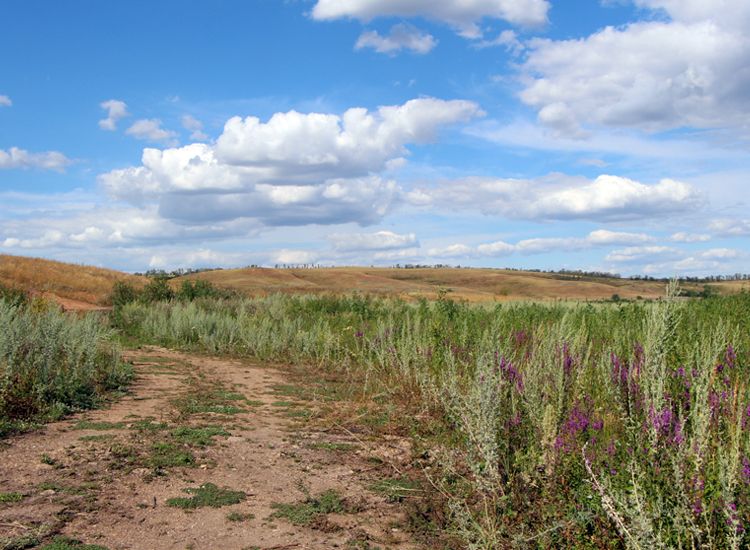
Thar Desert has 700 kinds of vegetation, out of which 107 is types of grass. Most of the grass here is known to have therapeutic properties and are used in a number of medications and oils for soaps.
Climate of the Thar
Thar Desert is arid and hot and thus the climate is quite hard. Rains visit this place very rarely and that too 120 to 350 mm. In the winter months, the temperature ranges around -4.4ºC and in summer months, it is averagely around 48.9ºC. The sun gives out hard radiations at 200-600 cal/cm2 in one day. 40 Km/hour is the speed of the winds in the summer season. Though rainfall brings slight respite from the heat but it increases the humidity. The condition gets slightly better in winters. Rolling sand hills are the prime feature of this arid region.
Related Posts :