
Jaipur is easier to enjoy when its attractions are grouped by what they offer rather than treated as one long checklist.
For a first visit, Amber Fort, City Palace, Hawa Mahal and Jantar Mantar deserve priority as places to visit in Jaipur. Together, they cover Jaipur's hill-fort heritage, royal life, old-city architecture and scientific history.
After these, choose according to your interests. Jaigarh is stronger for military history. Nahargarh works well for city views. Albert Hall adds museum depth, while Galtaji and Govind Dev Ji Temple introduce Jaipur's religious side. Panna Meena ka Kund and Jal Mahal are useful shorter stops that fit naturally around bigger monuments.
Most travellers will get more from six or seven well-chosen attractions than from trying to cover every place on the same trip.
Quick Planning Snapshot
In summer, keep exposed forts and outdoor monuments for the morning. Museums and palace interiors are easier later in the day.
Which Jaipur Attraction Should You Prioritise?
| Traveler Need | Best Choice |
|---|---|
| Essential Jaipur heritage | Amber Fort |
| Best royal interiors | City Palace |
| Best architecture photography | Hawa Mahal |
| Best guided-context monument | Jantar Mantar |
| Best sunset viewpoint | Nahargarh Fort |
| Best family evening | Chokhi Dhani |
| Best wildlife experience | Jhalana Leopard Reserve |
| Best craft/textile experience | Anokhi Museum + Bagru |
| Best short photo stop | Jal Mahal |
| Limited time | Amber Fort + City Palace + Hawa Mahal |
Jaipur Tourist Attractions: Timings and Entry Fees
| Attraction | Current Visiting Time | Current Entry Fee / Access |
|---|---|---|
| Amber Fort / Amer Palace | 8:00 AM–5:30 PM | ₹200 Indian adult; ₹1,000 foreign adult |
| Nahargarh Fort | Around 10:00 AM–5:30 PM | ₹100 Indian adult; ₹600 foreign adult |
| Jaigarh Fort | 9:00 AM–6:30 PM; last entry 6:00 PM | ₹200 Indian adult; international tariff should be checked on the fort's live ticket selector |
| Hawa Mahal | Around 9:00 AM–7:00 PM | ₹100 Indian adult; ₹600 foreign adult |
| City Palace Museum | 9:30 AM–6:30 PM | ₹400 Indian adult for standard museum access; international rate should be checked on the official International Resident selector |
| Jal Mahal | 6:00 AM–6:00 PM for normal lakeside viewing | Free; palace interior not open for ordinary public visits |
| Sisodia Rani Garden | Around 8:00 AM–5:30 PM | Around ₹50 Indian / ₹200 foreign visitor; confirm live OBMS rate |
| Jantar Mantar | 9:00 AM–7:00 PM; last ticket 6:30 PM | ₹100 Indian adult; ₹600 foreign adult |
| Gatore Ki Chhatriyan | Around 9:30 AM–5:00 PM | Around ₹30 Indian / ₹50 foreign adult |
| Panna Meena ka Kund | Daylight hours; roughly 7:00 AM–6:00 PM | Free |
| Albert Hall Museum | Day museum around 9:00 AM–5:00 PM | ₹100 Indian adult; ₹600 foreign adult |
| Anokhi Museum of Hand Printing | Tue–Sat 10:30 AM–5:00 PM; Sun 11:00 AM–4:30 PM; Mon closed | ₹80 adult; ₹25 child; concessions available |
| Govind Dev Ji Temple | Multiple darshan windows from early morning to evening; generally around 4:30 AM–11:30 AM and 5:30 PM–9:30 PM | Free |
| Birla Temple | Approx. 8:00 AM–12:00 PM and 4:00 PM–8:00 PM | Free |
| Galtaji Temple | 5:00 AM–9:00 PM | Free |
| Moti Dungri Ganesh Temple | 5:00 AM–1:30 PM and 4:30 PM–9:30 PM | Free |
| Nahargarh Biological Park | 8:30 AM–5:30 PM, 15 Mar–14 Oct; 9:00 AM–5:00 PM, 15 Oct–14 Mar; Tuesday closed | ₹50 Indian / ₹300 foreign visitor |
Forts
1. Amber Fort
Built in 1592 — a UNESCO World Heritage Site and one of the finest examples of Rajputana architecture, The Amer fort. Maze-like passages, Sheesh Mahal (Hall of Mirrors), Jas Mandir, Shila Mata Temple, and an evening Sound and Light Show. A tunnel connects Amber Fort to Jaigarh Fort – worth exploring for families interested in the fort’s defensive architecture. It is approximately 11 km from the city centre.
- Why Visit: Travellers who enjoy architecture and guided cultural context will get the most from the visit, but the layout is also easy enough to follow independently.
- Time needed: 2 to 3 hours
- Timings: 8:00 AM–5:30 PM
- Entry fee: ₹200 Indian adult; ₹1,000 foreign adult
- Tips: Arrive early for the best light and lowest crowds. Use a jeep ascent rather than an elephant for ethical reasons. Pair with Panna Meena ka Kund and Jal Mahal on the same half-day. Hire a family guide — a treasure hunt activity for kids is available. Confirm Sound and Light Show timings locally before planning.
Nahargarh Fort
Nahargarh Fort is best visited for its views over Jaipur and the palace rooms of Madhavendra Bhawan, rather than as another large military fort.
Built in 1734 and later expanded, the fort occupies a ridge of the Aravalli Hills above Jaipur. Nahargarh fort contains a series of suites linked by corridors and decorated with murals. Rajasthan Tourism identifies it as one of the fort's main architectural features.
- Why visit: Choose Nahargarh if panoramic views and a lighter fort experience appeal to you. If your schedule is short and you are already visiting Amber, Nahargarh is optional.
- Time needed: Around 1–1.5 hours.
- Timings: Around 10:00 AM–5:30 PM.
- Entry fee: ₹100 for Indian adults; ₹600 for foreign adults under the revised 2026 state monument rates.
- Pair with: Gatore Ki Chhatriyan if you are already travelling through the northern side of Jaipur.
Jaigarh Fort
Jaigarh gives a more military view of Jaipur's hill heritage than nearby Amber.
Its ramparts, armoury, cannon foundry, water-harvesting system and Jaivan cannon reflect the fort's defensive role. Jaigarh fort trust also maintains museum galleries and a sculpture park.
- Why visit: Add Jaigarh if you are interested in military architecture or want to understand how the Amer hill complex was defended.
- Time needed: Around 1–1.5 hours.
- Timings: 9:00 AM–6:30 PM; last entry at 6:00 PM.
- Entry fee: ₹200 for an Indian adult. International visitors should use the current International Resident ticket option on the official site.
- Pair with: Amber Fort.
Palaces and Old City Landmarks
Hawa Mahal
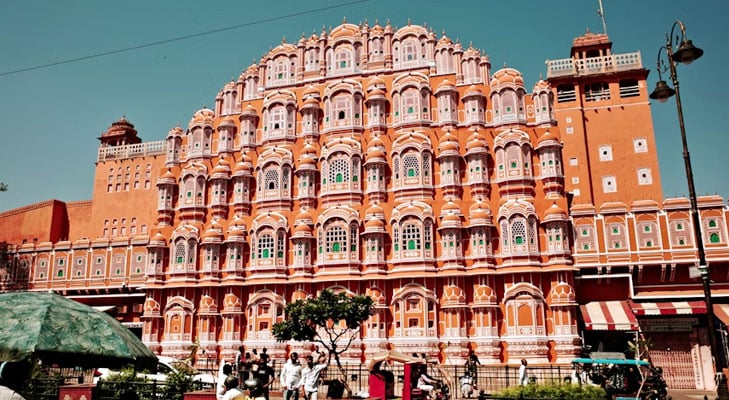
Hawa Mahal is worth seeing for more than its famous street-facing façade.
Built in 1799, its five-storey design is lined with 953 small jharokhas. These screened openings allowed women of the royal household to observe processions and activity in the streets while remaining largely unseen.
The exterior of Hawa Mahal is at its best in softer morning light, but going inside gives you a different view. Narrow passages and upper levels look back towards Jaipur's old city and nearby royal precinct.
- Why visit: It is one of Jaipur's strongest architectural stops and works naturally with City Palace and Jantar Mantar.
- Time needed: Around 45–60 minutes if entering; much less for an exterior photo stop.
- Timings: Around 9:00 AM–7:00 PM.
- Entry fee: ₹100 for Indian adults; ₹600 for foreign adults under the current 2026 tariff.
City Palace
The City Palace remains one of Jaipur's strongest attractions for travellers who want to see royal courtyards, ceremonial spaces, arms, paintings and palace architecture within one complex.
The standard museum route includes spaces such as Pritam Niwas Chowk, Sarvato Bhadra and Sabha Niwas. City palace is still linked with Jaipur's former royal family, with private sections remaining outside the standard museum route.
- Why visit: It gives a more detailed view of Jaipur's royal life than Hawa Mahal and is easier to explore than the hill forts.
- Time needed: Around 1.5–2.5 hours.
- Timings: 9:30 AM–6:30 PM daily. The museum is normally closed only on Dhulandi.
- Entry fee: Standard Indian museum admission is currently ₹400 for an adult. International visitors should check the current International Resident option because the palace operates several ticket categories.
- Pair with: Jantar Mantar and Hawa Mahal.
Jal Mahal
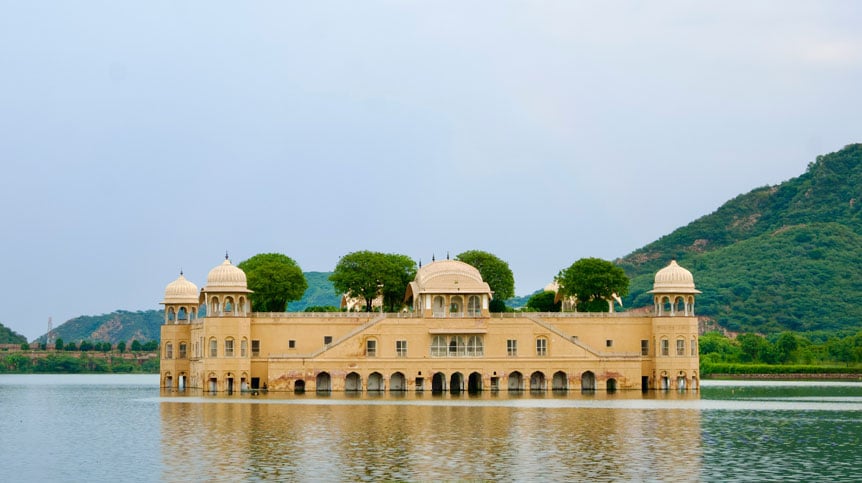
Jal Mahal works best as a short lakeside stop, not as a full palace visit.
The five-level structure stands in Man Sagar Lake. When water levels are high, four levels sit below the lake surface, and the upper level remains visible above water. Rajasthan Tourism currently states that the palace itself is not open for normal public access, so visitors experience it from the lakeside.
- Why visit: The lake, palace and surrounding hills create one of Jaipur's most recognisable views.
- Time needed: Around 20–30 minutes for most visitors.
- Viewing time: Roughly 6:00 AM–6:00 PM.
- Entry fee: Free for lakeside viewing.
- Pair with: Amber Fort, because Jal Mahal lies naturally along the Amer Road.
Monuments & Museums
Panna Meena ka Kund
Panna Meena ka Kund is a compact historic stepwell in Amer known for its striking criss-cross pattern of stairs.
It is worth adding when you are already visiting Amber. You do not need to make a separate journey across Jaipur for it.
- Why visit: It offers a very different form of historic architecture from the nearby fort and is one of the easiest short stops in the Amer area.
- Time needed: Around 20–30 minutes.
- Timings: Best treated as a daylight attraction, roughly 7:00 AM–6:00 PM.
- Entry fee: Free.
- Visitors may be restricted from walking down the staircases for safety and conservation reasons.
- Pair with: Amber Fort and Anokhi Museum.
Jantar Mantar
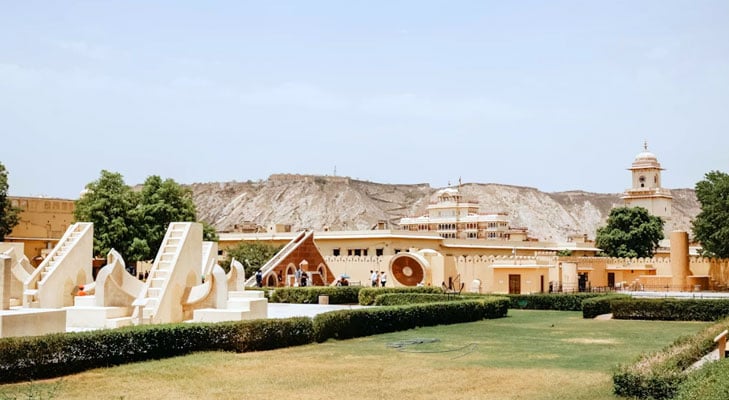
UNESCO World Heritage Site. 19 architectural astronomical instruments built by Maharaja Sawai Jai Singh II in the 18th century, including the world’s largest stone sundial. Opposite City Palace — a natural combined visit.
- Timings: 9 AM–6 PM. Entry fee: Indians INR 50, foreigners INR 200. Free on World Heritage Day (April 18) and Rajasthan Day (March 30).
- Tips: Without a guide, the instruments feel abstract — hire on-site for the experience to become genuinely memorable. Allow 45–60 minutes.
Gatore Ki Chhatriyan
Royal cenotaphs of former Jaipur kings — Sawai Madho Singh, Sawai Jai Singh, and Sawai Ram Singh among them. Ornately carved marble and sandstone chhatris, set against low hills. Views of Jal Mahal and Mansarovar Lake. Less crowded than the headline icons — one of the quieter monuments in Jaipur city.
- Timings: 9:30 AM–5 PM. Entry fee: Indians INR 30, foreigners INR 100.
- Tips: Combine with a Nahargarh sunset visit — stop at Gatore en route in the late afternoon for the most efficient circuit.
Patrika Gate and Jawahar Circle
Vividly painted archways at Asia’s largest circular park. Musical fountain show daily 7–7:30 PM.
- Timings: 6 AM–9 PM. Entry fee: Indians INR 10, foreigners INR 20.
- Tips: Visit around golden hour or after dark for the fountain show and illuminated gate. Best as an evening standalone rather than part of a daytime heritage circuit.
Albert Hall Museum
Indo-Saracenic building (1887) in Ram Niwas Garden. 16 galleries covering the Egyptian mummy, Persian Garden Carpet, miniature paintings, clay art, marble sculptures, musical instruments, textiles, and coins. Experience night illumination between 7–10 PM; it is one of Jaipur’s best evening experiences.
- Timings: Day 9 AM–5 PM; Night 7–10 PM.
- Tips: Allow 1–1.5 hours for a standard visit. The building is magnificent when lit at night — even viewed from outside without entry, it justifies the trip. Located in Ram Niwas Bagh — combine with the garden visit.
City Palace Museum (Maharaja Sawai Man Singh II Museum)
Royal attire, weapons, and artefacts of Jaipur rulers in Mubarak Mahal, Chandra Mahal, and Maharani Palace.
- Timings: 9:30 AM–5 PM.
- Tips: Closed at weekends — plan accordingly. Best combined with the broader City Palace visit on the same morning.
Anokhi Museum of Hand Printing
Situated near Panna Meena ka Kund, 1 km from Amber Fort, you will find traditional Indian block printing techniques with hands-on workshops. Authentic hand-printed fabrics and souvenirs for purchase.
- Timings: Tue–Sat 10:30 AM–5:00 PM; Sun 11:00 AM–4:30 PM; Mon closed
- Tips: Closed Mondays. The hands-on workshops are the strongest reason to visit — book in advance if you want to participate rather than just observe.
Temples
Moti Dungri Ganesh Ji Temple
Built in 1761, the Moti Dungri Ganesh Ji Temple has a 500-year-old Ganesha idol with a leftward-pointing trunk — which is considered particularly auspicious among temples in Jaipur. Wednesdays are considered to be the most auspicious days for worship. Located about 400 metres from Birla Temple.
- Timings: 5:00 AM–1:30 PM and 4:30 PM–9:30 PM
- Tips: Wednesday morning visits draw the largest crowds and offer the most devotional atmosphere. Combine with the Birla Temple on the same afternoon circuit.
Khole Ke Hanuman Ji Temple
Khole Ke Hanuman Ji Temple is one of Jaipur’s most important Hanuman temples and works best for travellers interested in local devotion rather than monument-style sightseeing.
- Best for: Spiritual travellers and visitors comfortable with larger local temple crowds.
- Worth dedicated time? Optional unless religious interest is part of the trip.
Galtaji Temple
Galtaji is a historic pilgrimage complex set between hills east of Jaipur.
Its temples, pavilions and sacred water tanks make it quite different from Jaipur's fort-and-palace sightseeing. The site remains an active place of worship, so it should be approached as a religious space rather than mainly as the “Monkey Temple.”
- Why visit: It suits travellers who want religious architecture and a living pilgrimage setting alongside Jaipur's royal monuments.
- Time needed: Around 45–60 minutes.
- Timings: 5:00 AM–9:00 PM.
- Entry fee: Free.
- Pair with: Sisodia Rani Garden, which lies on the same general eastern side of Jaipur.
Gardens and Viewpoints
Nahargarh Biological Park
Nahargarh Biological Park is a family-oriented nature attraction outside central Jaipur and should be treated separately from Nahargarh Fort.
It works best for travellers who want an animal and nature stop after Jaipur's major heritage attractions have already been covered.
- Why visit: It provides a break from forts and museums, particularly for families with children.
- Timings:
- 15 March–14 October: 8:30 AM–5:30 PM
- 15 October–14 March: 9:00 AM–5:00 PM
- Closed Tuesday
- Entry fee: ₹50 for Indian visitors; ₹300 for foreign visitors. Additional vehicle and camera charges may apply.
Sisodia Rani Garden
Located around 10 km from Jaipur on the Jaipur–Agra Road, Sisodia Rani Garden is a terraced royal garden built by Maharaja Sawai Jai Singh II for his queen from the Sisodia clan of Udaipur. Its painted pavilions, fountains, murals, and layered garden layout make it one of the best gardens in Jaipur.
- Best for: Garden photography, couples, slower heritage travellers, and visitors already exploring Galtaji or the Jaipur–Agra Road side.
- Worth dedicated time? Optional for short Jaipur stays; useful for travellers who want a quieter break from fort-heavy sightseeing.
Vidyadhar Garden
Vidyadhar Garden sits near Ghat Ki Guni and Sisodia Rani Garden and is named after Vidyadhar Bhattacharya, the architect of Jaipur. The garden combines Mughal, Rajput, and classical Indian design with pavilions, fountains, flower beds, and painted wall motifs.
- Best for: Quiet walks, garden photography, birdwatching, and travellers already visiting Sisodia Rani Garden or Galtaji.
- Worth dedicated time? No — best treated as a short add-on within the Ghat Ki Guni garden route.
Kanak Vrindavan Garden
Located near Amber Fort in the foothills of the Nahargarh range, Kanak Vrindavan Garden is a landscaped royal garden with Mughal-Rajput design, fountains, lotus ponds, and views toward the Amber hill corridor. It works particularly well as a short stop between Jal Mahal and Amber Fort.
- Best for: Families, photographers, and travellers who want a softer garden stop near the Amber route.
- Worth dedicated time? No — best added briefly to the Amber–Jal Mahal circuit.
Central Park
Central Park is Jaipur’s largest urban green space and works best as a relaxed morning or evening walking stop rather than a heritage attraction. It is useful for travellers staying near C-Scheme or Statue Circle who want a low-effort break between heavier sightseeing days.
- Best for: Morning walks, families, senior travellers, and slower itineraries.
- Worth dedicated time? Optional; not a first-time sightseeing priority.
Jaipur Attractions That Pair Well Together
Amber Fort + Panna Meena ka Kund + Anokhi Museum
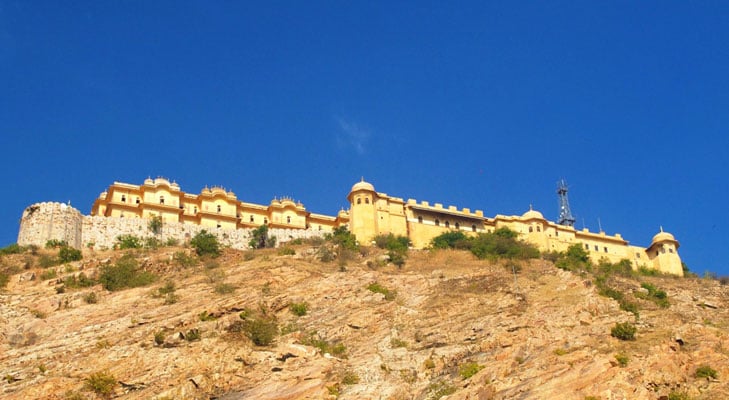
This is the most natural northern Jaipur combination.
Start with Amber Fort while the day is cooler. Panna Meena ka Kund needs only a short stop. Add Anokhi Museum if textiles and traditional craft interest you.
City Palace + Jantar Mantar + Hawa Mahal
These three attractions sit within Jaipur's old-city heritage zone and work well together.
City Palace needs the most time. Jantar Mantar is next door and becomes much more interesting with good interpretation. Hawa Mahal can then be explored inside or treated as a shorter architectural stop.
Birla Temple + Moti Dungri Ganesh Temple
These temples are close enough to combine without using a separate sightseeing block for each.
Visit if religious architecture is part of your interests. They are optional on a short heritage-focused Jaipur trip.
Galtaji + Sisodia Rani Garden
Both lie towards the eastern side of Jaipur.
Galtaji brings a living pilgrimage setting, while Sisodia Rani Garden provides a quieter heritage landscape. This pairing is better for travellers with three or more sightseeing days than for a rushed first visit.
Practical Tips for Visiting Jaipur's Tourist Attractions
Continue Planning Your Jaipur Trip
Start with the city's strongest contrasts: Amber Fort for the hill-palace experience, City Palace for royal interiors, Jantar Mantar for Jaipur's scientific legacy and Hawa Mahal for old-city architecture.
From there, add places that match your interests. Choose Jaigarh for military history, Nahargarh for views, Albert Hall for museum collections, or Galtaji and Govind Dev Ji Temple for religious heritage.
Continue with the Jaipur Travel Guide for wider city planning, the Jaipur Forts and Jaipur Museums pages for deeper sightseeing detail, and the relevant Rajasthan Tour Packages once you are ready to plan the wider route.