
Jodhpur’s fort-and-palace layer is best planned around one major anchor — Mehrangarh Fort — and then shaped by how much royal heritage depth you want beyond it. First-time visitors should prioritise Mehrangarh and Jaswant Thada. At the same time, travellers interested in palace interiors, Art Deco architecture, or luxury heritage stays can add Umaid Bhawan Palace, Mandore, Rohet Garh, or other countryside forts. This guide helps you decide which sites deserve time, which work better as optional add-ons, and how to structure a realistic Jodhpur heritage day.
Which Fort or Palace Should You Prioritize?
| Traveler Need | Best Choice |
|---|---|
| Strongest overall heritage experience | Mehrangarh Fort |
| Best palace architecture and royal lifestyle | Umaid Bhawan Palace |
| Best calm monument paired with Mehrangarh | Jaswant Thada |
| Best heritage-garden circuit | Mandore Fort and Gardens |
| Best rural heritage stay | Rohet Garh Fort |
| Best luxury countryside stay | Fort Chanwa / Khejarla Fort |
| Limited time in Jodhpur | Mehrangarh + Jaswant Thada only |
Mehrangarh Fort
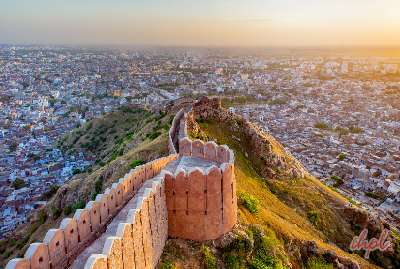
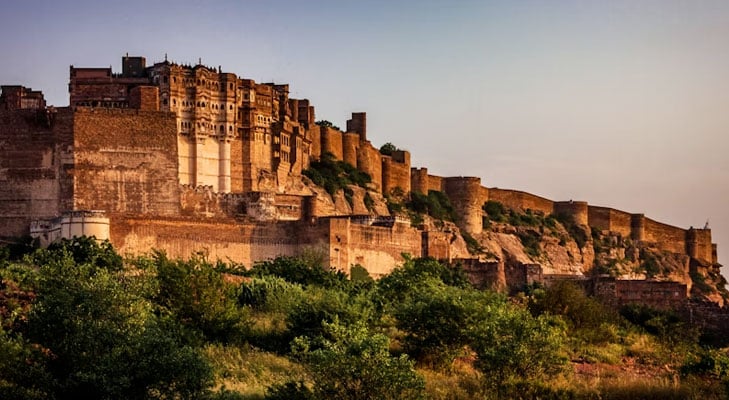
The centrepiece of Jodhpur and one of the most compelling forts in India. Mehrangarh sits on a 125-metre-high rocky outcrop above the city — visible from almost everywhere in Jodhpur — and its sheer scale, the quality of its museum, and the views from its ramparts over the blue-washed city below make it the non-negotiable anchor of any Jodhpur visit.
The fort was founded by Rao Jodha in 1459 and expanded by successive Rathore rulers across centuries. Seven gates lead to the citadel — Jai Pol and Fateh Pol are the primary entries, both bearing cannonball indentations from historic battles and heavy iron spikes designed to repel elephant charges. The hermit Cheeria Nathji’s curse — cast when he was displaced from his cave during construction — is marked by a memorial plaque, alongside the story of Rajaram Meghwal’s sacrifice that followed. The fort’s folklore is as compelling as its architecture.
The fort also houses Nagnechiji Temple and Chamunda Devi Temple, which add a family deity and a devotional layer to the fort circuit.
Best for: First-time visitors, museum-focused travellers, photographers, and anyone with only one heritage slot in Jodhpur.
Comfort note: Expect uneven stone surfaces, long internal walking, stairs, and exposed rampart areas. The elevator helps senior travellers but does not remove all walking effort.
Key Attractions Within the Fort
Palace Museums — One of the best-curated museum complexes in Rajasthan. Royal palanquins, elephant howdahs, ancient armour, rare khanda swords, royal cradles, and textiles are displayed in a way that rewards slow exploration. The armoury and palanquin galleries are the highlights.
Phool Mahal — The most lavish hall in the fort. Designed to resemble a flower, adorned with windows, mirrors, and gold leaf — originally used for royal entertainment by female dancers.
Moti Mahal — Room for private royal audiences featuring coloured window glass, a gold-leaf and sea-shell ceiling, and the Srinagar Chowki throne. Five alcoves with hidden balconies where queens observed court proceedings without being seen.
Sheesh Mahal — Mirror palace with intricate glass inlay work.
Zenana Deodi — Stone lattice screens create sharp geometric shadow patterns on the floors — one of the strongest photography opportunities inside the fort. Best in the morning when light enters at a strong angle.
Chamunda Mataji Temple — At the far end of the fort, away from the main tour groups. Quieter, more reflective — temple bells and circling kites above the cliffs. Worth the walk for travellers wanting solitude within the fort complex.
Ramparts and Viewpoints — Unobstructed views over the blue houses of the old city stretching toward the desert. Best at sunrise and sunset. The old cannons provide natural framing for photography.
Raptors of the Ramparts — Hundreds of Black Kites and Egyptian Vultures circle the fort’s cliffs. Late afternoon feeding by the fort’s keepers is a rare wildlife experience — raptors at eye level against Thar Desert updrafts.
Flying Fox Zipline — Optional adventure add-on around Mehrangarh’s moat and battlements. Best for families with older children and travellers who want a different view of the fort. Keep it secondary to the fort visit itself.
Umaid Bhawan Palace
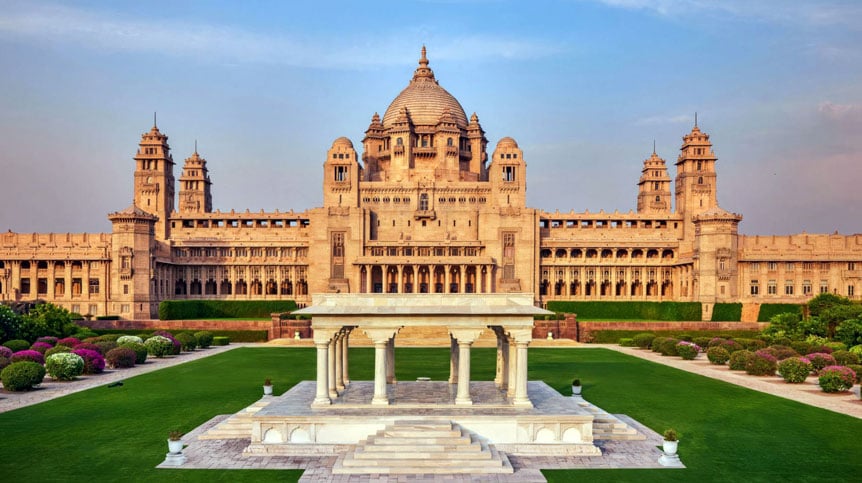
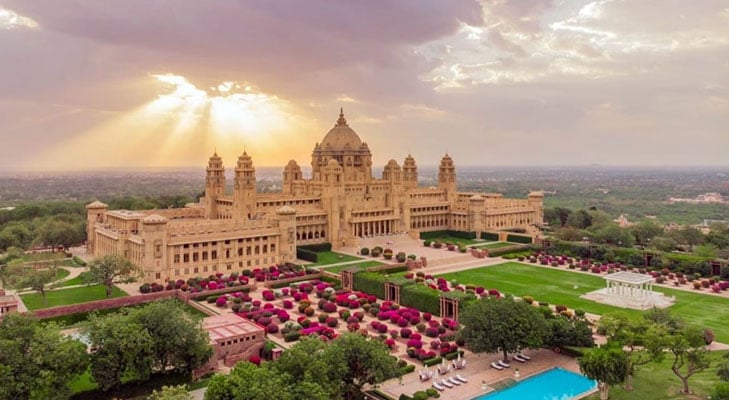
Built between 1929 and 1943 under Maharaja Umaid Singh, Umaid Bhawan Palace is one of the largest private residences in the world, with 347 rooms designed by the renowned Edwardian architect Henry Vaughan Lanchester. Also known as Chittar Palace, named for the Chittar Hill stones used in its construction that give the structure its golden-yellow colour. The dome rises to 500 feet and reflects Western architectural influence alongside Hindu decorative elements, including murals depicting the Ramayana in the throne room.
Best for: Architecture lovers, photographers, luxury travellers, and visitors interested in royal lifestyle rather than deep military history.
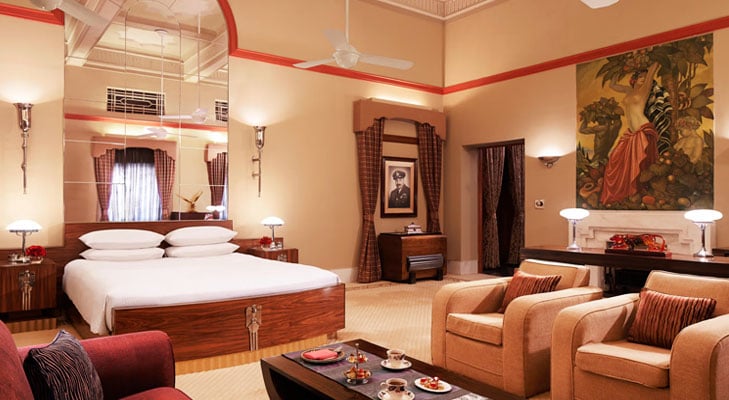
The palace serves three functions simultaneously: the current royal family of Jodhpur still resides in one wing, a luxury heritage hotel (voted Best Hotel in the World by TripAdvisor in 2016) occupies another, and a museum is open to the public.
Museum highlights: Royal family antiques, antique clocks, Art Deco interiors, miniature paintings, rare household items, stuffed leopards, weapons, and a large banner gifted by Queen Victoria. The vintage car collection displayed in the front garden is a standout — classic cars in a palace forecourt setting and one of the most photographed spots in Jodhpur.
Museum timings: 10 AM–4:30 PM. Closed on public holidays.
Distance: 3 km from Jodhpur Airport, 5 km from Jodhpur Railway Station.
Route fit: Umaid Bhawan works well as an afternoon palace stop after Mehrangarh or as part of a softer half-day route with Ghanta Ghar, Kailana Lake, or Toorji Ka Jhalra. Taj notes that the palace is around 15 minutes from the airport and convenient for Mehrangarh Fort, Ghanta Ghar, Kaylana Lake, and Toorji Ka Jhalra Stepwell.
Jaswant Thada
An immaculate white marble mausoleum built in 1899 by Maharaja Sardar Singh to commemorate his father, Maharaja Jaswant Singh II. Located a 10-minute walk from Mehrangarh Fort, Jaswant Thada sits above a small lake and offers a serene counterpoint to the imposing fort nearby.
The milky white marble construction is understated yet intricate — carved marble lattice screens adorned with portraits of Rathore rulers dating back to the 13th century. The structure glows translucent in certain light conditions, giving it a quality unlike any other monument in Jodhpur. Views of the cityscape and Umaid Bhawan Palace from the site are strong. The lake, birds, and manicured garden surrounding the cenotaph create an atmosphere of genuine calm.
Best for: Photographers, slower-paced travellers, and visitors who want a quieter marble memorial after the scale of Mehrangarh.
Timings: 9 AM–5 PM.
Priority note: Essential when visiting Mehrangarh, but not worth planning as a separate, standalone excursion.
Mandore Fort and Gardens
One of Rajasthan’s most popular heritage garden sites — temples, memorials, and high rock terraces. Associated with the legend of Ravana’s marriage, a Ravana temple marks the birthplace of his wife, Mandodari. Gardens are a major attraction in their own right.
Timings: 8 AM–8 PM. Government Museum: Saturday–Thursday 9 AM–6 PM.
Best for: Slower heritage travellers, repeat Rajasthan visitors, and those interested in cenotaphs, memorial architecture, and old Marwar history.
Rohet Garh Fort
A 16th-century classical heritage fort on the banks of a small lake, approximately 40 km from Jodhpur. The residence of the Rathore royal family since the 16th century, now converted into a heritage hotel. The perfectly manicured gardens with dancing peacocks, serene verandahs, and beautifully decorated lounges make it one of the most atmospheric heritage stays in the Jodhpur region. Cultural activities under the Village Safari program include culinary workshops and local village experiences.
Rohet Garh is best approached as a quiet heritage pause within a Jodhpur or wider Rajasthan itinerary, not as a headline monument. It works especially well for travellers who want rural heritage, garden courtyards, verandahs, photography corners, and a softer pace after intense city sightseeing.
Timings: Heritage hotel — open to guests and confirmed day visitors.
Best for: Heritage-stay travellers, families who prefer open walking spaces, photographers, and slow-travel itineraries.
Route fit: Best as a one- or two-night stay in the Jodhpur–Marwar corridor, especially when connecting Jodhpur with Osian or Nagaur.
Secondary Heritage Forts and Palace Stays Near Jodhpur
These properties are best treated as heritage-stay options rather than core sightseeing stops. Include them only if your itinerary allows slower pacing or countryside stays.
Fort Chanwa — Built in 1894 by Kaviraj Muraridanji, reconstructed by Maharaja Dalip Singh. Red sandstone with beautiful latticework. Now a heritage hotel with fine dining.
Khejarla Fort — Red sandstone Rajput architecture with intricate Jharokha detailing. Strong for history and architecture lovers.
Amargarh Fort — A 250-year-old fort in Amargarh village. Built for quiet and eco-friendly relaxation surrounded by forests and mountains.
Balsamand Fort and Palace — Located beside Balsamand Lake. Heritage palace now a hotel, surrounded by natural greenery with papaya, plum, and mango trees.
Rai Ka Bagh Palace — Built in 1663 in an octagonal shape, favoured by Jaswant Singh. Rock carvings and a lush garden.
Ranbanka Palace — A heritage palace hotel in Jodhpur that works better as a stay experience than a sightseeing stop. Include it only as part of the city’s royal-stay layer, not as a major monument.
Bijolai Palace — A lake-facing heritage property outside the main sightseeing core. Best for travelers looking for a quieter stay near water and countryside views rather than a core palace visit.
Chhatris (Cenotaphs)
Umbrella-shaped memorial structures with four pillars built by royal families across Jodhpur. Monuments paying tribute to great kings and queens — they do not house remains. Found throughout the city, most notably at Mandore Gardens.
Timings: Open during daylight hours at Mandore Gardens. Entry fee: Confirm locally.
How to Plan Jodhpur’s Fort and Palace Circuit
Short stay: Prioritise Mehrangarh Fort at opening time, then walk to Jaswant Thada. This is the strongest heritage combination in Jodhpur.
One full heritage day: Mehrangarh Fort → Jaswant Thada → Umaid Bhawan Palace Museum. Add Toorji Ka Jhalra or Ghanta Ghar only if energy allows.
Slow heritage stay: Add Mandore Fort and Gardens as a separate half-day circuit.
Countryside heritage extension: Choose Rohet Garh, Khejarla, Fort Chanwa, or Balsamand Palace as stay-led experiences, not quick sightseeing stops.
Planning Notes
Mehrangarh is non-negotiable for first-time visitors.
Jaswant Thada is best paired immediately with Mehrangarh.
Umaid Bhawan is more useful for architecture and palace-lifestyle interest than for deep historical interpretation.
Mandore needs 2–3 hours and benefits from the guide context.
Rohet Garh and other countryside forts are best as overnight heritage stays.
October to March is the best season.
Arrive at Mehrangarh by 9 AM; late morning to mid-afternoon is the busiest window.
Use the elevator at Mehrangarh for senior travellers, but still expect walking.