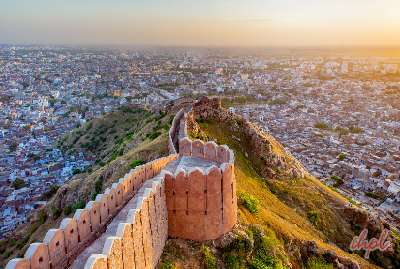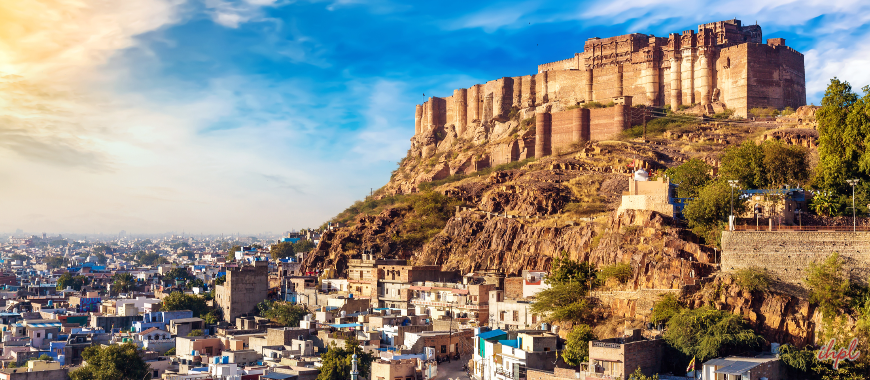

Mehrangarh Fort is the main place to visit in Jodhpur if you want to understand the city’s royal and military past.
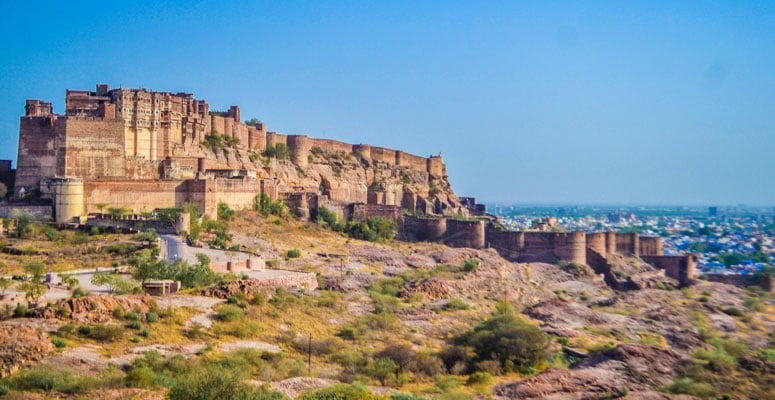
The fort rises above the old city and combines massive defensive walls with richly decorated palace rooms, museum galleries, temples and ramparts overlooking the blue neighbourhoods below. Rao Jodha began building the fort in 1459, but later rulers continued adding to it for centuries. This is why different parts of Mehrangarh look and feel quite different from one another.
For most visitors, around 3 hours gives enough time for the museum, main palace rooms and ramparts without rushing.
What to See Inside Mehrangarh Fort
A structured approach helps you explore Mehrangarh Fort without feeling overwhelmed by its scale:
- Begin at the main gates (Jai Pol → Fateh Pol): Observe battle marks and defensive features as you ascend
- Move gradually through the internal courtyards: Allowing time to understand how the fort expands in layers
- Enter the palace museum sections next: Focusing on key galleries such as palanquins, armoury, and royal artefacts rather than attempting to cover everything
- Continue toward the zenana and lattice-work areas: Where architectural detailing is most visible
- Head to the ramparts and outer viewpoints: Where the Blue City views open up fully
- End your visit near Chamunda Mata Temple: Which offers a quieter and more reflective close to the experience
The Fort Gates and Defensive Approach
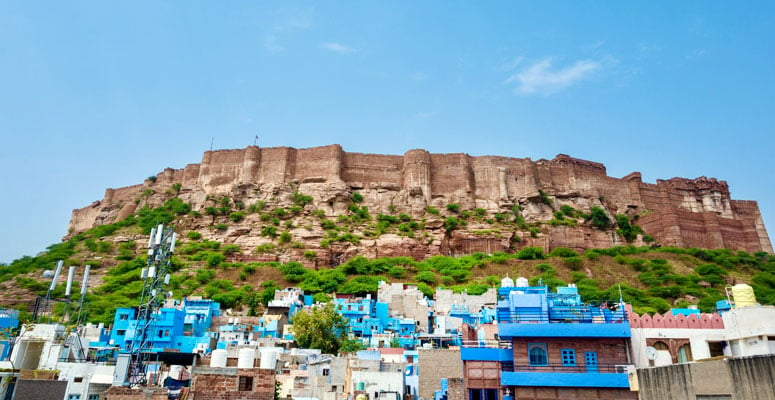
The climb into Mehrangarh is part of the experience.
Begin around Jai Pol, where the main visitor ticketing is located, and follow the rising approach towards the inner fort. The massive walls, gateways and tight turns show how difficult the fort was designed to attack.
Rajasthan Tourism also notes surviving marks from cannon fire on one of the gates.
Moti Mahal
Moti Mahal, or the Pearl Palace, is one of the oldest surviving palace rooms in the fort.
It was built in the late 16th century during the reign of Sawai Raja Sur Singh and functioned as a Hall of Public Audience. Its polished walls, decorative niches and mirror-and-gilt ceiling give it a very different character from the exterior fortifications.
Phool Mahal
Phool Mahal is richer and more private in character.
Built in the 18th century for Maharaja Abhay Singh, it was used as a private audience hall. Gold decoration, mirrors, stained glass and later paintings make it one of the most detailed interiors in the fort.
Sheesh Mahal
Sheesh Mahal was once part of the private apartments of Maharaja Ajit Singh.
Mirror work is combined with painted religious figures, including depictions of Krishna, Rama, Sita and other deities. Later additions include its wooden ceiling and chandelier.
Takhat Vilas
Takhat Vilas was the bedchamber of Maharaja Takhat Singh, the last Jodhpur ruler to live in Mehrangarh as his main residence.
Almost every surface is painted. The decoration mixes Indian religious imagery with scenes and figures influenced by the wider world of the 19th century.
Jhanki Mahal
Jhanki Mahal was created so women of the royal household could watch activity in the courtyards below through screened openings.
Today, it houses part of the museum’s collection of royal cradles.
Howdah and Palanquin Galleries
The museum’s collections are a major reason to give Mehrangarh enough time.
The Howdah Gallery displays historic seats used on elephants, including a silver howdah connected with Mughal emperor Shah Jahan.
The Palanquin Gallery displays covered conveyances used by members of the Marwar royal household.
Daulat Khana and Arms Gallery
Daulat Khana brings together paintings, textiles, decorative art, manuscripts and weapons connected with centuries of Rathore history.
The separate Arms Gallery displays swords, armour, daggers, shields and other examples of metalwork from Marwar.
Ramparts and Blue City Views
After the museum rooms, continue towards the ramparts.
The fort stands around 400 feet above the surrounding plain, so this part of the visit opens wide views over Jodhpur and the blue-painted neighbourhoods below.
The Trust’s official Rampart Trail is included with the standard museum ticket.
Chamunda Mata Temple
The rampart route continues towards Chamunda Mata Temple, an active place of worship within the fort.
The present structure includes rebuilding carried out in the 19th century after damage to this part of Mehrangarh.
Visitors should dress and behave respectfully because it is still used for worship.
How to Experience Mehrangarh Fort
A simple sequence makes the fort easier to understand.
Start at Jai Pol and follow the main ascent into the fort. Once inside the museum route, give most of your time to the palace rooms and the galleries that interest you rather than trying to study every display.
Continue through rooms such as Moti Mahal, Phool Mahal, Sheesh Mahal and Takhat Vilas, then move towards the ramparts for views over Jodhpur.
If energy and time allow, continue along the Rampart Trail towards Chamunda Mata Temple. The Trust includes this trail with the standard museum ticket.
This route gives the visit a clear progression: fortifications → royal rooms → museum collections → city views.
Best Time to Visit Mehrangarh Fort
October to March gives the easiest conditions for exploring Mehrangarh.
Although many museum galleries are indoors, the approach, courtyards and ramparts involve outdoor walking.
From April to June, visit close to opening time. Temperatures in Jodhpur can become very high later in the day, making the open sections much harder to enjoy.
During the monsoon, cloud cover can make the fort more comfortable, but rain may leave stone ramps and steps slippery.
For photography, morning gives clearer sightseeing conditions without requiring you to depend on sunset access after normal museum hours.
Mehrangarh Fort Timings and Entry Fees
| Visitor Information | Current Details |
|---|---|
| Opening time | 9:00 AM |
| Closing time | 5:00 PM |
| Open | All days |
| Domestic adult ticket | ₹200 |
| Domestic student / senior citizen | ₹100 |
| International adult ticket | ₹800 |
| International student ticket | ₹500 |
| Elevator – one way | ₹50 |
| Domestic audio guide | ₹180 |
| International audio guide | Included with international admission |
| Recommended visit duration | Around 3 hours |
The Mehrangarh Museum Trust currently publishes these rates and confirms that ticket sales close at 5:00 PM. General admission is free on 12 May, Jodhpur Foundation Day, although the elevator remains chargeable.
Current Guide Charges
The Trust currently lists:
| Group Size | Licensed Guide Fee |
|---|---|
| 1–4 people | ₹500 |
| 5–15 people | ₹600 |
| 16–30 people | ₹800 |
| 31–50 people | ₹1,000 |
These fees include GST and are paid directly to the guide.
Note: The above are operating rates, which are subject to change. Recheck and confirm before planning a visit.
Is Mehrangarh Fort Suitable for Senior Travellers?
Yes, but plan the route around mobility rather than avoiding the fort completely.
The fort has an elevator for part of the ascent, currently priced at ₹50 one way. This can reduce the initial climb. However, it does not remove all the walking.
Palace rooms, courtyards and rampart areas still involve steps and uneven historic surfaces. Travellers with limited mobility may prefer to focus on the museum route and skip the longer rampart walk.
When Is Mehrangarh Fort Less Crowded?
Arriving near the 9:00 AM opening time is the simplest choice if you prefer easier movement through the palace rooms.
The museum route includes several enclosed rooms and narrow passages, so organised groups can make individual sections feel busy even when the fort itself does not feel crowded.
Avoid publishing fixed claims such as “crowds peak from 11:30 AM to 3:30 PM” unless IndianHoliday has visitor data to support that level of precision.
Weekends, holidays and Rajasthan’s winter travel season can naturally bring more visitors, so keep enough time rather than planning a rushed visit between two other major attractions.
Do You Need a Guide at Mehrangarh Fort?
A guide is useful but not essential.
Mehrangarh has a well-developed museum, so independent visitors can still understand much of the collection. An audio guide is also available, and it is currently included with international adult admission.
Choose a licensed guide if you want more context around the palace rooms, Rathore history and the way the fort changed over several centuries.
For a first-time international visitor, a good guide can also help you decide where to spend time instead of trying to see every gallery at the same pace.
Optional: Flying Fox at Mehrangarh
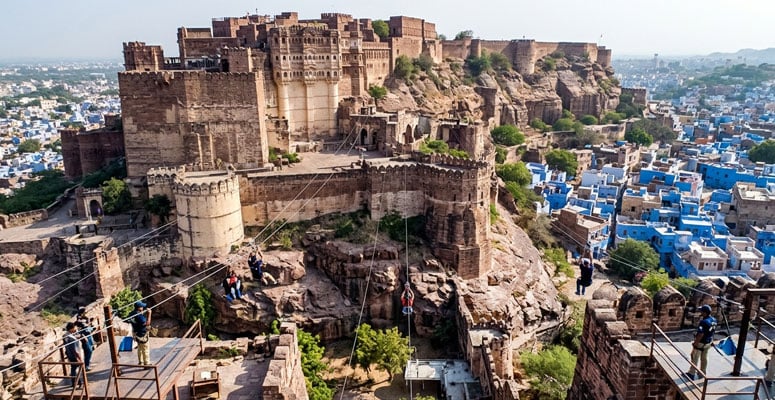
A zip-line experience operates around the lakes and rocky landscape beside Mehrangarh.
It is directly connected to the fort setting, so it can remain on an attractions page as an optional activity, but it should not dominate the heritage content.
The Mehrangarh Museum Trust currently lists the Flying Fox trail among its visitor experiences, with tickets handled separately from normal museum admission.
If you plan to do both, keep additional time rather than trying to fit the zip-line into the standard three-hour museum visit.
Nearby Attractions to Visit with Mehrangarh Fort
Jaswant Thada
Jaswant Thada is the most natural monument to pair with Mehrangarh.
The white-marble cenotaph was completed in 1906 in memory of Maharaja Jaswant Singh II. Its smaller scale and quieter setting make it a useful contrast after several hours inside the fort.
For most first-time visitors, Mehrangarh + Jaswant Thada makes more sense than adding another large monument immediately afterwards.
Rao Jodha Desert Rock Park
Rao Jodha Desert Rock Park sits beside Mehrangarh and works well for travellers interested in the natural landscape around the fort.
The 70-hectare park was created to restore native vegetation on the rocky terrain surrounding Mehrangarh.
Add it if landscape, walking or ecology genuinely interests you. It is optional on a short first visit.
Practical Tips for Visiting Mehrangarh Fort
- Keep around three hours for the museum, palace rooms and ramparts.
- Start earlier during warmer months.
- Use the elevator if the initial ascent is difficult, but expect walking once inside.
- Spend more time in a few palace rooms rather than rushing through every gallery.
- Wear comfortable shoes for ramps, steps and uneven surfaces.
- Use a guide or audio guide if you want deeper context.
- Keep Jaswant Thada in the same sightseeing block because it is close to the fort.
- Add Rao Jodha Desert Rock Park only if you enjoy walking and landscape.
- Remember that Chamunda Mata is an active temple. Follow local religious etiquette.
- Do not build the standard visit around sunset. Normal museum hours currently end at 5:00 PM.
Continue Planning Your Jodhpur Visit
Mehrangarh deserves to be treated as Jodhpur’s main heritage visit rather than a quick fort stop.
The palace rooms show different periods of royal life. The galleries add objects and context. The ramparts then open the view across the city that developed below the fort.
Afterwards, continue to Jaswant Thada for a shorter architectural stop or add Rao Jodha Desert Rock Park if you want to spend more time around the fort landscape.
Continue with the Jodhpur Travel Guide for the rest of the city and use the relevant Jodhpur Tour Packages or Rajasthan Tour Packages when you are ready to connect Mehrangarh with a wider heritage journey.