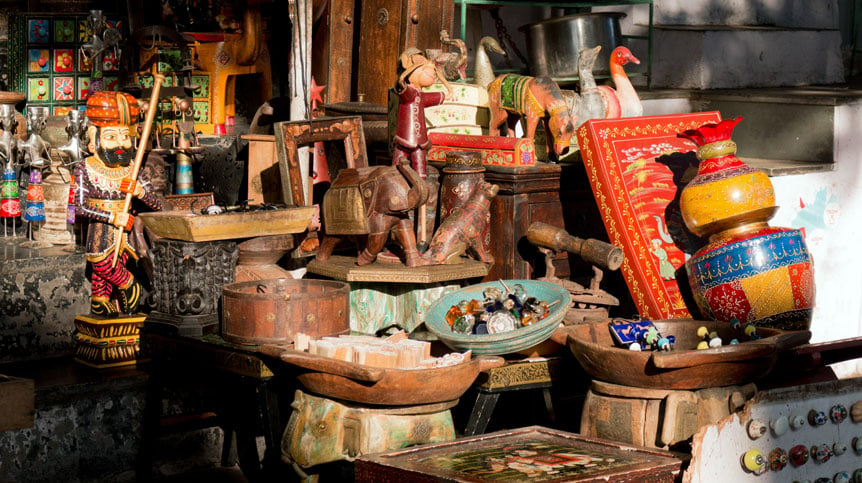

The arts and crafts of Rajasthan share close-knit relationships with their native places, communities and traditions. Whether it is hand-printed textiles of Jaipur, delicate artwork of Mewar, pottery, jewellery, or leatherwork, every place in Rajasthan is rooted in its own artistic character.
For travellers, these crafts offer something far more than simply an opportunity to shop. Visiting a working studio, watching a textile being printed by hand or speaking with an artisan can reveal a side of Rajasthan that is easy to miss when travelling only between forts and palaces.
If you are an art, textile or traditional handcrafted goods enthusiast, then a customary workshop or artisan visit can be included in your Rajasthan itinerary.
What Arts and Crafts Is Rajasthan Famous For?
Rajasthan is known for various forms of exclusive craftsmanship, including:
- Hand block printing
- Bandhani and Leheriya textiles
- Blue pottery
- Miniature paintings
- Pichwai and Phad paintings
- Kota Doria weaving
- Kundan and Meenakari jewellery
- Thewa work
- Leatherwork and traditional footwear
- Carpets and dhurries
- Terracotta and clay work
- Wood and stone carving
- Kathputli puppets
Some customs have ties to a town or region. For these customs, seeing them in the place of practice provides a far better experience than seeing the finished product in a large city market.
Hand Block Printing in Bagru and Sanganer
Exquisite textiles are one of the most distinguished forms of Rajasthan’s craft heritage.
Bagru and Sanganer are towns in the Jaipur region famous for their association with the hand block printing technique. Craftsmen use hand-carved wooden blocks to make patterns and designs across the fabric length. Different blocks are used for building designs and using individual colours on the fabric.
Bagru and Sanganeri hand block printing are recognised as separate Geographical Indications, reflecting their individual craft traditions.
Although Bagru textiles feature earth tones and geometric or floral patterns, Sanganeri work features fine floral patterns that are more muted. Traditional Rajasthan techniques endorsed by Rajasthan Tourism include Bagru, Sanganeri, Bandhani and Leheriya.
Bandhani and Leheriya Textiles
Bandhani is created with the help of a tie-and-dye process where small sections of fabric are tied before adding colour. Upon removal of the ties, distinctive dotted patterns are created.
Leheriya, meanwhile, uses a different fabric tie to create a diagonal, wave-like band of fabric. Leheriya is derived from the Hindi word leher, which means 'wave'.
Both patterns are seen on numerous Rajasthani fabric products like sarees, scarves, and dupattas.
Instead, take care to analyse the process behind the fabric, like the fabric itself, the colouring, and the technique and region of production. Often customers appreciate that process and the experience.
Jaipur Blue Pottery
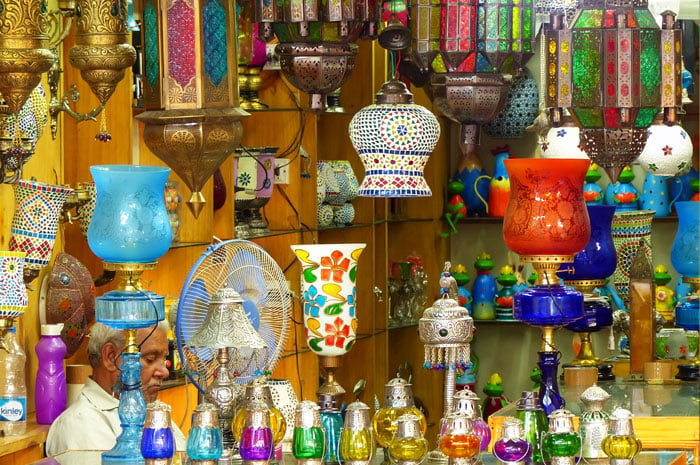
One of the most famous crafts of Jaipur and often cited as the city’s speciality, the Blue pottery even has its own registered Geographical Indication.
It is mostly loved for its smooth glazed finish and intricate patterns that come in shades of turquoise, green and similar hues. There are floral designs, animals and birds patterns and motifs painted on vases, bowls, jars, tiles and even decorative objects.
Tourists who like handcrafted items will be truly delighted to see the whole painting and glazing process in a proper studio.
Smaller items are generally easier to carry during a multi-city Rajasthan trip. If you are considering a larger or fragile piece, ask about professional packing and shipping before purchase.
Miniature Paintings of Rajasthan
The miniature paintings of Rajasthan are an art form that has developed across several royal centres, and over time, some distinctive styles have emerged in regions like Mewar, Marwar, Bundi, Kota, Bikaner, Jaipur and Kishangarh.
At first glance, the differences are quite subtle, but upon looking more closely, we find variations and differences in the use of colour, composition, and the painting subject as it all stands out. These miniature paintings are usually distinguished for the fine brushstrokes and carefully arranged scenes from history and mythology, such as royal courts, hunting scenes, and landscapes.
When you visit a working studio, you see the difference and the minute techniques through which these artworks are created. You see how earlier ways and visual traditions have made way for modern interpretations.
If you are considering buying a painting, ask a few questions first. Is it an original work or a reproduction? What pigments, materials and techniques were used? These details can make a considerable difference to what you are actually purchasing.
Pichwai Painting
Pichwai painting is closely associated with Nathdwara, near Udaipur, and with the devotional traditions surrounding Shrinathji.
Earlier, these paintings used to serve as elaborate backgrounds in temple worship instead of simple decorative works. Lord Shrinathji is the subject, while animals, flowers, gardens and scenes from Lord Krishna’s life are also featured.
If you are an interested traveller in such arts that are handcrafted, Nathdwara is a likely place for you to experience culture near Udaipur. The experience can be further enhanced if you look beyond the surface and understand the context, which can be time-consuming.
It is therefore better treated as a considered excursion rather than squeezed between several unrelated sightseeing stops.
Phad Painting
Phad follows a rather different tradition.
Typically painted on long pieces of cloth, Phads developed as narrative works connected with stories of local deities and the performers who carried those stories from place to place.
They were not originally thought of simply as decoration. The painting formed part of a larger storytelling practice in which images, songs and oral narration worked together.
This suggests that seeing a finished Phad without knowing the story behind it can reveal only part of its meaning.
Travellers interested in Rajasthan's folk traditions may find an interaction with an artist particularly worthwhile. Once the characters, symbols and sequence of the narrative are explained, the imagery often becomes much easier to read.
Kota Doria Weaving
Kota Doria is a lightweight woven textile associated with Kaithoon near Kota.
Kaithoon town is recognised by Rajasthan Tourism as a traditional centre of Kota Doria weaving, while Kota Doria itself has Geographical Indication registration. The association with the region is therefore more than a matter of contemporary branding.
The fabric feels light and airy. Its characteristic weave is well suited to sarees, dupattas and other garments, particularly comfortable for warmer conditions.
Jewellery: Kundan, Meenakari and Thewa
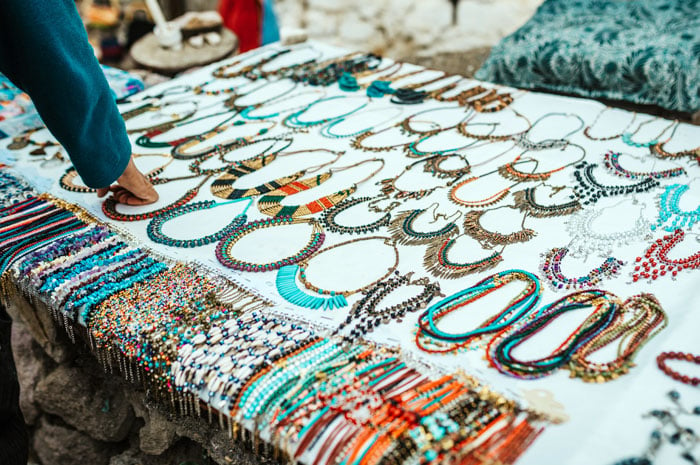
Rajasthan has a strong jewellery-making tradition, and Jaipur remains one of its best-known centres for gemstones and decorative jewellery.
Kundan is a traditional technique used to set stones into jewellery. Meenakari, on the other hand, uses coloured enamel on metal. The two are often seen together, but they are different crafts.
Then there is Thewa, a more specialised tradition associated with Pratapgarh. It typically combines delicate gold work with coloured glass, and Thewa Art Work is registered as a Geographical Indication of Rajasthan.
If you are buying valuable jewellery, make sure you choose an established jeweller rather than simply going for the price.
Ask questions about the metal used, check purity, stones and other material and ask for documentation where needed. For a high-value purchase, the quality of the work and its authenticity will usually matter more than finding the chepest quote.
Molela Clay Work
Molela clay work is widely known in the Udaipur region, is known for its distinctive clay and terracotta relief work.
You will find plaques and figures showing deities, folk characters and themes associated with local community traditions. Molela Clay Work is also registered as a GI of Rajasthan.
A visit here feels quite different from shopping in a city handicraft market.
It is potentially more rewarding for travellers who want to understand how a craft is made, who makes it and how it fits into local life.
If Udaipur is already part of your itinerary, Molela can be a cultural excursion rather than a stand-alone detour.
Leatherwork, Carpets and Woodcraft
Rajasthan’s craft traditions go far beyond paintings and textiles.
You will also come across leather footwear such as mojaris and juttis, embroidered leather goods, carpets, dhurries, carved wood and decorative furniture.
What you see in a Jaipur or Jodhpur shop may not always have been made there. Some pieces come from other parts of Rajasthan too.
But if that matters to you, ask the following questions:
- Where was it made?
- Who made it?
- What material was used?
These are simple questions, but they can tell you a lot about what you are buying.
Larger pieces need a little more thought. Carpets, furniture and carved objects are not easy impulse purchases. Check the size, material, packing and shipping details before you decide.
Reviving the Art & Craft of Rajasthan
Art and Crafts of Rajasthan were dormant for some time as industrialization took over, and the only place you could glance through them were in the museums, palaces, and havelis of Rajasthan. However, the government of Rajasthan is slowly trying to revive this old art form and is gaining momentum every year. To that effect, many fairs and festivals are held in Rajasthan, whose main motto is to encourage Rajasthani culture and tradition through its art.
Browse through our Rajasthan Tour Packages from Pune, Rajasthan Tour Packages from Vadodara, Jaipur Tour Packages from Kochi
Kathputli: Rajasthan’s Puppet Tradition
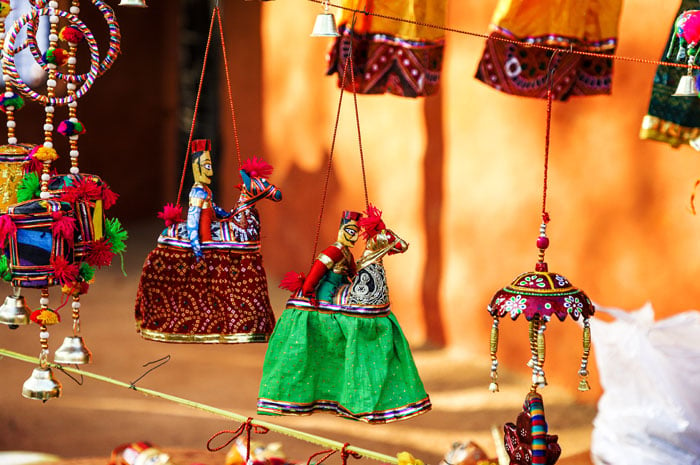
Kathputli puppets are easy to recognise. Bright clothes. Painted faces. Long strings.
But they are not just decorative objects.
Traditionally, these puppets used to be an integral part of live performances where music, humour and storytelling brought the characters to life. Kathputlis of Rajasthan are also recognised under India’s GI system.
For families, especially if you are travelling with children, a good puppet show can be a simple way to experience Rajasthan’s folk culture.
It is often easier to connect with than a museum display. The stories move, speak and make people laugh.
Where to Experience Rajasthan’s Crafts
Jaipur, Bagru and Sanganer
Jaipur is one of the easiest places to begin when we talk about crafts and jewellery. You can explore blue pottery, jewellery, miniature painting and textiles without changing your route too much.
Bagru and Sanganer, close to Jaipur, are better known for block printing.
If your Jaipur schedule is already full, choose one craft experience and give it proper time. One good workshop is usually more enjoyable than rushing through three.
Udaipur and Nathdwara
Udaipur is a good base for travellers interested in painting and the artistic traditions of the Mewar region.
Nathdwara works naturally with this route if you want to understand Pichwai painting.
Molela is more specialised. It may suit travellers who are curious about pottery, clay work and artisan communities rather than general sightseeing.
The point is not to collect craft stops.
Pick the one that genuinely interests you.
Jodhpur and Western Rajasthan
Jodhpur is a useful place to explore crafts from western Rajasthan.
Its markets often include textiles, leatherwork, furniture, metalware and decorative objects.
Browsing is easy. Understanding what you are looking at can be harder.
If you are genuinely interested in the making, history or origin of a craft, a knowledgeable guide can make the market experience more useful.
Kota, Bundi and Kaithoon
If your route already includes Kota or Bundi, Kaithoon can be a sensible addition.
It is closely associated with Kota Doria weaving and fits naturally into this part of Rajasthan.
This may appeal more to travellers with a specific interest in textiles, or to repeat visitors who want to look beyond the better-known sightseeing circuit.
It does not need to be added to every Rajasthan trip.
For more details, contact Indian Holiday today. Plan a trip to Rajasthan and visit the top Art and Craft Rajasthan schools.
How to Shop for Handicrafts in Rajasthan
Shopping can be part of the experience. It just helps to slow down a little.
Ask where the piece was made. Find out what material was used and whether the work was done by hand.
For jewellery, carpets or expensive artwork, get a proper bill. Ask about authenticity, returns and shipping before you pay.
Handmade pieces may not look completely identical.
A slight variation in colour, shape or pattern can come from the making process. But this does not mean every imperfect object is automatically handmade.
Use some judgement.
And do not feel that every craft stop has to end with a purchase.
It is also worth avoiding itineraries packed with compulsory shopping visits. One market, studio or workshop that you actually enjoy can add far more to the trip than being taken from showroom to showroom.
How Much Time Should You Allow for a Craft Experience?
You do not need a full day in most cases.
A workshop or guided market visit can usually take around two to four hours.
A craft village or specialist centre may need half a day, especially once travel time is added.
For a first Rajasthan trip, one or two craft experiences are often enough.
That leaves space for the forts, old cities, landscapes and everyday moments that are also part of the journey.
Crafts should add something to the trip, not make the schedule heavier.
Making Arts and Crafts Part of Your Rajasthan Journey
The easiest approach is to follow your existing route.
If you are already in Jaipur, explore block printing nearby.
If Udaipur and Nathdwara are part of the journey, Pichwai fits naturally.
If you are travelling through Kota or Bundi, Kaithoon makes more sense there.
This usually leads to a calmer itinerary. Fewer unnecessary drives. Less rushing.
And probably a better experience.
If Rajasthan’s crafts are a major reason for your visit, give yourself time in each region rather than trying to see every tradition in one trip.
You are more likely to remember one meaningful conversation with an artist than six hurried stops.
Continue Planning Your Rajasthan Journey
You can explore Rajasthan Tour Packages for route ideas, or continue with the Rajasthan Travel Guide, Shopping in Rajasthan, Jaipur Travel Guide and Udaipur Travel Guide as you plan the rest of your trip.