
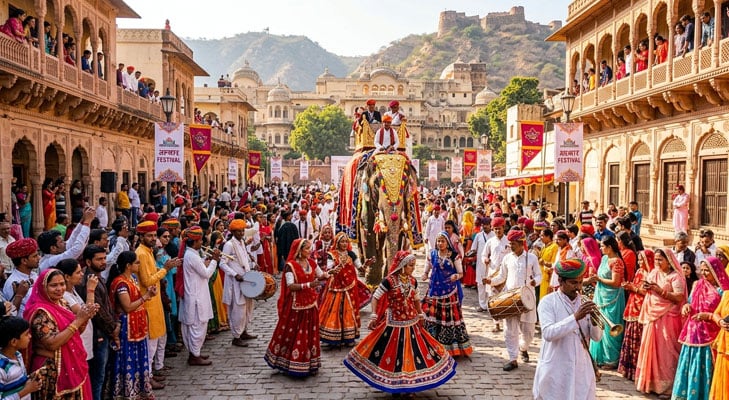
Rajasthan’s festival calendar is unlike any other state in India — a year-round sequence of camel fairs, royal processions, tribal congregations, desert music festivals, and women’s celebrations that collectively give travellers direct access to the living culture of the state. The festivals here are not staged performances for tourists — they are working religious events, livestock markets, and community celebrations that happen to be extraordinary to witness. Planning a Rajasthan trip around even one major festival transforms the experience entirely.
Which Festival Should You Prioritise?
Date caution: Festival dates in Rajasthan often follow lunar calendars and may shift year to year. Always verify final dates with Rajasthan Tourism or the local tourism office before booking flights and hotels.
This is important because the official Rajasthan Tourism calendar publishes multi-year fair/festival dates, but individual event schedules can still change operationally.
| Traveler Need | Best Festival |
|---|---|
| Biggest overall cultural spectacle | Pushkar Camel Fair |
| Desert culture and folk performances | Desert Festival, Jaisalmer |
| Music in a heritage setting | RIFF, Jodhpur |
| Literary and intellectual travel | Jaipur Literature Festival |
| Camel culture | Bikaner Camel Festival |
| Tribal culture | Baneshwar Fair |
| Women-led traditional celebration | Gangaur / Teej |
| Craft shopping | Shilpgram Crafts Mela |
| Monsoon festival experience | Teej Jaipur / Kajli Teej Bundi |
| Offbeat devotional fair | Kallaji Fair / Kailadevi Fair |
Rajasthan Festival Calendar by Season
Winter: October–February — Pushkar Camel Fair, Desert Festival, Camel Festival Bikaner, Jaipur Literature Festival, International Kite Festival, RIFF, Marwar Festival, Kolayat Fair, Shilpgram Crafts Mela, Mount Abu Winter Festival.
Spring: March–April — Gangaur, Mewar Festival, Brij Festival, Holi, Mahaveerji Fair, Kailadevi Fair, Banganga Fair, Shekhawati Festival, Karni Mata Mela.
Monsoon: July–September — Teej Jaipur, Kajli Teej Bundi, Gogamedi Fair.
Year-end / Regional Add-ons — Bundi Utsav, Chandrabhaga Fair, Mount Abu Winter Festival.
Major Festivals in Detail
Desert Festival — Jaisalmer
Dates 2026: January 30–February 1 | Location: Sam Sand Dunes and Jaisalmer city
Three days of folk performances, camel sports, and cultural competitions staged against the golden backdrop of the Sam Sand Dunes, 40 km from Jaisalmer. The festival grew from a historical celebration of Rawal Jaiswal’s founding of the Jaisalmer kingdom in 1196.
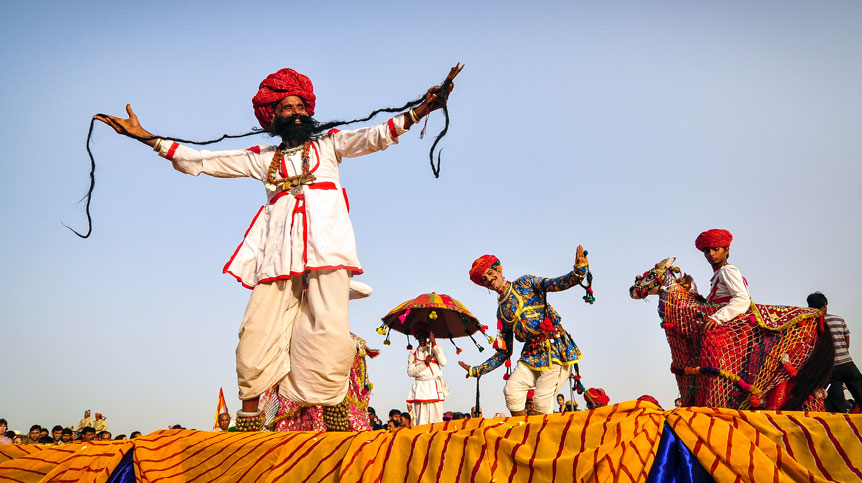
Signature experiences: Camel races, camel polo, decorated camel parades, turban-tying and longest moustache competitions, tug-of-war, folk dance and music performances including Gir Dance and Fire Dance, dune bashing, quad biking, desert safaris, and handicraft shopping from local artisans.
Worth planning a trip around? Yes, especially for travelers already interested in Jaisalmer, dunes, and folk performance.
Pushkar Camel Fair (Pushkar Mela)
Dates 2026: October 30–November 5 | Location: Pushkar, Ajmer District
One of the world’s largest livestock fairs and India’s most famous rural festival — a combination of camel and cattle market, Hindu pilgrimage, and open-air cultural carnival centred on the sacred Pushkar Lake. Over 50,000 animals and 300,000 people converge on this small desert town over seven days. The fair ends on Kartik Purnima — the full moon — when pilgrims take a sacred dip in Pushkar Lake and offer prayers at the Brahma Temple.
Signature experiences: Camel beauty contests, camel and horse races, decorated camel parades, moustache and turban-tying competitions, Kalbeliya folk dance performances, hot air balloon rides over the fairground, Kartik Purnima aarti and ritual bathing at the ghats, shopping for silver jewellery, Rajasthani textiles, leather goods, and handicrafts.
Expect long walking distances, dust, crowding around Kartik Purnima, and heavy accommodation pressure. Senior travelers and families should use shorter guided windows rather than trying to cover the entire fairground in one day.
Also retain the responsible tourism note because camel numbers at Pushkar have declined due to changing livelihoods and shrinking grazing lands.
Worth planning a trip around? Yes — one of Rajasthan’s strongest time-specific travel experiences.
Best for: Photographers, cultural travelers, livestock-fair enthusiasts, and travelers comfortable with heavy crowds.
Bikaner Camel Festival
Dates 2026: January 11–12 | Location: Junagarh Fort, Bikaner
A two-day celebration of Rajasthan’s camel culture, organized by the Department of Tourism, Art and Culture. Bikaner has been the primary camel breeding region since the city’s founding by Rao Bika Ji — the Ganga Risala camel corps served in World Wars and Indo-Pak conflicts and still serves in the Border Security Force.
Signature experiences: Colorful camel parade against the backdrop of Junagarh Fort, camel races, camel dance and acrobatics, fire dance, folk music and puppet shows, fireworks finale. Camel milk sweetmeats and camel milk tea are unique food experiences available only here.
Jaipur Literature Festival
Dates 2026: January 15–19 | Location: Hotel Clarks Amer, Jaipur
Celebrating its 20th year in 2026, the Jaipur Literature Festival has grown from 18 writers and 100 attendees in 2006 to the world’s largest free literary festival — drawing nearly 100,000 attendees annually including Nobel laureates, Man Booker Prize winners, historians, journalists, and debut novelists. Five days of panels, debates, readings, and book signings.
Best for: Readers, writers, intellectual travelers, and visitors who want a softer cultural Jaipur experience without rural fair conditions.
International Kite Festival — Jaipur
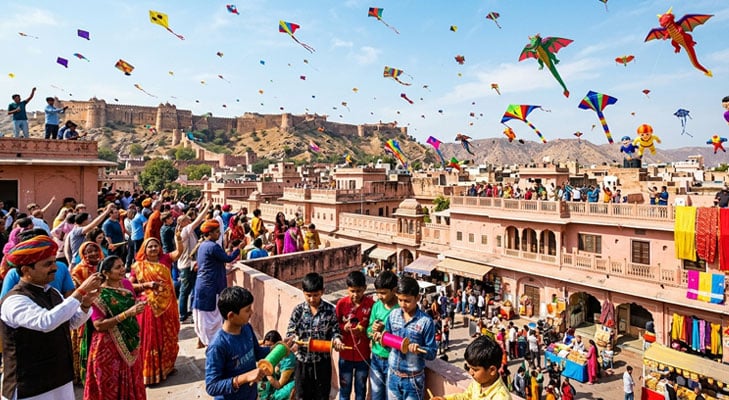
Dates 2026: January 14–16 | Location: Jaipur Polo Ground and Umaid Bhawan Palace
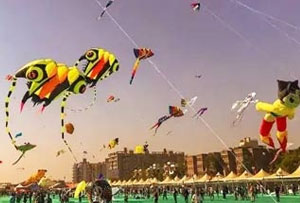
Celebrated on Makar Sankranti, the International Kite Festival fills Jaipur’s skies with kites of every color from dawn to dusk. Inaugurated at the Polo Ground with prize distribution at Umaid Bhawan Palace on the final day. Kite war competitions and friendly flying sessions run alongside cultural events and lantern lighting at night.
Gangaur Festival
Dates 2026: March 15–25 | Location: Jaipur (grandest), also Udaipur and across Rajasthan
An 18-day women’s festival celebrating marital love and the divine union of Lord Shiva and Goddess Parvati. Married and unmarried women craft clay idols of Gauri and Isar, worship them daily, observe fasts, and carry earthen pots with illuminated lamps (Ghudlias) through the streets. The festival culminates in a grand procession with local bands, horses, and beautifully adorned women in vibrant lehengas.
Mewar Festival — Udaipur
Dates 2026: April 12–14 | Location: Udaipur
Udaipur’s spring festival marking the advent of the season. The celebration includes a procession with images of Gangaur and Isar moving through the city from the City Palace to Lake Pichola, where the images are taken on boats. Folk dances, songs, and cultural programs accompany the procession. The white palaces and ghats lit up at night give the festival a cinematic quality unique to the City of Lakes.
Brij Festival — Bharatpur
Dates 2026: March 26–27 | Location: Bharatpur
Celebrated a few days before Holi in the Brij region — believed to be where Lord Krishna spent his childhood. Raslila dance performances depicting the love story of Radha and Krishna, devotional music at the Radha Krishna temple, holy dip at the ghats of the Banganga River, and vibrant color play. Less commercial than metro Holi celebrations — more rooted in devotional tradition.
Holi in Rajasthan
Date 2026: March 4 | Location: State-wide
Rajasthan celebrates Holi across multiple distinctive traditions. Braj Mahotsav in Bharatpur district — three days of Raslila and color play before Holi. Dhulandi in Jaipur — the tourism department hosts an exclusive event for international guests at Khasa Kothi Hotel. Mali Holi — men of the Mali community throw colors on women who respond with sticks. Dolchi Holi in Bikaner — a 300-year-old tradition where the Harsh and Vyas communities throw water in camel-skin vessels on each other’s backs without colors. Gair at Godaji — men from 12 villages near Ajmer gather to play Gair with drummers and troupes.
Rajasthan International Folk Festival — RIFF
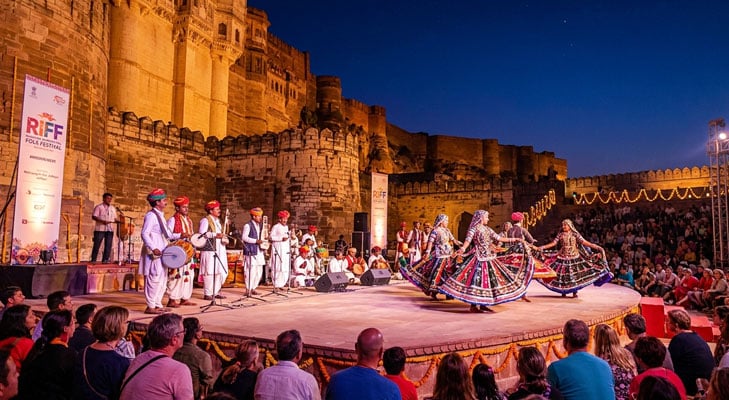
Dates 2026: October 2–6 | Location: Mehrangarh Fort, Jodhpur
UNESCO-endorsed as the People’s Platform for Creativity and Sustainable Development. A five-day folk and world music festival at Mehrangarh Fort bringing together Rajasthani folk legends with international artists from Hungary, Brazil, Australia, France, and beyond. Dawn concerts on the ramparts, midnight jam sessions in the fort courtyards, cross-genre collaborations, and informal workshops.
Signature experiences: Living Legends series featuring Manganiyar and Langa musicians, international fusion performances, sunrise ragas overlooking Jodhpur’s blue city from the fort ramparts.
Worth planning a trip around? Yes for music-focused travelers.
Marwar Festival — Jodhpur
Dates 2026: October 6–7 | Location: Mehrangarh Fort and Umaid Bhawan Palace, Jodhpur
Two days dedicated to the folk music and heroic legends of Marwar — originally known as the Maand festival for the traditional folk music genre. Celebrates the heroism of Rajasthan’s warriors through music, dance, camel tattoo show, horse polo, and puppet shows. Set during the full moon of Sharad Poornima.
Bundi Utsav
Dates 2026: November 27–29 | Location: Bundi
A three-day cultural showcase organized by the Rajasthan State Tourism Department that transforms this small, blue-washed Hadoti town into a celebration of traditional craft, art, and performance. Shobha Yatra procession, ethnic sports, folk dance performances, bridal attire competitions, handicraft exhibitions, and a fireworks finale.
Kolayat Fair — Bikaner
Date 2026: November 27 | Location: Kolayat Lake, near Bikaner
Also known as the Kapil Muni Fair. All 52 ghats around Kolayat Lake are beautifully decorated and lit with oil lamps floated on the calm water — hundreds of lighted lamps reflecting on the lake is the defining visual of this festival. Devotees take holy dips believing it removes sins. Smaller in scale than Pushkar but deeply atmospheric.
Worth planning a trip around? Strong atmospheric add-on for Bikaner trips, not a primary trip driver.
Teej Festival — Jaipur
Dates 2026: Hariyali Teej August 15, Kajari Teej August 31, Hartalika Teej September 14 | Location: Jaipur (grandest), also Bundi
A monsoon festival celebrating the union of Lord Shiva and Goddess Parvati — particularly significant for married women who fast and pray for their husbands’ well-being. In Jaipur, the grand Teej procession moves through the old city from Tripolia Gate through Johari Bazaar with decorated elephants, horses, and palanquins carrying the Teej Mata idol. Women wear green saris symbolizing prosperity.
Kajli Teej in Bundi (August 20–21): The most atmospheric regional celebration — a procession from the main bazaars to Azad Park featuring performing artists, elephants, camels, and bands. More intimate than Jaipur but equally charged with the monsoon energy of the season.
Nagaur Fair
Dates 2026: February 17–21 | Location: Nagaur
India’s second-largest cattle fair — a 4-day event organized by the Department of Animal Husbandry. Thousands of animals including horses, cows, bullocks, oxen, and camels gather for trade. Tug-of-war, camel and bullock races, cockfights, and folk music and dance performances in the evenings.
Worth planning a trip around? Better as a Jodhpur extension than a standalone trip.
Baneshwar Fair — Dungarpur
Dates 2026: February 15–March 4 | Location: River confluence of Som, Mahi, and Jharkhand, Dungarpur
India’s largest tribal fair — organized around the Baneshwar Mahadev Temple at the confluence of three rivers, drawing the Bhil tribal community from Rajasthan, Madhya Pradesh, and Gujarat. Five consecutive days of ritual bathing, Rasleela performances, Ghoomar dance, bonfire music gatherings, magic shows, acrobatics, and a grand procession carrying a silver idol of Saint Mavji on horseback.
Best for: Readers, writers, intellectual travelers, and visitors who want a softer cultural Jaipur experience without rural fair conditions.
Additional Festivals Worth Planning Around
Kailadevi Fair, Karauli (March–April) — 2 lakh devotees on the banks of the Kalisil River. Many devotees cover 15–20 km by lying flat in devotion. One of Rajasthan’s most intensely devotional fair experiences.
Karni Mata Mela, Bikaner (twice yearly — April–May and October–November Navratri) — Deshnok temple opens at 4 AM on the first day. The golden-crowned deity statue and the sacred rats of Deshnok are the primary attractions.
Alwar Festival (February 13–15) — 3-day event promoting Alwar tourism. Elephant polo, fancy dress competitions, antique exhibitions, and film shows. Sariska National Park and Bhangarh Fort are within easy reach for combining with the festival visit.
Banganga Fair, Jaipur (April–May) — Religious fair with holy dip in the Banganga River where Arjuna’s arrow is believed to have created a spring, with temple visits to Ganga Bihari, Hanuman, Shiva, and Goswamiji Math.
Mahaveerji Fair (March 31) — Rath Yatra procession honoring the 24th Jain Tirthankar at Mahaveerji temple. Significant pilgrimage for the Jain community.
Gogamedi Fair (August) — Honoring Goga Veer — the snake god — with livestock trading, handicrafts, and folk performances.
Shekhawati Festival (March 21–22) — Promoted across Sikar, Nawalgarh, Churu, and Jhunjhunu. Haveli competitions, cultural programs, rural games, fireworks, and organic food. The ideal companion festival to a Mandawa haveli circuit — visit both on the same trip for full Shekhawati depth.
Flamenco and Gypsy Festival, Jodhpur (April) — 25 Rajasthani artists and 19 Spanish Flamencos at Mehrangarh Fort tracing the shared roots of Romani and Rajasthani music traditions. Three-day festival beginning at 6:30 PM with international after-parties.
Shilpgram Crafts Mela, Udaipur (December 21–31) — 10-day handicraft fair showcasing hand-woven fabrics, leather goods, embroideries, and mirror work from cottage industries across Rajasthan. Platform for weavers and craftspeople to sell directly to visitors. Best for: Craft shoppers, textile lovers, and travelers who want direct artisan interaction.
Mount Abu Summer Festival (May 10–12) — Two-day festival on Buddha Poornima. Folk and classical music, boat race on Nakki Lake, skating races, Panihari Matka Race, Deepdaan, and Sham-e-Qawwali performances.
Mount Abu Winter Festival (December 29–31) — Three-day year-end festival. Daph, Ghoomar, and Gair dance performances, rowing competitions, and Deepdaan — oil lamps floated on Nakki Lake.
World Music Festival, Udaipur (February 7–9) — 150 artists from 16 countries performing at Fateh Sagar Lake over three days. Free to attend.
Chandrabhaga Fair, Jhalawar (October–December, Kartik Purnima) — Held in Jhalrapatan, 6 km from Jhalawar. Holy dip in the Chandrabhaga River on Kartik Purnima. Combined cattle fair with traders from Madhya Pradesh and Maharashtra.
Kallaji Fair — Banswara (March-April) — Kallaji Fair is an annual local fair in Banswara district, usually held on the first Sunday of Navratri. It takes place across areas such as Gopinath ka Gadha, Padoli Govardhan, and Bodla, and is best suited to travelers interested in regional devotional gatherings rather than mainstream tourist festivals. Planning note: Treat it as an offbeat tribal/devotional add-on within a Banswara–Dungarpur–Udaipur circuit rather than as a standalone Rajasthan trip driver.
Rajasthan Day Celebrations — Jaipur / Statewide: Rajasthan Day is increasingly used for curated folk-culture programming, especially in Jaipur. Recent celebrations at Albert Hall included large-scale folk performances such as Ghoomar, Kalbelia, Chari, Kachchhi Ghodi, Bhavai, Chang-Dhap, and Kathak. Planning note: This is best treated as a cultural evening add-on if already in Jaipur, not a primary trip-planning festival.
Kalbelia — Rajasthan’s UNESCO Dance
The Kalbelia folk dance of Rajasthan is inscribed on UNESCO’s Intangible Cultural Heritage list. Performed by women of the Kalbelia nomadic tribe — traditionally snake charmers — the dance mimics serpent movements with twisting, swaying, and spinning to an accelerating rhythm. Women perform in black attire with widely flared skirts embroidered with mirrors and silver threads. Men accompany with Poongi (been), dholak, khanjari, and sarangi.
Planning Your Festival Visit
Best overall window: October to March gives maximum festival density with comfortable weather — Pushkar Camel Fair, Desert Festival, Bikaner Camel Festival, Jaipur Literature Festival, RIFF, Marwar Festival, Mewar, Gangaur, and Baneshwar all fall in this window.
Monsoon window (July–September): Teej in Jaipur, Kajli Teej in Bundi, and Gogamedi Fair — genuinely rewarding for travelers comfortable with occasional rain and significantly lower crowds than the winter peak.
Booking lead times: Pushkar Camel Fair — 3–4 months minimum. RIFF and Jaipur Literature Festival — 2–3 months. All other festivals — 4–6 weeks adequate.
What to bring: Light cotton for daytime, warm layers for desert nights (near freezing in Jaisalmer and Pushkar in winter), comfortable closed shoes, sun protection, modest clothing for religious sites, old clothes for Holi, and cash for market stalls and entry fees.
Cultural etiquette: Dress modestly at all religious fairs and temple sites. Ask permission before photographing individuals — particularly women, children, and sadhus. Remove footwear at ghats and temples. Leather items are discouraged near holy sites in Pushkar. Alcohol is restricted in Pushkar town.
Responsible tourism: Camel numbers at the Pushkar Fair have declined over the years as grazing lands shrink and younger generations move to cities. Choose operators and camps that treat animals properly. Avoid rides or shows where animals show signs of distress.