
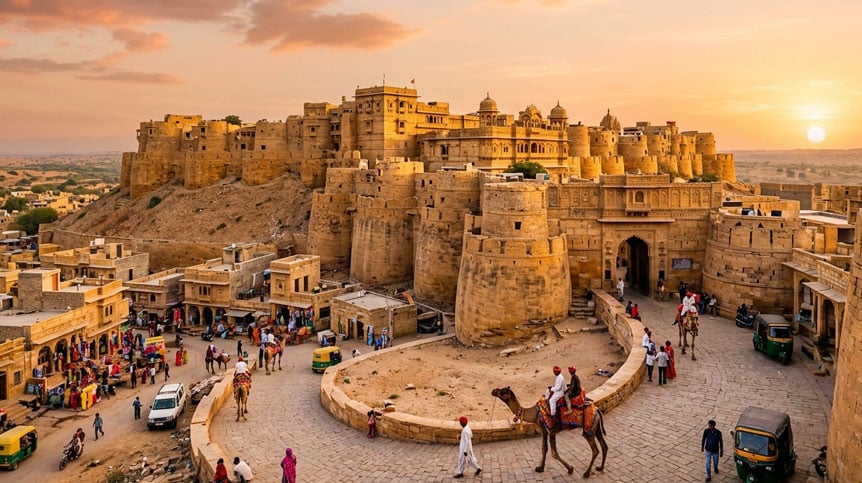

Jaisalmer Fort is different from most forts in Rajasthan because life still continues inside its walls.
Homes, temples, shops and narrow lanes sit alongside the former royal palace and old defensive structures. UNESCO describes Jaisalmer as an unusual example of a desert hill fort whose historic township remains inhabited.
For visitors, the main experience is therefore not just one palace or museum. It is the combination of the gateways, Dussehra Chowk, Jain temples, royal palace, sandstone lanes and views over Jaisalmer.
Keep around 2 to 3 hours for a first visit. Go earlier in the day if you want to include the temples in Jaisalmer, as visitor access there is concentrated in the morning.
Quick Planning Snapshot
How to Experience Jaisalmer Fort
The fort functions best when followed as a walking route through its living, residential quarters:
- Start at Akhai Pol, the first of four massive gates, to enter the fortified hilltop from the town level.
- Follow the stone ramp upward through the subsequent gates to reach Dussehra Chowk, the main central square.
- Head from the square toward the Jain Temple complex to see the cluster of seven interconnected shrines.
- Walk past the Raj Mahal (Royal Palace) and continue into the narrow residential lanes where locals still live.
- Move toward the outer bastions, such as the cannon point, to see the perimeter defences and the desert horizon.
- Exit back through the main gates or stop at a lane-side shop to see traditional stone-cutting work in progress.
What to See Inside Jaisalmer Fort
Fort Gates and the Main Approach
The experience begins before you reach the palace.
A winding uphill route passes through a series of fortified gates before opening into the main part of the citadel. UNESCO's management documentation notes that the fort historically had one main approach through a sequence of gates that acted as defensive checkpoints.
Walking through them helps you understand how the hill and narrow access route were used for defence.
Why stop here: The entrance gives the clearest sense of Jaisalmer Fort as a defensive structure rather than simply an old neighbourhood.
Dussehra Chowk
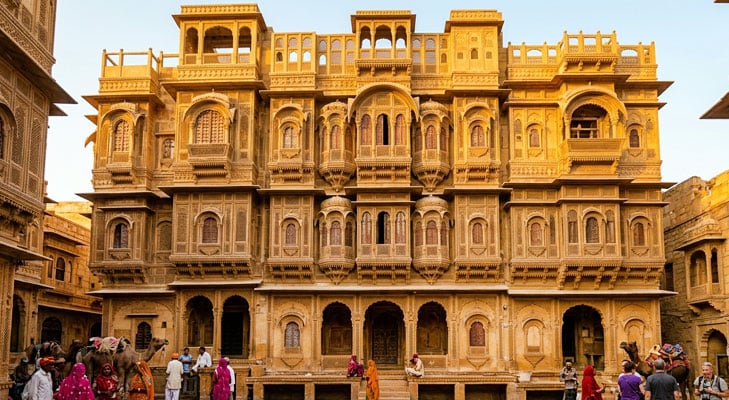
Dussehra Chowk is the main open square inside the fort and one of the easiest places to understand its layout.
The former royal palace rises around this part of the fort, while lanes lead away towards temples, houses and other sections of the settlement. UNESCO's site-management documentation identifies the palace complex and Dussehra Chowk as the fort's main focal area.
Why visit: It is the natural orientation point before entering the Palace Museum or walking deeper into the lanes.
Jaisalmer Fort Palace Museum
The former royal palace is the main ticketed heritage attraction inside the fort.
Today, the Jaisalmer Fort Palace Museum takes visitors through former royal rooms and galleries. The Jaisalmer Trust highlights the silver coronation throne, the decorated Sarvottam Vilas, murals in Rang Mahal, weapons, sculptures, historic documents and elevated views over the city.
The rooftop is also useful if you want a wider view of the tightly packed golden sandstone city below.
Why visit: Choose the museum if you want more historical and architectural context than you can get from simply walking through the public lanes.
Time needed: Around 60–90 minutes.
Current visitor hours: Around 10:00 AM–5:00 PM; reconfirm before the visit.
Current entry fee:
- Indian adult – ₹200
- Foreign adult – ₹600
- Student – ₹100
- Indian child – ₹100
- Foreign child – ₹500
The official Jaisalmer Trust booking system confirms these current tariffs.
Jain Temples
The Jain temple complex is one of the most detailed architectural stops inside Jaisalmer Fort.
The connected temples are built from the same warm sandstone as the surrounding fort, but their interiors are much more intricate. Rajasthan Tourism highlights temples dedicated to different Jain Tirthankaras, including Chandraprabhu, Rishabhdev, Sambhavnath, Shantinath and Kunthunath.
Look closely at the carved pillars, ceilings and small sculptural details rather than treating the complex as a quick religious stop.
Why visit: The temples provide the strongest close-up stone carving inside the fort and show the importance of Jaisalmer's Jain merchant community.
Time needed: Around 45–60 minutes.
Tourist visiting hours: Generally around 8:00 AM–12:00 PM.
Entry fee: Current published tariffs conflict and Rajasthan Tourism does not list an official visitor fee. Confirm the current temple and photography charges at the entrance rather than publishing an unreliable fixed amount.
Visitor note: Dress modestly, remove footwear where required and follow current rules on leather items and photography.
Living Lanes and Sandstone Houses
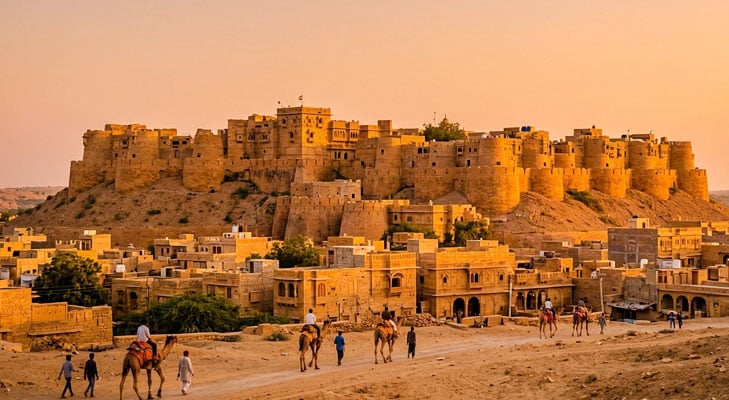
Do not finish the visit as soon as you leave the palace or temples.
Much of Jaisalmer Fort's character comes from its narrow residential lanes. UNESCO notes that most buildings inside the fort are residential houses and that habitation has always been part of the fort's character. Also it is one of the major tourist attractions of Jaisalmer.
Walk slowly and look at carved balconies, façades, small shrines and the way houses fit into the dense fortified settlement.
Why visit: This is what separates Jaisalmer from Rajasthan's largely museum-style forts.
Remember that people live here. Keep voices low around homes and avoid blocking doors or narrow lanes for photographs.
Bastions and City Views
The outer edges of the fort open onto views across Jaisalmer and the surrounding desert landscape.
The Palace Museum rooftop gives one of the clearest elevated viewpoints, while other parts of the fort allow glimpses across the sandstone rooftops and plains beyond. The Trust specifically highlights the Palace Museum rooftop for its panoramic city and desert view.
Why visit: The view helps show how compact the fort settlement is compared with the open desert around Jaisalmer.
Best Time to Visit Jaisalmer Fort
October to March is the best time to visit Jaisalmer for exploring the fort on foot.
Much of the visit takes place in exposed lanes, courtyards and stone passages, so cooler weather makes a noticeable difference.
From April to June, start early. The yellow sandstone absorbs heat, and the uphill approach and narrow streets become tiring later in the day.
During the monsoon, occasional rain can cool the fort and clear desert dust, but polished stone lanes and steps may become slippery.
If you want to include the Jain temples, plan the fort for the morning because tourist visiting hours there generally end around midday.
Jaisalmer Fort Timings and Entry Fees
| Area | Timings | Entry Fee |
|---|---|---|
| Jaisalmer Fort public lanes | No single monument-style closing time; best explored during normal daytime and early-evening hours | Free |
| Fort Palace Museum | Around 10:00 AM–5:00 PM | ₹200 Indian adult; ₹600 foreign adult |
| Jain Temple complex | Generally around 8:00 AM–12:00 PM for tourist visits | Confirm current locally managed tariff |
| Dussehra Chowk / public residential lanes | Accessible as part of the living fort |
Note: Reconfirm Palace Museum and Jain Temple hours before future publishing updates because operating arrangements can change independently.
When Is Jaisalmer Fort Busiest?
Visitor movement usually builds from late morning, particularly around Dussehra Chowk, the Palace Museum and Jain temple area.
For a calmer walk, start earlier.
The fort's narrow lanes can feel crowded quickly because visitors, residents and local traffic share limited space. This matters more than the overall number of people inside the fort.
December to February is the main travel season, so allow extra time rather than trying to move quickly through the central lanes.
Do You Need a Guide at Jaisalmer Fort?
You can explore the public lanes independently.
A guide becomes more useful if you want to understand how the gates, palace, religious buildings and residential areas fit together as one fortified settlement.
For a first visit, guided context is particularly useful around the Palace Museum and Jain temple complex.
There is no need to publish a fixed guide price unless IndianHoliday has a current authorised rate. Fees vary by guide, group size and coverage.
Nearby Attractions to Visit with Jaisalmer Fort
Patwon Ki Haveli
Patwon Ki Haveli is the strongest heritage pairing with the fort.
The group of merchant mansions shows a different side of Jaisalmer's sandstone architecture, with elaborate façades, carved balconies and latticework. Incredible India currently lists visiting hours of 9:00 AM–5:00 PM.
Keep the fort and Patwon Ki Haveli in the same heritage sightseeing block if you have enough time.
Salim Singh Ki Haveli
Salim Singh Ki Haveli is another useful old-city stop for travellers interested in carved merchant architecture.
Its upper section and distinctive balconies contrast with the heavier fort architecture.
Timings: 8:00 AM–6:00 PM.
It is optional if you are already visiting Patwon Ki Haveli and your Jaisalmer stay is short.
Gadisar Lake
Gadisar Lake works better as a lighter stop after several hours of sandstone architecture.
Pair it with the fort later in the day rather than rushing directly from the fort into a desert excursion.
For most first-time visitors, Jaisalmer Fort + Patwon Ki Haveli + Gadisar Lake creates a more balanced city sightseeing day than combining the fort with a same-day desert safari tours.
Practical Tips for Visiting Jaisalmer Fort
Continue Planning Your Jaisalmer Visit
Jaisalmer Fort is the natural starting point for understanding the Golden City.
The palace and temples give the historical context, while the inhabited lanes show why this fort still feels different from Rajasthan's other major citadels.
After the fort, continue with Patwon Ki Haveli for merchant architecture or Gadisar Lake for a quieter change of pace.
Use the Jaisalmer Travel Guide for wider city planning and the relevant Rajasthan Tour Packages when you are ready to connect the fort with a broader desert and heritage journey.


