
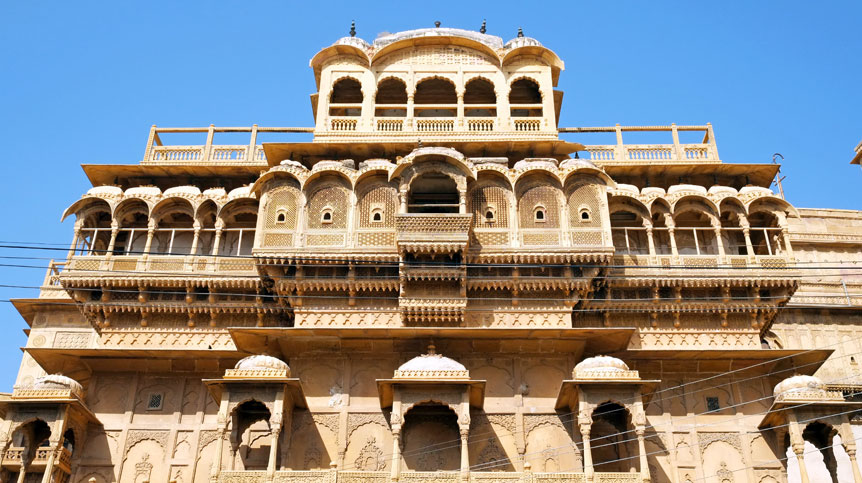

Jaisalmer’s havelis are most rewarding for travellers who enjoy architecture, craftsmanship, and slower heritage walking rather than checklist-style sightseeing. These merchant mansions are not interchangeable — Patwon Ki Haveli offers the city’s strongest overall haveli experience, Nathmal Ki Haveli is best appreciated for facade detail and architectural symmetry, while Salim Singh Ki Haveli stands out for its unusual silhouette and atmospheric old-city setting. For short-stay travellers, choosing one major haveli and combining it with a slower old-city walk is usually more rewarding than trying to enter every heritage mansion.
Which Haveli in Jaisalmer Deserves Your Time?
| If You Want… | Best Choice |
|---|---|
| Strongest overall haveli experience | Patwon Ki Haveli |
| Best intricate facade details | Nathmal Ki Haveli |
| Most unusual architecture & roofline | Salim Singh Ki Haveli |
| Best haveli for internal exploration | Patwon Ki Haveli |
| Limited time in Jaisalmer | Patwon Ki Haveli only |
| Photography-focused walking route | Salim Singh + old-city lanes |
| Architecture & carving detail | Patwon + Nathmal |
| Atmospheric heritage walking | Nathmal + nearby bazaars |
Patwon Ki Haveli
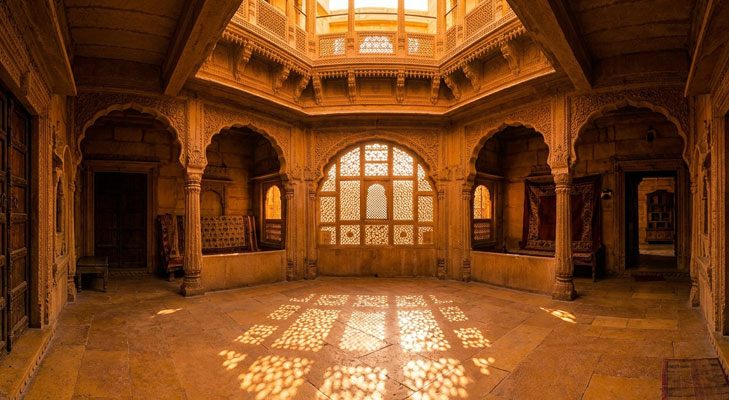
The most significant haveli in Jaisalmer — actually a cluster of five interconnected mansions built over more than 60 years along the old Silk Road. In 1805, wealthy banker Guman Chand Patwa commissioned the construction of one unique haveli for each of his five sons. Today, one haveli is privately owned by a businessman, one is under the Archaeological Survey of India, and the remaining three are still with the Patwa family. The carved facade is the most intricate in Jaisalmer — each of the five havelis has its own distinct decorative scheme, and the cumulative effect is extraordinary.
Best for: First-time visitors, architecture-focused travellers, photographers, and travellers who want the most complete haveli experience in Jaisalmer.
The Patwa family were wealthy traders in gold, silver, and brocade textiles, and the haveli complex reflects the scale of merchant wealth that passed through Jaisalmer’s caravan trade routes.
Timings: 8 AM–6 PM. The Patwa family sections are viewable from the street. Tips: Allow 45–60 minutes. The ASI-maintained haveli allows internal access — prioritise this section. The others are viewable from the street, and the exterior examination alone is worth 20–30 minutes. Morning light brings out the yellow sandstone carvings most strongly — arrive before 10 AM for the best photography.
Guide value: Guided interpretation substantially improves the experience because many carvings, merchant symbols, mirror-work rooms, and trade-era design details are easy to overlook independently.
Nathmal Ki Haveli
Built in 1885 AD by Maharawal Barisal and gifted to his Diwan Nathmal, this ornate two-storey haveli is a masterpiece of stonework. Stone elephants on either side of the haveli’s platform symbolise the majesty and status of the diwan. Nathmal’s seventh generation still resides here — internal access is not permitted, but the exterior facade is one of the finest in Jaisalmer and worth examining closely.
Nathmal Ki Haveli is especially known for the subtle asymmetry in its design — two architect brothers reportedly worked on opposite sides of the facade simultaneously, creating near-identical but not perfectly matching sections.
Timings: External viewing at any time. Tips: External viewing only. The stone elephant sculptures at the entrance are the most distinctive architectural feature — examine the carving detail up close before stepping back for the full facade view. Allow 20–30 minutes. Combine with Patwon Ki Haveli on the same circuit — both are in the old city and within easy walking distance.
Best for: Photographers, architecture lovers, and travellers interested in facade craftsmanship rather than museum-style interior exploration.
Worth dedicated time? Better treated as a visually rewarding stop within the old-city walking circuit rather than a standalone heritage attraction.
Guide value: A heritage walk guide improves appreciation of the carving styles, merchant symbolism, and Indo-Islamic influences visible across the facade.
Salim Singh Ki Haveli (Moti Mahal)
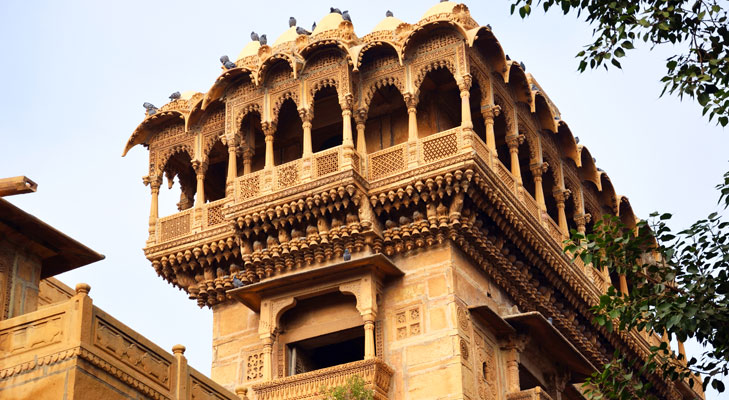
Built by Salim Singh, the powerful Prime Minister of Jaisalmer, this haveli is one of the city’s most visually distinctive heritage structures. Also known as Jahaz Mahal because of its ship-like form, the upper facade spreads outward dramatically above a narrower base, creating the illusion of a floating structure.
The haveli features 38 intricately carved balconies, each with slightly different detailing, making it one of the strongest examples of experimental sandstone architecture in Jaisalmer.
Best for: Travellers interested in unusual architecture, silhouette photography, and atmospheric old-city walking rather than museum-style interiors.
Timings: Morning visits are recommended for a full exploration. Tips: Allow 30–45 minutes. The peacock-shaped top floor is best appreciated from a distance — step back across the lane for the full silhouette view before approaching the facade. Combine with Patwon Ki Haveli on the same old city circuit.
Badal Mahal
Located inside Jaisalmer Fort, Badal Mahal (“Cloud Palace”) is known for its painted interiors, arched windows, and elevated fort views over the Golden City. Unlike the merchant-focused havelis, Badal Mahal reflects the royal architectural layer of Jaisalmer and works best as part of the wider fort circuit rather than as a standalone stop.
Best for: Travellers exploring Jaisalmer Fort in depth and visitors interested in royal rather than merchant architecture.
Worth dedicated time? Secondary compared with Patwon Ki Haveli, but worthwhile within the fort route.
Tazia Tower
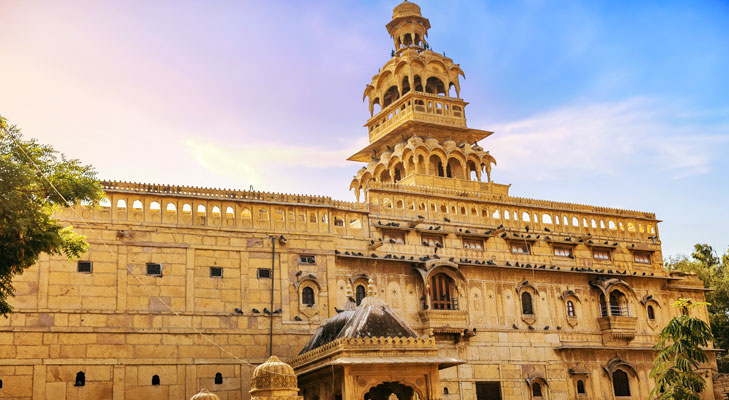
Located near the renowned Badal Palace in the centre of Jaisalmer, the Tazia Tower is a five-storey structure with each storey carrying its own architectural significance. The balconies feature different and distinctive designs at each level. Built in a city where Rajputana architecture predominates, the tower shows the cultural confluence that shaped Jaisalmer’s built environment.
Timings: Viewable at any time from the street. Entry fee: Confirm locally. Tips: Best viewed as part of the old city heritage walk rather than a standalone stop. Allow 15–20 minutes to examine each storey’s distinct balcony design.
Optional Cultural Add-Ons Near Gadsisar Lake
Travellers wanting additional cultural context beyond the havelis can add the Desert Cultural Centre and Folklore Museum near Gadsisar Lake. These work best as lighter evening add-ons rather than core heritage priorities.
Desert Cultural Centre and Museum
Located on Gadisagar Road, established in 1997 by N.K. Sharma and maintained by the Jaisalmer Tourism Department. Strongest for its evening puppet show and folk-culture displays. Best paired with Gadsisar Lake sunset.
Folklore Museum
A private museum on the shores of Gadsisar Lake, established in 1984 by K. Sharma. More useful for travellers specifically interested in Thar Desert customs and ethnographic collections.
Jain Temples (Within Jaisalmer Fort)
The Jain temples inside Jaisalmer Fort are architecturally important but work better as part of the fort circuit rather than the haveli layer itself.
Seven Jain temples were built between the 12th and 15th centuries within the fort complex. The largest is the Parsvanath Temple, the most architecturally significant. Others include Chandraprabhu, Rishabhdev, Shitalnath, Kunthunath, and Shantinath temples.
Timings: Most temples 6 AM–7 PM; Chandraprabhu 8 AM–6 PM. Tips: Visit as part of a Jaisalmer Fort morning circuit. Remove footwear before entering all temple sections. Photography rules vary — confirm locally before shooting.
Best for: Travellers interested in temple carvings and fort-era architecture rather than merchant-haveli craftsmanship.
Heritage Stays
Several of Jaisalmer’s havelis have been converted into heritage hotels — the strongest way to experience the city from within its historic architecture.
- Hotel Garh Jaisal Haveli — 11th-century castle on Gadisagar Lake with honey-coloured suites, outdoor restaurant, garden café, and bar lounge with live entertainment. Best for travellers wanting fort and lake proximity.
- Hotel Royal Haveli — Within 300 metres of Gadsisar Lake. Heritage property with fort views. Better for quieter stays near Gadsisar.
- Hotel Swan Haveli — 2-minute walk from the neighbourhood market with a rooftop restaurant and views of the Golden Fort. Strongest for rooftop photography and market access.
Tips: Heritage haveli stays book out 4–6 weeks in advance during the October to February peak season. Book early — particularly for the Desert Festival period in February.
How to Plan Jaisalmer’s Haveli Circuit
Short Stay (Best for First-Time Visitors)
Patwon Ki Haveli → Nathmal Ki Haveli → old-city walking lanes → rooftop café stop.
Photography-Focused Route
Salim Singh Ki Haveli → narrow old-city lanes → Jaisalmer Fort viewpoints → late-afternoon sandstone photography.
Full Heritage Day
Jaisalmer Fort → Jain Temples → Badal Mahal → Patwon Ki Haveli → Gadsisar Lake → Desert Cultural Centre puppet show.
Planning Notes
- Patwon Ki Haveli is the only haveli that genuinely rewards deeper internal exploration.
- Nathmal Ki Haveli is primarily an exterior architectural stop.
- Salim Singh Ki Haveli is strongest for silhouette photography and facade appreciation.
- October–March is the best season for haveli walking routes.
- Midday heat can make old-city walking uncomfortable between April and June.
- Heritage walks become significantly more rewarding with local storytelling around trade history and merchant families.
Continue Planning Your Jaisalmer Heritage Trip
Travellers exploring Jaisalmer’s havelis often combine them with fort circuits, desert routes, and slower old-city walking experiences.
Continue planning through:


