


Chittorgarh’s sightseeing is centred around Chittorgarh Fort, a vast hill-fort complex filled with palace ruins, towers, temples and water structures. It is part of UNESCO’s Hill Forts of Rajasthan and was once an important centre of the Mewar kingdom.
The major attractions of Chittorgarh fort include Rana Kumbha Palace, Padmini Palace, Vijay Stambh, Kirti Stambh, Ratan Singh Palace and Fateh Prakash Palace. These attractions are spread across the fort rather than concentrated in one area, so a visit needs more time than a typical palace stop.
If you are interested in history, architecture or Rajasthan’s royal past, keep enough time to understand the stories behind the ruins rather than treating Chittorgarh Fort as a quick sightseeing stop.
Chittorgarh Fort
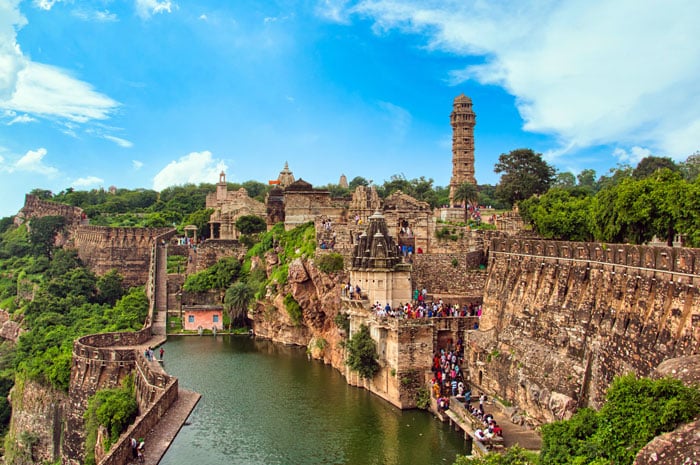
Chittorgarh Fort is the chief attraction of the city. This huge hill fort was once an important centre of the kingdom of Mewar. UNESCO describes Chittorgarh as a former capital of the Sisodia rulers and notes its connection with three major historical sieges. Its surviving structures are several centuries old.
Inside the Chittorgarh fort, you will find palaces, temples, towers, reservoirs and old residential areas. The monuments are spread out, so the fort does not feel like a single building. But two landmarks stand out immediately: Vijay Stambh and Kirti Stambh.
Vijay Stambh, or the Tower of Victory, was built by Maharana Kumbha between 1440 and 1448. The nine-storey tower is decorated with detailed carvings of Hindu deities.
Kirti Stambh, or the Tower of Fame, is older. It dates to the 12th century and is dedicated to Adinath, the first Jain Tirthankara.
But these towers are only part of the experience. The palaces inside the fort reveal another side of Chittorgarh.
- Opening Hours: Sunrise to sunset.
- Entry Fee: ₹40 for Indian adults and ₹600 for foreign visitors.
- Time Needed: At least 3 to 4 hours for the major attractions.
Rana Kumbha Palace
Rana Kumbha Palace is one of the most important palace ruins inside the Chittorgarh Fort.
The present name can be slightly misleading, as the palace was built before Maharana Kumbha. It became known as Kumbha Mahal after he restored and expanded it during his reign.
Today, much of the palace is in ruins, yet its scale is still clear. You can see remains of residential areas, courtyards and sections linked with the royal household. The complex includes areas known as the Suraj Gokhada, Janana Mahal and Kanwarpada Palace.
Do not expect a polished palace interior as you would find in Udaipur. The Rana Kumbha Palace is interesting because of what remains of it.
Walking through its broken walls and open courtyards helps you understand the fort as a place where people once lived, governed and gathered.
- Opening Hours: Visit during Chittorgarh Fort’s operating hours.
- Entry Fee: Normally covered within the Chittorgarh Fort ticket; no separate entry ticket is generally required.
Padmini Palace
Padmini Palace sits beside a water body within the fort complex.
The white palace is closely associated with the story of Rani Padmini, or Padmavati, and the siege of Chittor by Alauddin Khalji.
However, travellers should understand the difference between recorded history and later tradition.
The famous story of Padmini and the mirror is part of a long literary and local tradition. Contemporary accounts of Alauddin Khalji’s 1303 campaign do not mention Padmini. Her best-known story appears much later in Malik Muhammad Jayasi’s 16th-century poem Padmavat.
But that does not make the Padmini palace insignificant. The story has become so deeply connected with Chittorgarh’s cultural memory that it is best approached with that context rather than presenting every part of the legend as confirmed history.
The setting itself is also worth seeing. The palace stands beside the water and feels very different from the heavier ruins of Rana Kumbha Palace.
- Opening Hours: Sunrise to sunset.
- Entry Fee: Included within Chittorgarh Fort entry; no separate ticket is normally required.
Fateh Prakash Palace and Government Museum
Fateh Prakash Palace belongs to a much later period of Chittorgarh’s history.
Maharana Fateh Singh built the palace as a residence, but today, the building houses the Government Museum. The museum’s collection comprises weapons, paintings, sculptures, regional craft objects and other material connected with the area.
It is worth including if you enjoy museums or want more context after seeing the ruins. The experience is different from Rana Kumbha Palace.
One is mainly explored through surviving architecture. The other helps you understand the region through objects and collections.
- Opening Hours: 9:45 AM to 5:15 PM, Tuesday to Sunday. Closed on Mondays.
- Entry Fee:
- Indian Adult: ₹20
- Indian Student: ₹10
- Foreign Adult: ₹100
- Foreign Student: ₹50
- Children below 7 years: Free
Ratan Singh Palace
Ratan Singh Palace used to serve as a winter palace for the royal family. Today it overlooks a small lake. While much of the building is now weathered, the setting remains attractive.
After the busier areas around Vijay Stambh and Padmini Palace, Ratan Singh Palace can offer a slower stop with more space to take in the fort landscape.
- Opening Hours: 9:30 AM to 6:00 PM.
- Entry Fee: Included within Chittorgarh Fort entry; no separate ticket is normally required.
Jaimal and Patta Palaces
The ruins of the palaces of Jaimal and Patta also belong to Chittorgarh’s wider group of historical monuments. Rajasthan Tourism officially considers them as significant structures.
They are smaller than the major palace sites and may not need much time to explore. But they still help the visitor complete the picture of Chittorgarh as a fortified settlement rather than a single royal residence.
- Opening Hours: 9:30 AM to 6:30 PM.
- Entry Fee: Included within Chittorgarh Fort entry; no separate ticket is normally required.
Temples and Water Structures
Temples and water systems are a major part of the fort, and UNESCO specifically notes that Rajasthan’s hill forts combined defensive structures with palaces, settlements, temples and extensive water-harvesting systems.
Famous temple near chittorgarh include Meera Temple, Kumbha Shyam Temple and Gaumukh Reservoir. The Gaumukh Reservoir is fed by a spring emerging from a rock formation shaped like a cow’s mouth.
What Should You Prioritise If You Have Limited Time?
If this is first visit, start with the places that show you the fort’s main gateways and landscapes; subsequently, you can spend time in and around Vijay Stambh and Rana Kumbha Palace.
Later, continue to Padmini Palace for a different architectural experience and to get to know the stories behind it.
If time permits, add Kirti Stambh, Meera Temple and Gaumukh Reservoir to your list as well. If you enjoy visiting museums, Fateh Prakash Palace is useful for you. Ratan Singh Palace and the smaller ruins suit visitors who have more time at hand and prefer exploring beyond the busiest stops.
How Much Time Should You Keep for Chittorgarh Fort?
Keep at least three to four hours if you want to see the main monuments without rushing. History-focused travellers can comfortably spend longer.
Do you need a Guide?
For Chittorgarh, a good guide is worth considering as most monuments are in ruins. A guide can help you with historical context and help you understand different periods and documented history.
Choose an approved guide and agree on the route and time before starting.
When Is the Best Time to Visit Chittorgarh Fort?
October to March is the most comfortable period for exploring Chittorgarh Fort. Much of the sightseeing takes place outdoors, and cooler daytime temperatures make it easier to move between the palaces, towers and temples.
From April to June, start early and avoid leaving the larger outdoor sections for the hottest part of the afternoon.
Why Chittorgarh Feels Different from Rajasthan’s Other Forts
Rajasthan has several great forts, but they do not offer the same experience. Chittorgarh feels different as its impact comes from scale, ruins, and its multifaceted historical relevance.
For travellers who enjoy history and architecture, that difference makes Chittorgarh worth slowing down for.
Continue Planning Your Chittorgarh Visit
After exploring the forts and palaces, continue with the Chittorgarh Travel Guide for an overview of the city.
If Chittorgarh is part of a wider heritage journey, explore Rajasthan Tour Packages for itinerary ideas that combine it with Udaipur, Jaipur, Bundi and other destinations.


