


Chittorgarh, home to the majestic Chittorgarh Fort, a UNESCO World Heritage site that speaks volumes about Rajasthan’s rich history and valour. The fort complex, with its palaces and temples, offers a peek into the royal past.
Standing proudly in the southeast of Rajasthan, Chittorgarh city is a repository of historic monuments, rich heritage and an evergreen folklore that is widely appreciated all over the world. In order to define the city’s historic valour and bravery, Chittorgarh has numerous attractions to depend on. One of the major attractions to look out in this part of Rajasthan is Chittorgarh fort. Resting on a 180 m high hill, the fort depicts the heroic battles of many Indian warriors such as Gora, Maharana Pratap and Kumbha.
Chittorgarh Fort is also one of the six Hill Forts of Rajasthan recognised as a UNESCO World Heritage Site. UNESCO notes the scale and variety of its remains, which date from different periods between the 8th and 16th centuries.
Explore the grandeur of the city using our detailed chittorgarh tour guide to plan your trip seamlessly.
Chittorgarh Sightseeing at a Glance
| Planning Point | What Works Best |
|---|---|
| Ideal for | History lovers, cultural travellers, architecture enthusiasts and photographers |
| Minimum time | Keep aside at least 3 to 4 hours for the main fort attractions |
| Better experience | A full day is necessary if you want to include temples, quiet ruins and the museum |
| Guide | Useful, especially for understanding the ruins and the historical context behind it |
| Best period | October to March for more comfortable sightseeing during the day |
| Pacing | Do not plan every monument. Prioritise according to your interests |
| Getting around | There is walking involved, but you need a car wherever possible to move around comfortably. |
Forts, Towers and Historic Landmarks in Chittorgarh
Here are the most significant landmarks of Chittorgarh that are recommended for any traveller.
Chittorgarh Fort
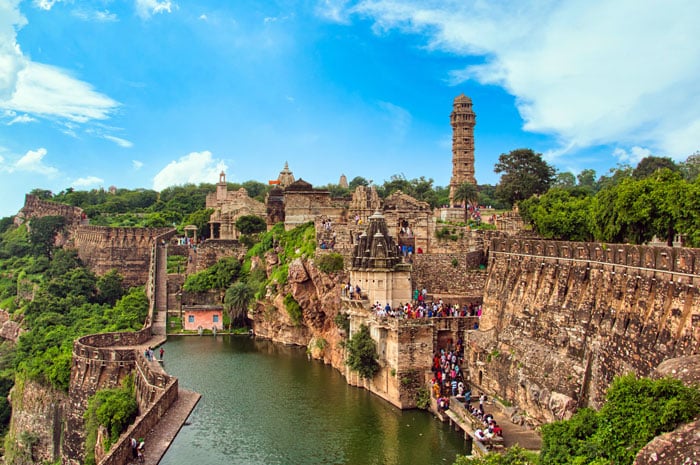
Chittorgarh Fort is not simply the main attraction. It contains most of the places you will want to see.
This majestic hill fort was once a major centre of Mewar. It is closely connected with the history of the Sisodia rulers and has witnessed major sieges. Chittorgarh is described by UNESCO as an exceptional fort owing to its scale and sturdy architecture.
Best for: First-time visitors, history and architecture enthusiasts
Time needed: At least 3–4 hours for the main sights
Pair with: The major attractions below as part of the same fort visit
Vijay Stambh
Vijay Stambh, or the Tower of Victory, is one of the most recognisable landmarks of Chittorgarh.
Built by Maharana Kumbha between 1440 and 1448, this nine-storey-high tower was used to commemorate his victories. The exterior walls are filled with carvings of Hindu deities and other figures.
Best for: Architecture, history and photography
Time needed: Around 20–30 minutes is sufficient
Pair with: Rana Kumbha Palace and other central fort monuments
Kirti Stambh
This seven-storey Tower of Fame dates back to the 12th century and is dedicated to Adinath, the first Jain Tirthankara. Built by a wealthy Jain merchant, the Kirti Stambh is decorated with Jain figures and has Jain temples surrounding its vicinity.
Best for: Jain heritage, architecture and detailed stone carving
Time needed: Around 20–30 minutes
Pair with: The Jain temples within Chittorgarh Fort complex
Palaces Inside Chittorgarh Fort
Rana Kumbha Palace
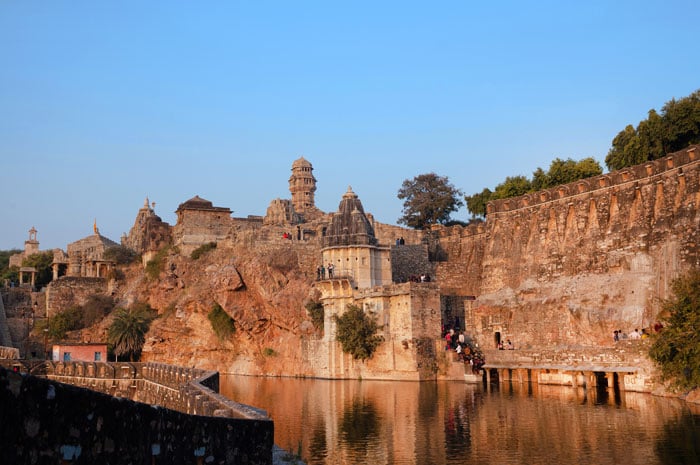
Rana Kumbha Palace is one of the most important ruins inside the fort. One useful detail to note is that the original palace predates Maharana Kumbha. It came to be known as Kumbha Palace because it was restored and expanded by Maharana Kumbha. While much of it lies in ruins, the Rajasthan Tourism body identifies various sections like Suraj Gokhada, Janana Mahal and Kanwarpada Palace.
A guided tour is highly recommended; without one, you may just see walls, passages and open courtyards.
Best for: Travellers interested in Mewar history
Time needed: Around 30–45 minutes
Pair with: Vijay Stambh and the nearby heritage section of the fort
Padmini Palace
Padmini Palace stands beside a water body within the Chittorgarh Fort complex.
The palace is historically associated with Rani Padmini and is one of the best-known places connected with legends, cultural memories and lore of Chittorgarh. Rajasthan Tourism describes the palace as standing beside a lotus pool and designed for privacy for royal women of the household.
Best for: First-time visitors and travellers interested in Chittorgarh’s historical traditions
Time needed: Around 20–30 minutes
Pair with: Other palace and heritage stops within the fort circuit
Ratan Singh Palace
Ratan Singh Palace is a quieter place and served as a winter palace for the royal family overlooking a small lake. While the structure seems weather-worn, the setting and location make it an interesting choice for travellers to explore.
If your visit is short, this does not need to take priority over Rana Kumbha Palace or Padmini Palace.
Best for: Travellers who enjoy quieter ruins
Time needed: Around 20 minutes
Pair with: Other less-crowded parts of the fort
Fateh Prakash Palace
Fateh Prakash Palace was built during Maharana Fateh Singh’s reign. It offers a glimpse into the later period of royal life at Chittorgarh Fort. Today, it houses a museum displaying sculptures, weapons and historic objects. Visit it if you are interested in more context beyond the fort’s monuments.
Best for: History lovers
Time needed: 30–45 minutes
Pair with: Vijay Stambh and Rana Kumbha Palace
Temples and Places of Worship
Temples form a significant part of the Chittorgarh fort complex.
Meera Bai Temple and Kumbha Shyam Temple
Both these temples are 15th-century shrines located inside the Chittorgarh Fort.
Kumbha Shyam Temple has much older origins. Rajasthan Tourism states that it was originally dedicated to Lord Varaha (a powerful boar incarnation of Lord Vishnu) and was later renovated by Maharana Kumbha in the 15th century.
The nearby Meera Bai Temple is associated with the poet-saint Meera Bai and her devotion to Lord Krishna. The temple stands on a raised platform and follows a traditional North Indian temple form.
Best for: Spiritual heritage, architecture and travellers interested in Meera Bai
Time needed: Around 30–45 minutes for both temples
Pair with: Main heritage monuments in the fort
Kalika Mata Temple
The Kalika Mata temple dates back to the 8th century and was originally associated with worship of the Sun God. During the 14th century, the structure suffered major damage during the invasions of Alauddin Khilji. Subsequently, the site was reconsecrated and rebuilt as a temple dedicated to Goddess Kali.
It is worth including if temple architecture interests you, but you must remember that it’s a place of worship and behave accordingly.
Best for: Temple architecture and religious heritage
Time needed: Around 20–30 minutes
Pair with: Other sacred sites within the fort
Water and Landscapes around Chittorgarh
UNESCO recognises the historical water harvesting systems across the hill forts in Rajasthan.
Gaumukh Reservoir
Gaumukh Reservoir is one of Chittorgarh Fort’s best-known water structures.
There is a natural spring that flows through a rock that is shaped just like a cow’s mouth into a reservoir below, hence the name Gaumukh. The site holds religious significance, particularly for natives.
The ground is uneven, and the steps are slippery, which makes access a bit inconvenient for travellers with mobility issues.
Best for: Cultural context, photography and travellers exploring beyond the main monuments
Time needed: Around 20–30 minutes
Pair with: Temple stops within the wider fort visit
How to Plan Your Chittorgarh Sightseeing
If You Have 3–4 Hours
Prioritise Chittorgarh Fort, Vijay Stambh, Rana Kumbha Palace, Meera Bai and Kumbha Shyam temples, and Padmini Palace.
These provide you with a good variety of fort history, architecture and religious heritage of Rajasthan.
If You Have a Full Day
Start with all the major attractions but slow down a little.
Add Kirti Stambh, Gaumukh Reservoir, Kalika Mata Temple, Ratan Singh Palace and Fateh Prakash Palace Government Museum to your itinerary.
This works much better for travellers who want to understand Chittorgarh’s history.
If You Are Staying Overnight
An overnight stay gives you more flexibility to explore more and prioritise sites that interest you more.
Travellers staying longer can also consider Bassi or use Chittorgarh as part of a wider Mewar route.
Do you need a guide?
Guided context always helps when you are interested in understanding history. Several palace structures are close to ruins, and without explanation, it will be difficult to know about their glorious past.
Chittorgarh is also closely connected with both documented history and stories passed down through local tradition.
For travellers who value cultural depth, that context often adds more to the visit than trying to see two or three additional monuments.
Best Time of Day for Sightseeing
Try to begin in the morning.
Since the majority of the fort visit is outdoors, there is a lot of walking involved; hence, beginning in the morning is highly advisable.
The months of October to March usually offer the most comfortable conditions for long heritage visits. During warmer months, an early start becomes even more useful.
Keep water with you and wear comfortable footwear. Palace ruins, temple areas and old paths can include uneven stone and steps.
Continue Planning Your Chittorgarh Visit
Use the Chittorgarh Travel Guide for an overview of the destination, then continue to the dedicated Forts and Palaces in Chittorgarh page if you need more detail on its royal architecture.
For a wider journey, explore Rajasthan Tour Packages that include Chittorgarh alongside Udaipur, Bundi, Jaipur or other heritage destinations.


