
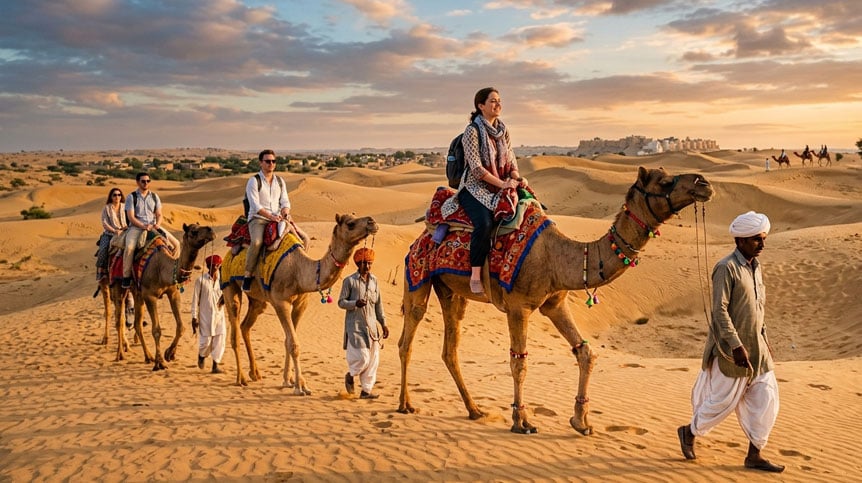

Jaisalmer works best for travellers who want desert heritage, living-fort atmosphere, and dune experiences in one compact route. The strongest trip usually combines Jaisalmer Fort, one haveli circuit, one lake or sunset stop, and one desert experience rather than trying to cover every attraction equally. First-time visitors should prioritise Sonar Quila, Patwon Ki Haveli, Gadsisar Lake, and Sam Sand Dunes, while slower travellers can add Khuri, Kuldhara, Khaba Fort, Desert National Park, Tanot Mata, and Longewala.
Two to three days cover Jaisalmer properly. Add one extra day for a western desert circuit or a day trip to Kuldhara and Bada Bagh. October to March is the strongest window. February is the most vibrant month — the three-day Desert Festival transforms the city and dunes into a carnival of camel races, folk performances, and turban-tying contests.
Which Jaisalmer Attraction Should You Prioritise?
| Traveller Need | Best Choice |
|---|---|
| Essential Jaisalmer experience | Jaisalmer Fort |
| Best desert experience | Sam Sand Dunes overnight |
| Quieter desert stay | Khuri Sand Dunes |
| Best architecture | Patwon Ki Haveli |
| Best family evening | Gadsisar Lake + puppet show |
| Best sunset photography | Bada Bagh |
| Wildlife and desert ecology | Desert National Park |
| Offbeat ruined settlements | Kuldhara + Khaba Fort |
| Border-history experience | Tanot Mata + Longewala |
| Limited time | Fort + havelis + Sam sunset |
Jaisalmer Fort (Sonar Quila)
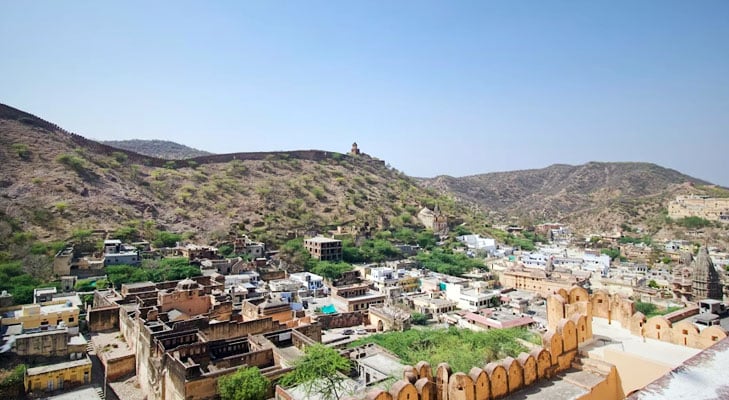
The defining landmark of Jaisalmer and one of the largest living forts in the world, approximately 3,000 people still reside within its walls. Built in 1156 by the Bhati clan from the same yellow sandstone as the surrounding desert, the fort turns honey-gold at sunset and is classified as a UNESCO World Heritage Site. The fort’s 99 turrets are visible for miles. Within its walls: seven interconnected Jain temples, Laxminath Temple, Patwon Ki Haveli, shops, restaurants, and winding lanes that feel like a storybook city.
Best for: First-time visitors, heritage walkers, photographers, and travellers who want to experience a living fort rather than a closed monument.
Timings: 9 AM–5 PM.
Havelis
1. Patwon Ki Haveli
The first and most elaborate haveli in Jaisalmer — a cluster of five interconnected mansions built over 50+ years by wealthy banker Guman Chand Patwa from 1805. Ornate jharokhas, gateways, archways, and intricate carvings across the entire facade. One haveli houses a museum. The most celebrated haveli architecture in the city.
Timings: 8 AM–6 PM. Entry fee: Standard charges apply — confirm locally.
2. Nathmal Ki Haveli
Two-storey masterpiece of stonework built in 1885. Stone elephants flank the entrance. Ceiling and wall paintings including two made with 1.5 kg gold leaf. Look for hidden animals, flowers, and miniature soldiers carved into the walls — the hidden figures are the distinctive feature that most visitors walk past without noticing. External viewing — seventh-generation family still resides within.
Timings: External viewing at any time. Entry fee: Confirm locally.
3. Salim Singh Ki Haveli (Jahaz Mahal)
Built by Salim Singh, former prime minister of Jaisalmer, completed 1815. Famous for 38 well-designed balconies and a rooftop resembling a peacock. The structure’s ship-like silhouette earns it the name Jahaz Mahal.
Timings: Morning visits recommended for a full exploration. Entry fee: Confirm locally.
Gadsisar Lake
Built in 1400 AD by Maharwal Gadsi Singh as a water conservation reservoir, Gadsisar Lake is now Jaisalmer’s most scenic leisure destination. The lake is surrounded by shrines, pavilions, and temples on its banks. Migratory waterfowl visit between October and March — one of the best birdwatching spots in Jaisalmer. Boat rides at sunset are the signature experience here.
Timings: 8 AM–8 PM. How to reach: 2.5 km from Jaisalmer Railway Station — a short tuk-tuk or cab ride.
Missing experience: Gadsisar Lake also has a light-and-sound / laser water show that adds historical storytelling to the lakeside experience. It works best as an evening add-on after boating or sunset photography.
Jain Temples (Fort Complex)
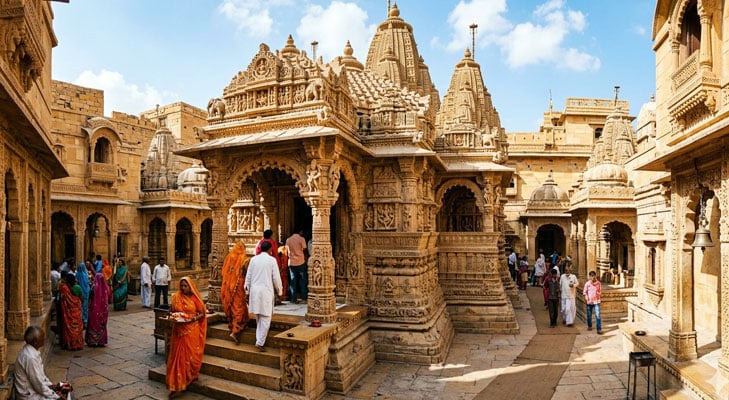
Seven interconnected Jain temples within the Jaisalmer Fort complex, built between the 12th and 15th centuries. The temples collectively house priceless ancient Jain manuscripts in basement rooms. Key temples: Parsvanath (largest, most celebrated facade), Sambhavnath (historical library with 11th-century texts), Chandraprabhu (1509 AD, intricate carved dome), Rishabhdev, Sheetalnath, Shantinath (1536), and Kunthunath.
Timings: Most temples 6 AM–7 PM; Chandraprabhu 8 AM–6 PM. Entry fee: Free. Rules: Dress modestly — shoulders and knees covered. Remove footwear. No food, leather goods, or shoes on temple grounds. Maintain silence. Photography rules vary — ask before shooting.
1. Amar Sagar Lake and Jain Temple
Amar Sagar works best as a quieter heritage-lake stop outside the main city circuit. The Jain temple and lake setting make it useful for travellers who have already covered Gadsisar Lake and want a less crowded extension.
Worth dedicated time? Optional; best for slower travellers and photographers.
2. Tazia Tower and Mandir Palace
Tazia Tower, near Mandir Palace, is a distinctive multi-storey structure known for its delicate balconies and unusual Islamic-influenced detailing within Jaisalmer’s sandstone architecture. It works best as a short architectural stop within the old-city circuit rather than a standalone attraction.
Best for: Architecture lovers and photographers.
Worth dedicated time? No, add it while exploring nearby markets and havelis.
Sam Sand Dunes
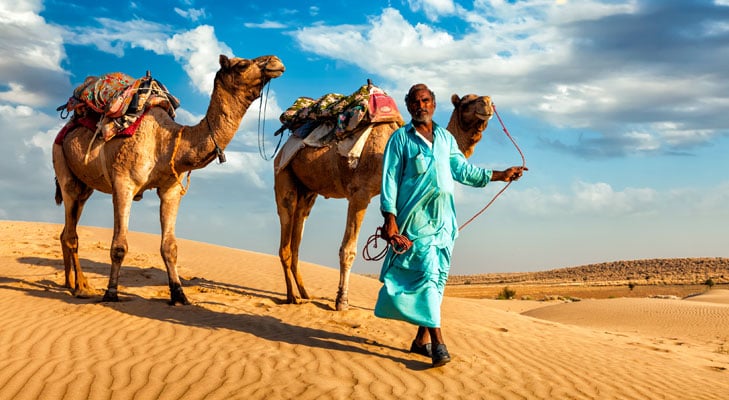
42–45 km west of Jaisalmer, Sam is the most popular desert dune destination in Rajasthan. Dunes reach 30–60 metres. The standard Sam sequence: depart Jaisalmer by 3–4 PM → camel or jeep safari → sunset at Sam Sunset Point → desert camp evening with Kalbelia dance, folk music, and Rajasthani dinner → overnight stay for stargazing and early morning silence.
Timings: Open 24 hours.
Best for: First-time desert travellers, families, couples, and visitors wanting the classic Jaisalmer camp-and-dune experience.
Kuldhara Abandoned Village
Worth visiting for atmosphere and photography, not for long exploration.
35 km from Jaisalmer. The entire population of Paliwal Brahmins vanished mysteriously in a single night over 200 years ago. The village remains eerily intact — streets, houses, and a temple all preserved. One of India’s most intriguing abandoned settlements.
Timings: 10 AM–6 PM. Entry fee: Small entrance fee — confirm locally.
Longewala War Memorial
Longewala War Memorial is best visited with Tanot Mata Temple as part of a full-day border-history route from Jaisalmer. It gives military context to the 1971 Indo-Pak war and works especially well for families, history enthusiasts, and travellers interested in India’s desert frontier.
Bada Bagh and Vyas Chhatri
6 km from Jaisalmer. A garden complex containing royal cenotaphs (chhatris) of the Maharajas of Jaisalmer — displaying a mix of Mughal, Paliwal, and Rajputana architectural styles. The Govardhan Stambh pillar, a dam, and a garden complement the cenotaphs. One of the strongest sunset photography spots near Jaisalmer. Adjacent Vyas Chhatris are dedicated to Hindu Sage Ved Vyas Ji — commanding views of Jaisalmer city.
Timings: Bada Bagh 8 AM–6 PM; Vyas Chhatri 8 AM–7:30 PM. Entry fee: Confirm locally.
Desert National Park
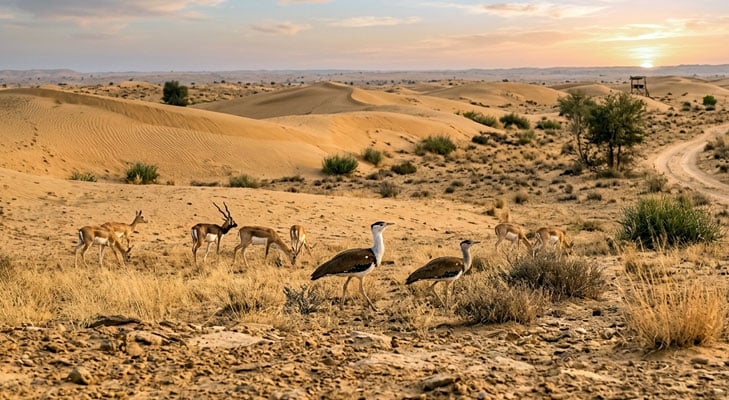
10 km from Jaisalmer. Spanning 3,162 square kilometres, Desert National Park is one of the largest national parks in India and the best place to understand the Thar Desert’s surprising biodiversity. The park’s landscape combines sharp rocks, rolling sand dunes, salt lakes, and mixed terrain.
Wildlife: The endangered Great Indian Bustard (Godawan) — one of the heaviest flying birds in the world — is the signature species. Also: chinkara, blackbuck, desert fox, desert cat, desert gerbil, sand grouse, blue bull, and eagles. Winter brings migratory birds including Eastern Imperial Eagle, Himalayan and Eurasian Griffon Vultures, and Saker Falcon.
Timings: 6 AM–6 PM.
Best for: Wildlife enthusiasts, birdwatchers, photographers, and repeat Rajasthan travelers.
Worth dedicated time? Yes for wildlife-focused travelers; optional for short first-time Jaisalmer trips.
Akal Wood Fossil Park
Around 15 km from Jaisalmer, Akal Wood Fossil Park is a specialist geological attraction where fossilised tree trunks and remains reveal the ancient natural history of the Thar region. It is not a mainstream sightseeing stop, but it adds unusual depth for travellers interested in geology, children’s learning experiences, or offbeat desert landscapes.
Best for: Families with curious children, geology-focused travellers, and repeat visitors.
Worth dedicated time? Optional; best added if you have an extra half day or are interested in natural history.
Optional Desert Adventure Add-ons
These are secondary experiences after the core fort, haveli, lake, and dune circuit. They should not dominate the attractions page.
1. Camel Safari
The most iconic Jaisalmer experience. Five formats available:
- Short rides (1–2 hours) — Best for families and first-timers. Sunset timing 4:30–6:30 PM. Includes dunes, sunset, tea and snacks. Cost: INR 20–200.
- Half-day safaris — Remote village visits, traditional Rajasthani meal in the dunes, desert wildlife spotting. Choose early morning or evening departures.
- Full-day safaris — Sam dunes, desert villages, oasis points, multiple camel sessions. Best October–February. Includes traditional lunch with a local family.
- Overnight camel safari — Evening ride → desert camp → Manganiyar folk music → bonfire → sleeping under stars on traditional khats → golden sunrise → morning ride back. Carry warm layers for chilly desert nights.
- Multi-day treks (2–3 nights) — 60–80 km of varied Thar terrain covering remote villages, ancient trade routes, and untouched dunes. Daily 4–5 hour camel rides, different camping spots each night.
Best locations: Sam Sand Dunes (most facilities), Khuri Dunes (quieter, more authentic), Lodhruva and Kuldhara (combine safari with heritage site visits).
2. Jeep Safari and Dune Bashing
4×4 SUV rides through the shifting Thar dunes. Covers abandoned villages, ancient ruins, and hidden desert spots that camel safaris can’t reach.
Cost: INR 500–1,500. Best time: October to March.
3. Quad Biking
Four-wheeled motorbikes across the sand dunes — genuinely thrilling on the dune terrain ups and downs. Available for single and multiple seats.
Cost: INR 800–1,700 per person standalone; INR 4,000–6,000 for a package including quad biking, desert safari, night camping, and bonfire. Best time: October to March. Rules: Carry passport for international visitors. No sharp objects, lighters, alcohol, or knives permitted. Stay hydrated throughout.
4. Parasailing and Paramotoring
Aerial views of the desert city from above. Expert accompanies all rides. Available through desert camp operators and adventure sports providers.
Cultural and Desert Heritage
1. Desert Culture Centre and Museum
Gadsisar Road. Established in 1997 by N.K. Sharma, maintained by the Jaisalmer Tourism Department. Traditional musical instruments, medieval coinage, ethnic items, fossils, jewellery, handicrafts, weapons, and a traditional opium mixing box. Evening puppet show — 40 minutes, strong cultural entertainment for families.
Timings: 10 AM–8 PM.
Best for: Puppet shows and family-friendly cultural context.
2. Thar Heritage Museum
Privately owned. Documents, postcards, ornaments, weapons, coins, types of turbans, kitchen equipment, death and birth customs, fossil collection, and a traditional Snakes and Ladders game. Evening puppet shows.
Timings: 8 AM–6 PM.
Best for: Desert customs, turbans, fossils, and local-life collections.
3. Folklore Museum
On the shores of Gadsisar Lake. Private museum established in 1984. Covers customs and cultural history of the Thar Desert people.
Timings: Confirm locally.
Best as a
4. Jaisalmer War Museum
Near Thaiyat. War artefacts, tales of actual battles, historical weapons, and stories of the emperors who controlled the city. Suited for history enthusiasts and families interested in military history.
Timings: Confirm locally.
Best for military-history travellers and families.
Day Trips from Jaisalmer
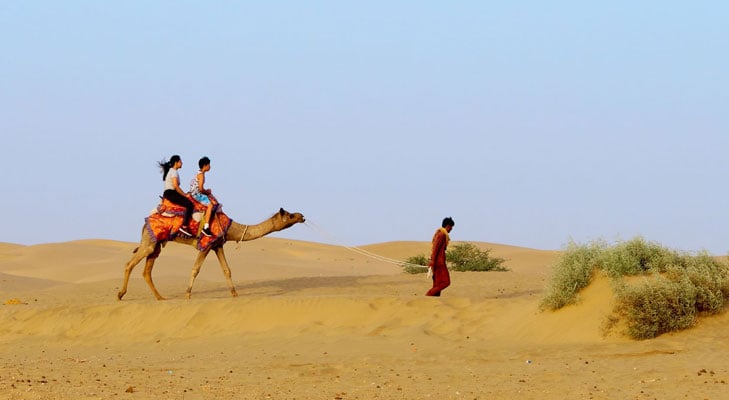
- Khuri Sand Dunes (40 km) — Quieter alternative to Sam. Softer, more organic dunes with fewer visitors. Intimate camp experience with traditional mud-and-thatch huts. Tips: Overnight here for the best night sky experience in the Jaisalmer region.
- Lodhruva Jain Temple (17 km) — Ancient Jain temple complex in vivid yellow sandstone. Parshvanath Temple with extraordinary jaali latticework. Peacocks roam the grounds. Visit around 11 AM for golden light on the stone. Timings: 6 AM–6 PM. Full coverage under Jaisalmer Temples.
- Khaba Fort (32 km) — Abandoned fort with ruins of homes from the once-prosperous Paliwal Brahmin community. Small museum displaying Paliwal artefacts. Panoramic desert views from the fort walls. Timings: 8 AM–6 PM. Nominal entry charge. Combine with Kuldhara on the same abandoned-settlement circuit. Best with Kuldhara; optional on short stays.
- Tanot Mata Temple (120 km) — Temple near the Indo-Pakistan border, famous for unexploded bombs from the 1965 war displayed in the museum. Managed by the Border Security Force. Carry identification — photography restrictions may apply. Timings: 6 AM–6 PM. October to March only.
Shopping
Shopping in Jaisalmer is strongest when focused on desert-specific crafts rather than generic Rajasthan souvenirs.
- Sadar Bazaar — Camel Leather shoes, Rajasthani puppet dolls, antiques, camel leather products, handicrafts. Timings: 10 AM–6 PM. Wide bargaining scope.
- Bhatia Bazaar — Textiles, sarees, traditional clothing, mirror work, wooden boxes. Timings: 9 AM–8 PM.
- Sonaron ka Baas — Gold, silver, precious stones, handcrafted jewellery. The dedicated jewellery market.
- Manak Chowk — Antique-style décor pieces.
What to buy: Camel leather products (bags, kopis, footwear), yellow sandstone carvings, mirror work textiles, Rajasthani puppets, silver jewellery.
Food
Rajasthani dishes worth seeking in Jaisalmer: Lauke ki Kofte, Ghatte ki Sabzi, Ker Sangri, Mirchi Bhajji, Pyaaz Kachori, Dal Baati Churma. Kadhi Pakora is better at local stalls than multi-cuisine restaurants. Carry cash in small denominations for local bazaar transactions.
How to Plan Jaisalmer’s Attraction Circuit
- Day 1 — Fort and havelis: Jaisalmer Fort morning (Jain temples + Laxminath Temple + fort lanes) → Patwon Ki Haveli → Nathmal Ki Haveli → Salim Singh Ki Haveli → Gadsisar Lake sunset → Desert Culture Centre puppet show.
- Day 2 — Desert circuit: Sam Sand Dunes afternoon (camel safari + sunset + overnight camp with folk music and stargazing).
- Day 3 — Outer circuit: Kuldhara abandoned village morning → Khaba Fort → Bada Bagh sunset. Or: Lodhruva Jain Temple + Desert National Park wildlife safari.
- Optional Day 4: Khuri Sand Dunes overnight for the quieter desert experience; Tanot Mata Temple for border heritage.
Planning Notes
- October to March is the best overall window.
- February is the strongest if you want a Desert Festival atmosphere.
- Avoid April to July for outdoor sightseeing and desert activities.
- Sam is best for facilities and first-time desert travellers; Khuri is better for quieter stays.
- Avoid full-moon nights for stargazing.
- Gadsisar Lake works well at sunrise, sunset, and during the evening laser show.
- Carry ID for Tanot Mata and Longewala.
- Choose licensed safari and camp operators.
- Use early mornings for Jaisalmer Fort, havelis, and Jain temples.
Continue Planning Your Jaisalmer Trip
Travellers exploring Jaisalmer usually combine fort walks, haveli circuits, desert camps, border-history excursions, and wider Rajasthan desert routes.


