
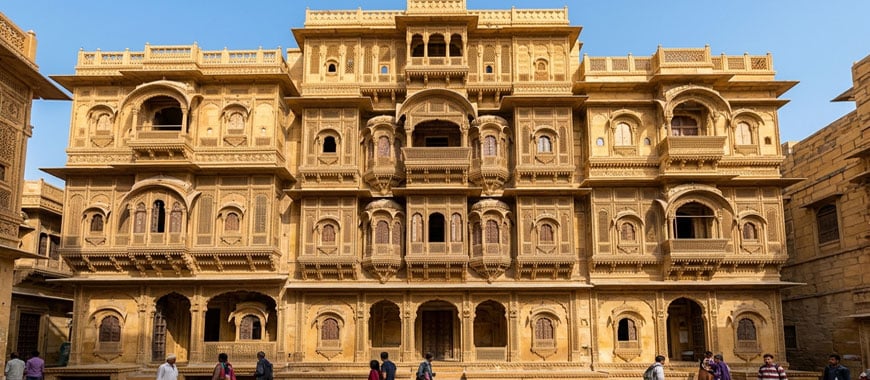

Patwon Ki Haveli is one of the best places in Jaisalmer to look closely at the craftsmanship behind the city's golden sandstone architecture.
Unlike Jaisalmer Fort, the appeal here is not scale. It is detail. Carved façades, jharokhas, narrow interiors, paintings and mirror work reflect the wealth of Jaisalmer's merchant families during the 19th century.
Patwon Ki Haveli is actually a group of five havelis rather than one mansion. Guman Chand Patwa commissioned the first haveli in 1805 for his family. The five-haveli complex developed over roughly the next 50 years.
Quick Planning Snapshot
Why Patwon Ki Haveli Is Worth Visiting
Patwon Ki Haveli tells a different story from Jaisalmer's forts and royal buildings.
It was created for a prosperous merchant family. That makes the architecture a useful window into the wealth, taste and domestic life of Jaisalmer's trading community.
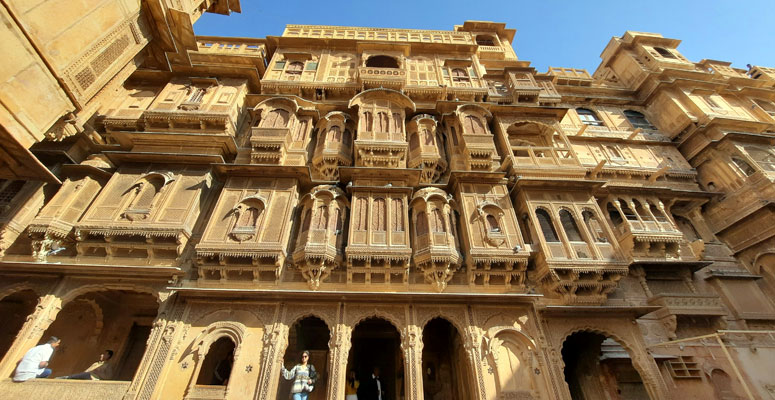
The façade is the strongest first impression. Yellow sandstone has been carved into balconies, screens, arches and decorative patterns. Inside, surviving paintings and mirror work add another layer to the visit. Rajasthan Tourism identifies the complex as one of Jaisalmer's largest and most elaborately carved havelis.
For architecture-focused travellers and photography enthusiasts, this is one place where slowing down matters more than covering every room.
What to See at Patwon Ki Haveli
The Main Sandstone Façade
Spend a few minutes outside before entering. Start at the main façade, observing the golden sandstone and intricate exterior carvings
The narrow street makes the building feel even taller, while rows of carved balconies and stone screens cover much of the façade.
Look closely at the floral forms, geometric patterns, brackets and window surrounds rather than trying to take in the whole structure from one viewpoint.
Why it matters: The exterior is one of the clearest examples of the fine sandstone carving associated with Jaisalmer's merchant havelis.
The Five-Haveli Complex
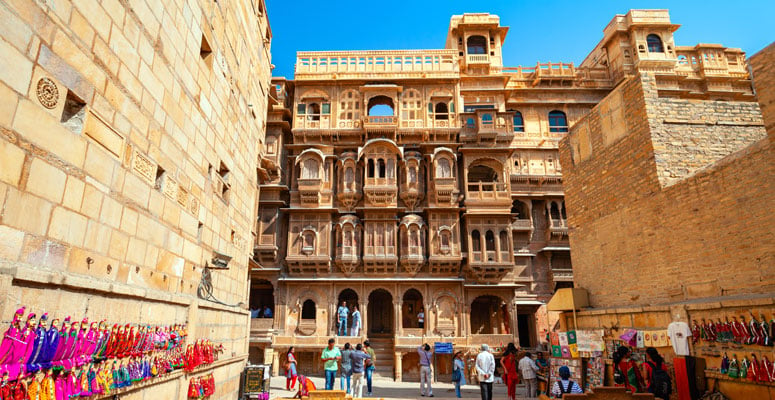
Patwon Ki Haveli is not one large house.
It is a group of five separate havelis created for members of the Patwa family. Rajasthan Tourism traces the project to Guman Chand Patwa and his five sons, beginning in 1805.
You do not need to enter every accessible section to understand the site.
The useful point is to notice how several residences form one dense architectural group within the old city.
Jharokhas and Stone Screens
The projecting jharokhas are among the most distinctive details.
They were decorative, but they were also practical. Screened openings provided shade, airflow and a degree of privacy within the house.
Why stop here: This is where Jaisalmer's stonework begins to look almost like carved lace.
Interior Paintings and Mirror Work
The interiors are less visually uniform than the façade, but surviving sections include wall paintings and mirror decoration.
Museum Sections
Parts of the complex are operated as museums.
The government-managed section displays material connected with the history and culture of Jaisalmer, while privately managed Kothari's Patwa Haveli presents furnished interiors and objects linked with merchant life.
Do not assume that one ticket covers every part of Patwon Ki Haveli.
Different sections have separate entrances and admission arrangements.
Best Time to Visit Patwon Ki Haveli
October to March is the easiest period for combining Patwon Ki Haveli with the rest of Jaisalmer's old-city sightseeing.
The haveli itself has shaded interiors, but reaching it involves walking through narrow streets, so cooler weather helps.
From April to June, visit earlier in the day. The surrounding sandstone streets become hot by afternoon.
Morning also works well for viewing the façade before the lane becomes busier.
Late afternoon brings warmer light onto the yellow sandstone, but the surrounding area may have more visitor movement by then.
Patwon Ki Haveli Timings and Entry Fees
Patwon Ki Haveli has more than one visitor section, so there is no single ticket that can be presented that covers the entire complex.
| Visitor Area | Current Timing | Current Fee |
|---|---|---|
| Patwon Ki Haveli general sightseeing | 9:00 AM–5:00 PM; open daily | Exterior viewing is free |
| Government museum section | Around 9:00 AM–5:00 PM | ₹50 Indian visitor; ₹250 international visitor |
| Kothari's Patwa Haveli Museum | Generally around 9:00 AM–6:00/6:30 PM | Separate private ticket; confirm current rate at entrance |
How Much Time Should You Spend at Patwon Ki Haveli?
Keep around 60 to 90 minutes.
One hour is enough if you mainly want to see the façade and one museum section.
Keep closer to 90 minutes if you enjoy architecture, want to look closely at the carvings or plan to take photographs inside.
There is little benefit in rushing through several sections simply because they are open.
The exterior deserves time too.
Is Patwon Ki Haveli Easy to Explore?
The overall distance is not large, but the visit is not fully mobility-friendly.
Patwon Ki Haveli sits within narrow old-city lanes. Rajasthan Tourism notes that the final approach is best made on foot or by rickshaw because vehicles cannot easily use the street.
Inside the museum areas, expect narrow passages and steep staircases. Recent 2026 visitors specifically report that the stairs can be difficult for seniors and families carrying babies.
Travellers with limited mobility may get more value from the exterior façade and accessible lower sections rather than trying to reach every upper floor.
When Is Patwon Ki Haveli Less Crowded?
Morning is usually the easier time to visit.
The narrow approach and compact interiors can feel busy quickly once tour groups arrive. This matters more here than at a large open monument because there is less space for visitors to spread out.
If photography is important, arrive earlier and spend time on the façade before entering.
Avoid promising that evenings are always quiet. Crowd levels change by season, weekend and group movement.
Nearby Attractions to Visit with Patwon Ki Haveli
Jaisalmer Fort
Jaisalmer Fort is the strongest attraction to pair with Patwon Ki Haveli.
The two give very different views of the city. The fort represents royal, religious and living heritage, while Patwon Ki Haveli focuses on merchant architecture.
The public lanes of Jaisalmer Fort do not require a general admission ticket, though the palace museum and temples inside are separately ticketed.
Keep both in the same old-city sightseeing day rather than making two separate journeys.
Salim Singh Ki Haveli
Salim Singh Ki Haveli is another merchant-era building in central Jaisalmer and works as a shorter follow-on stop.
Its upper structure and projecting balconies look very different from Patwon Ki Haveli.
Timings: 8:00 AM–6:00 PM.
Entry fee: Current admission should be confirmed at the entrance because reliable official pricing is not published online.
Choose it if haveli architecture is a strong interest. Otherwise, Patwon Ki Haveli alone is the higher priority.
Nathmal Ki Haveli
Nathmal Ki Haveli is another useful old-city comparison.
It is known for a façade whose two sides were worked on separately, creating similar but not perfectly matching details.
Timings: 10:00 AM–5:00 PM.
Parts remain privately occupied, so access should not be treated like a conventional museum.
For a short Jaisalmer stay, choose Patwon Ki Haveli first and add Nathmal Ki Haveli only if you want to look more closely at the city's merchant houses.
Practical Tips for Visiting Patwon Ki Haveli
Continue Planning Your Jaisalmer Visit
Patwon Ki Haveli works best when seen alongside Jaisalmer Fort.
The fort explains the city's royal and defensive story. Patwon Ki Haveli shows what prosperity looked like inside the homes of its merchant families.
If time allows, add Salim Singh Ki Haveli or Nathmal Ki Haveli for comparison. If not, spend the extra time looking more closely at Patwon Ki Haveli rather than rushing through another building.
Continue with the Jaisalmer Travel Guide for wider city planning and use the relevant Rajasthan Tour Packages when you are ready to connect the old city with the wider desert journey.


